

Vivian Yip (they/them), Artist Programs Intern at TAC, spent time with November WIP resident Maria Elena Pombo (she/her):
VY: You came to art through engineering and fashion. What does each still do in the studio, and in your art practice?
MP: In my first year of engineering school, in all the calculus classes, you have to prove so many things you assume are already true. There was always this idea of questioning everything. As my practice has gotten more serious, I make a clearer division—this is a finished work, this is process—but in my head it’s very democratic. Collecting materials, the process, and the finished result are equally important. When I’m researching, I think very much like an engineer.
The way my hands work, though, is 100% fashion. I came to fashion school right after graduating from engineering school, and at the beginning even using scissors was hard. It sounds ridiculous, but I realized I had lost dexterity in my hands; I’d only been writing, and I hadn’t cut paper in years. I didn’t have the dexterity, and I wasn’t confident in that more intuitive way of working, where you’re allowed to make a mistake. Working with fabric is such a tactile thing, and my hands really developed through it.
I prepare like an engineer and make like a fashion designer. I do all the research, planning, and testing beforehand, setting up the rules and parameters for the work. Once I start making, I can be much more intuitive. I've done all the preparation, and now I have to trust the process, trust my hands, and allow things to happen that I couldn't have planned.
VY: The yarn recipes come from molecular gastronomy. Where did you first meet the technique, and how did it become textile?
MP: In 2018, I was working on a project dyeing textiles with avocado seeds. I was getting them from restaurants and had so many that I started grinding them into a powder for storage. The powder looked like a very pink sand—there’s a beach in Venezuela with pink sand—and I wondered if it could act like sand, if I could make a kind of clay with it.
Reflecting on it now, I like working with materials in ways they aren’t intended to be used. There’s discovery, and mystery about whether it’s going to work. In 2019, I was mentoring students in the MFA Textiles program at Parsons, and they asked me for help with biomaterials. I started researching to help them and discovered this huge universe of people using algae—red algae, brown algae, agar-agar, carrageenan, sodium alginate—plus starches and tree resins as binders to make ceramics, leather, plastic, and ultimately yarn.
At that point my practice was mostly natural dyes, and I had books of all my dye recipes. Working with natural dyes is very much like cooking, while working with biomaterials is more like baking. I wanted to do the same thing—develop recipes to see which algae and starches I liked—and slowly I built my own material library. Just as I had done with natural dyes, I also wanted to understand the origins and histories of these materials, beyond their technical properties. In parallel, I started finding histories I wanted to tell through them.
As I researched the ingredients I was using as binders to make bricks and other materials, I started finding YouTube videos of people using the same algae to make strawberry spaghetti and other dishes. That's when it clicked that these techniques came from molecular gastronomy, which had been very popular in Venezuela when I was at university. I remembered this idea of taking something familiar, like a strawberry, and presenting it in a completely different form. I still like acknowledging that connection because while I respect the biomaterial community a lot, the molecular gastronomy community helped make these ingredients more widely available. I also feel a philosophical alignment with it. I'm interested in presenting familiar materials in unexpected ways, in making us experience something we think we know differently: what does it mean to weave a mountain, or the ocean?
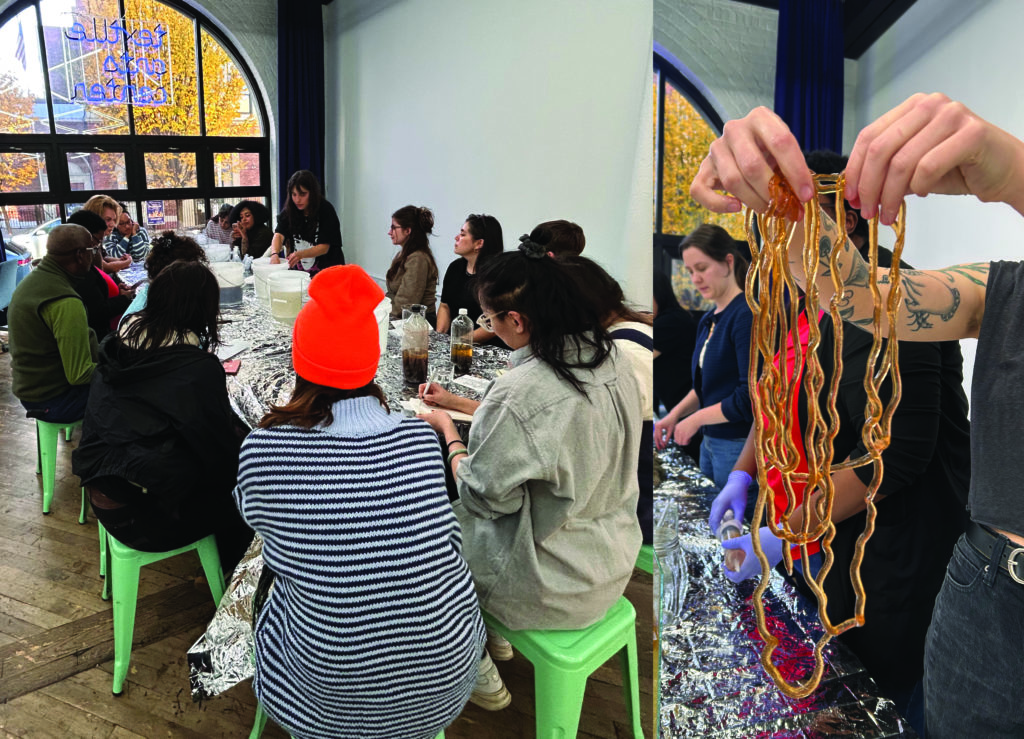
VY: Each Tejiendo work has its own weave pattern, horizontal for a lagoon, vertical for a waterfall. How is the pattern for the newest work in the series, San Benito, emerging?
[Author’s Note: Pombo’s Tejiendo series turns unconventional materials tied to Venezuelan territories and communities into woven yarn sculptures. San Benito, developed during her gmtc residency, draws on the rum-soaked Afro-Venezuelan and Catholic celebrations of San Benito de Palermo in her mother’s hometown of Cabimas.]
MP: The Tejiendo series is about nostalgia, whether it's nostalgia for a landscape, for a certain prosperity, or for people. The way I weave changes depending on what I'm missing. When I'm weaving a material from nature, I tend to use net-like patterns; when I'm weaving petroleum, I use a flat weave; and when the work is about missing people, as in Tejiendo el Guayabo, the weaving becomes more three-dimensional, with yarns tied together.
If it’s a mountain, I weave vertically, because that’s how I think of a mountain; if it’s the ocean, I weave horizontally. But of course the ocean also has depth, and a mountain also spreads sideways. I suspend the pieces from a middle point, so you can no longer tell whether they were made vertically or horizontally. And I’m never entirely sure what they’ll look like, because I don’t know how they’ll sit once I take them off.
San Benito is different because it’s more representational. All the other works are abstractions. I decide, this is the mountain, this is the ocean. The idea actually came to me when I had to Taima or Not to Taima at home. Looking at it, I felt like I was seeing the rain of rum thrown during the San Benito celebrations in Cabimas, and that's when I started imagining this piece. I had wanted to make work about San Benito for a while, but I resisted because making something simply because it looks like something else isn't usually how I work. In the end, I thought, sometimes you have to try something different.
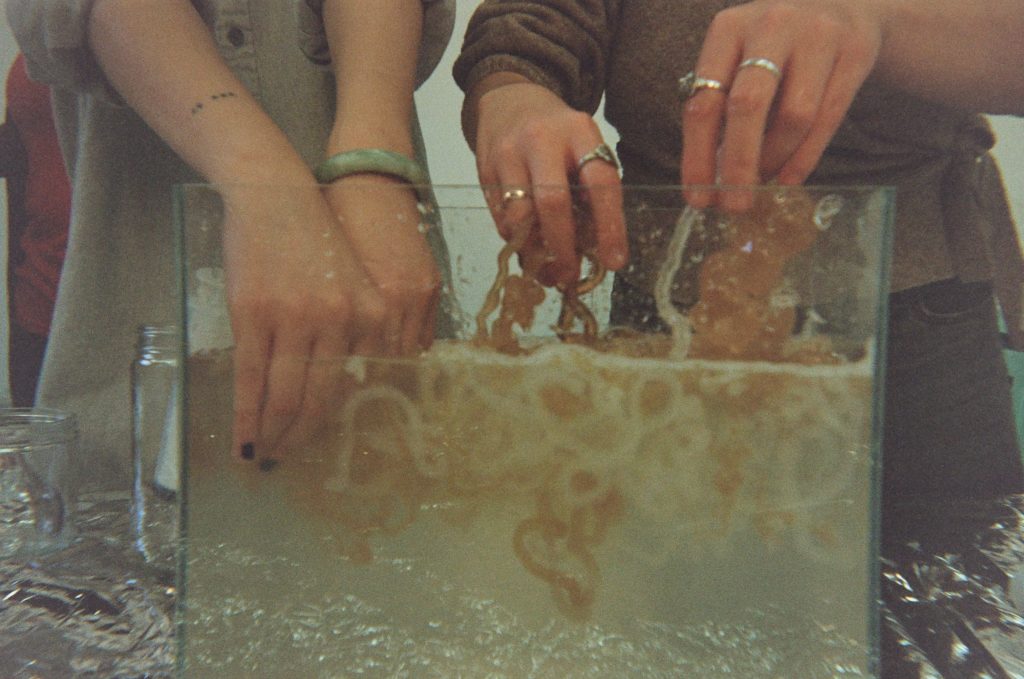
I developed the project during my residency at gmtc, which is a performance research laboratory. Because it was a performance lab, we had to figure out what the performance would actually be and how people could participate. I'm not a performer, so Sunmi, the director, and I had many conversations about how the project might unfold. Would people make the work? Would they drum? I said no to the drumming, because not everyone gets to drum at San Benito. It’s a respected role; you have to work hard to become a drummer. But anyone can participate in throwing rum, so we decided to reproduce that gesture.
We made the entire work collectively in one day, from preparing the gel and making the yarn to putting everything together. In the installation, the pieces form little clusters, some gathered together and others standing alone. I think of it as the work in the series that comes closest to representing a feeling, rather than a landscape or a place.
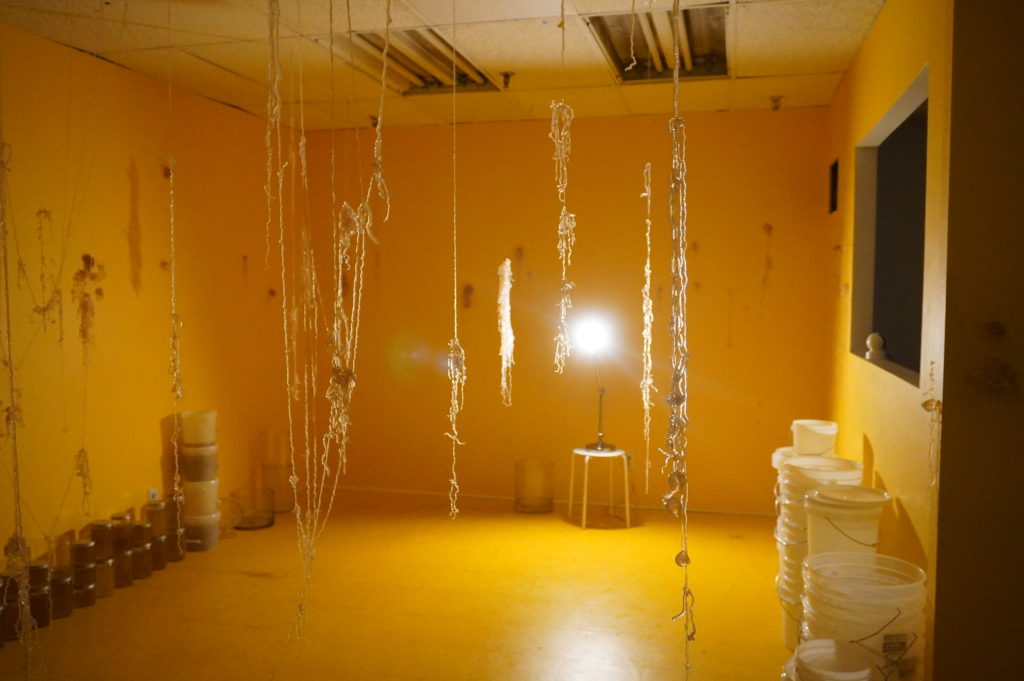
VY: You first refused your uncles' fishing nets when you wanted to begin weaving with petroleum. What was the reasoning for your change of mind?
MP: At first I said no because the act of making and weaving the yarn was very important to me. They proposed it half out of frustration that it was taking so long. But they’re also great enablers. I started with some frames, and one uncle made me a loom. Then my other uncle suggested the fishing net. I said no, but it only took me about an hour to say, okay, let’s do both. We were collaborating, so they should have input, and whether I show it is my decision. It was a negotiation: I let them have an idea, and they were more excited because they were being heard.
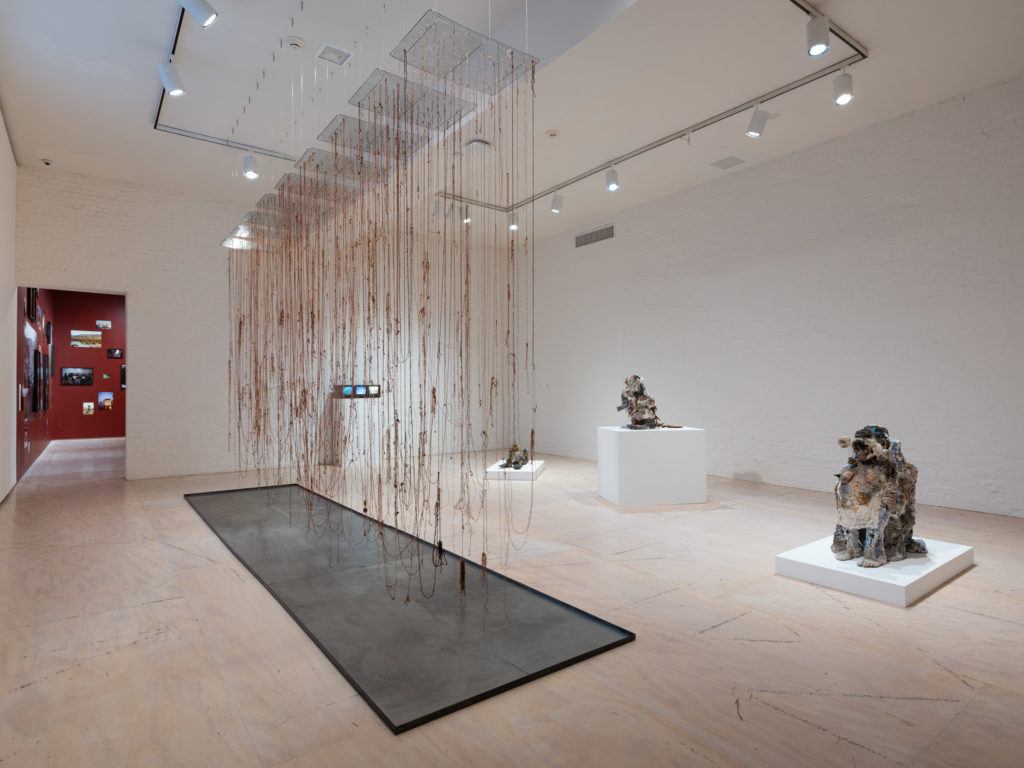
VY: Several To Taima samples evaporated or grew sediment. How do you think about conservation for work designed to change, and how do you approach that conversation with institutions?
MP: It requires more work from everyone—me, the institutions, the people—and more trust. If an institution really wants your work and thinks it’s relevant to the collection or the moment, they’ll figure it out with you—especially if you’re transparent.
For to Taima or not to Taima, with Tejiendo el Guayabo at MoMA PS1, I told the museum in our first conversation that the piece sweats. When it was shown in Caracas the year before, the gallery let the sweat puddle; it was part of the experience. I brought up the idea of the work being on a platform that collected the puddle, and MoMA liked the idea and it was implemented.
VY: Silk keeps returning: deadstock organza, Telurismos a Tres Tiempos exploration of the failed 1930s sericulture program. What does silk mean to you as opposed to cotton or synthetic fiber?
[Author’s Note: The failed sericulture program refers to when the Venezuelan government backed an ambitious public-private initiative to scale up a domestic silk industry in 1936.]
MP: I have two answers, and I’ll start with the pedestrian one. In my first semester at Parsons, our patternmaking teacher didn’t let us use synthetic fabrics. Synthetics are hard to work with: the holes from the sewing machine don’t recover if you make a mistake, and you can melt them when you iron. When I got into natural dyes, I prioritized silk, honestly because it takes the color better. Natural fibers take natural dyes better, and protein fibers like silk especially.
But as I learned more—about the mulberry tree and so on—I realized it needs spring, and Venezuela has a kind of perennial spring, a very comfortable climate. I wondered whether there had ever been projects to make silk there, and in the New York Times archive I found people starting one in Venezuela in the 1930s, but the project never took off.
There’s a general malaise, a melancholy, when Venezuelans regret our petro-economy, our petrostate. It’s not about the environment; it’s more philosophical. We didn’t develop any other economies. Finding this project felt very poetic: a big dream that never happened. Of course it didn’t. With the level of money entering a country with a petroleum industry that size, silk is insignificant.
VY: Juliana Sorondo warns that Venezuela can become an exotic premise. How do you keep the work from being read only as "crisis art"?
MP: I had so many answers that I wasn’t sure how to weave them together. The first is that I can’t control how people will see it. Early in my career I really suffered when people didn’t understand a work the way I wanted. Then I realized: one of my grandmothers in Venezuela thinks I’m blonde, and people here think my hair is black. My hair is brown. Whatever people think, I can’t convince them otherwise.
La Rentrada and to Taima or not to Taima are about the Venezuelan diaspora, and I try very hard to avoid the pornography of pain. I make projects in a slightly different way, so people actually care and stay there. There has to be a sense of wonder, and a focus on a specific history. The work should be interesting on its own, but there will always be a tension.
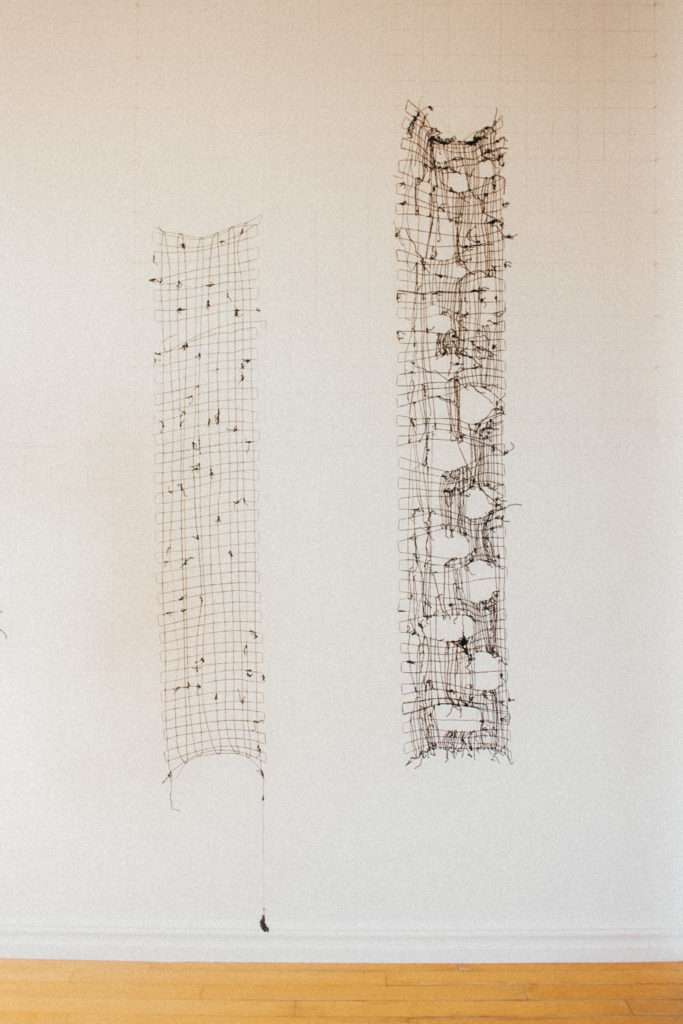
VY: You call They Called It Mena’ a farewell to oil. What does it mean to have a farewell to oil through the process of your work?
MP: I started They Called It Mena right after La Rentrada, which was really about putting avocado seeds to work—powering a car, doing everything petroleum does. I began a little before 2023. Now, with all these new wars, there’s a resurgence in demand for oil, but at that moment, for me, it wasn’t “down with oil.” It was “oil is over, so let’s say goodbye.”
I have a complicated relationship with oil as a Venezuelan. I went to a free public university in Venezuela thanks to oil money, and so did my parents. So it’s not just “done with oil.” If we say down with oil, how will we have not only fuel, but all these structures? I think the idea is a little misunderstood.
Mena is the name of the Indigenous people of western Venezuela, where the Venezuelan oil industry was born. They used it for medicinal purposes, and the first documented export from Venezuela was oil sent to Spain in the 1530s to treat the king’s goutarthritis. So I wanted to approach it differently: in the end, it’s a natural material. How can we say goodbye to it by making it do completely, “useless things?”
It’s also about giving it a face. I grew up visiting my mom’s hometown several times a year and seeing petroleum, but many people, even people from Caracas, never have. So I want to share it, so people can smell it and see it, even transformed. I can’t travel with it in liquid form, but they can see what it left on silk, or what it became.
María-Elena Pombo (b. 1988, Caracas, Venezuela) works through open-ended, interconnected projects that explore how histories, territories, and forms of knowledge are embedded within materials from the earth.
From avocado seeds, mollusk shells collected by restaurant workers, algae and petroleum sourced by individuals, and more. She transforms these materials beyond recognition to open new ways of understanding the world, working through installation, sculpture, video, and actions that play with site-specificity, ephemerality, and participation.
Pombo has participated in residencies and fellowships at Smack Mellon, Yaddo, Wave Hill, Lower Manhattan Cultural Council, Bronx Museum of the Arts, and NEW INC, the New Museum’s cultural incubator. In 2027, she will be the inaugural Judith Godwin Fellow at the International Studio & Curatorial Program (ISCP).
Her work is part of the permanent collection of the Art Institute of Chicago and has been exhibited at MoMA PS1’s Greater New York (2026), the Bronx Museum’s AIM Biennial (2024), Somerset House (London), Gewerbemuseum Winterthur (Switzerland), Grand-Hornu (Belgium), and Yamamoto Seika (Osaka). She has also developed site-specific public artworks in beauty salons, concrete factories, mechanic shops, and abandoned military structures across New York City.
Pombo received the 2021 London Design Biennale Theme Medal and grants from the Foundation for Contemporary Arts, New York Foundation for the Arts, Brooklyn Arts Council, Queens Council on the Arts, and New York Restoration Project. Her work has been featured in ARTnews, Cultured, The New York Times, The Slowdown, METAL Magazine, i-D Italia, and Vogue México.
Pombo was faculty at Parsons School of Design and has taught at the Brooklyn Botanic Garden and New York Botanical Garden. She has lectured widely at museums, universities, artist-run spaces, and community-based programs.
Cover image credit: Pombo in her WIP studio at the Textile Arts Center, Brooklyn, NY. Photo by Vivian Yip.