Vivian Yip (they/them), Artist Programs Intern at TAC, spent time with the artists in Cycle 18’s TAC’s Artist in Residence program—Lucia Rosenast, Fabiola Carranza, F. Lo Russo, Camille Lescarbeau, Z. S. Qiu, Natalia Hernandez, Nicole Cheng, and Honey Pierre—during their first month at TAC.
As our artists have moved in and began to settle into the flow of the meetings, classes, and the spaces at the Textile Arts Center, it seemed like the opportune time to sit down and speak with each of them. Wanting to capture the beginning of their journey, I began to get to know the artist and their current practices, taking a look around their current studio and capturing each of their beginnings. The hope is that at the end of their residency we can revisit these questions and their spaces to share the growth and journey each of them have taken.
Each artist were asked these same questions:
In a couple sentences, how would you describe your practice right now?
What question is driving your work at this moment?
What does TAC's community mean to your practice at this point?
What do you want your work to do that it isn't doing yet?
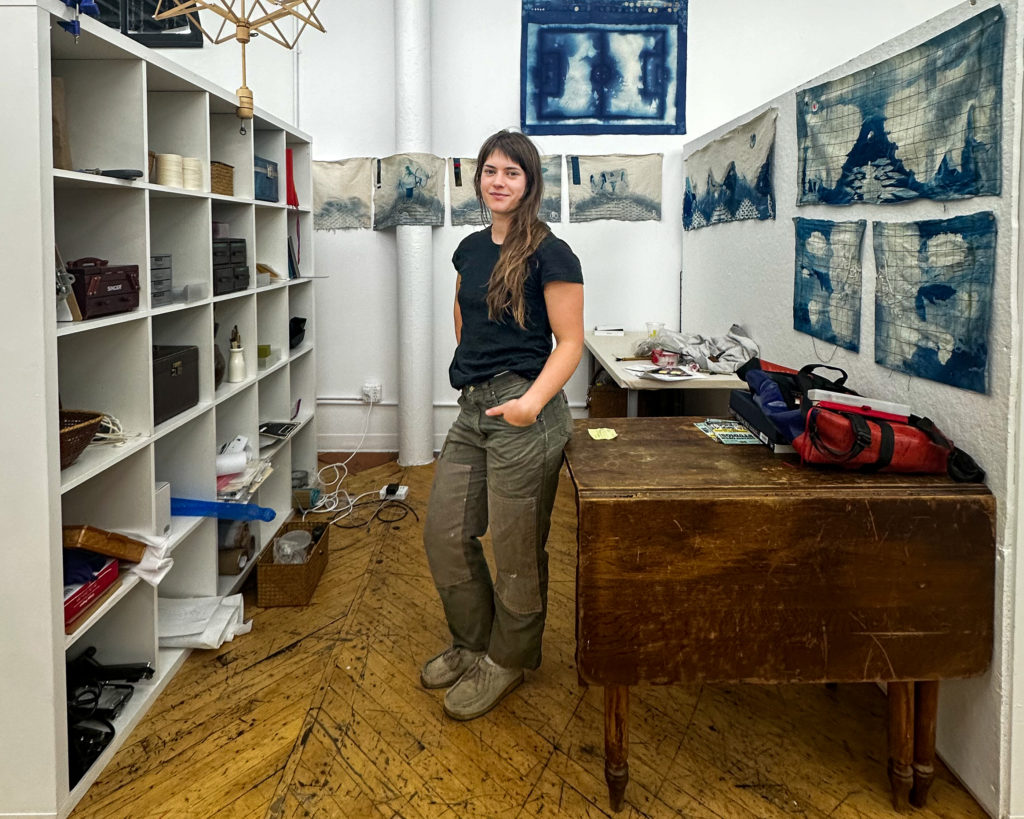
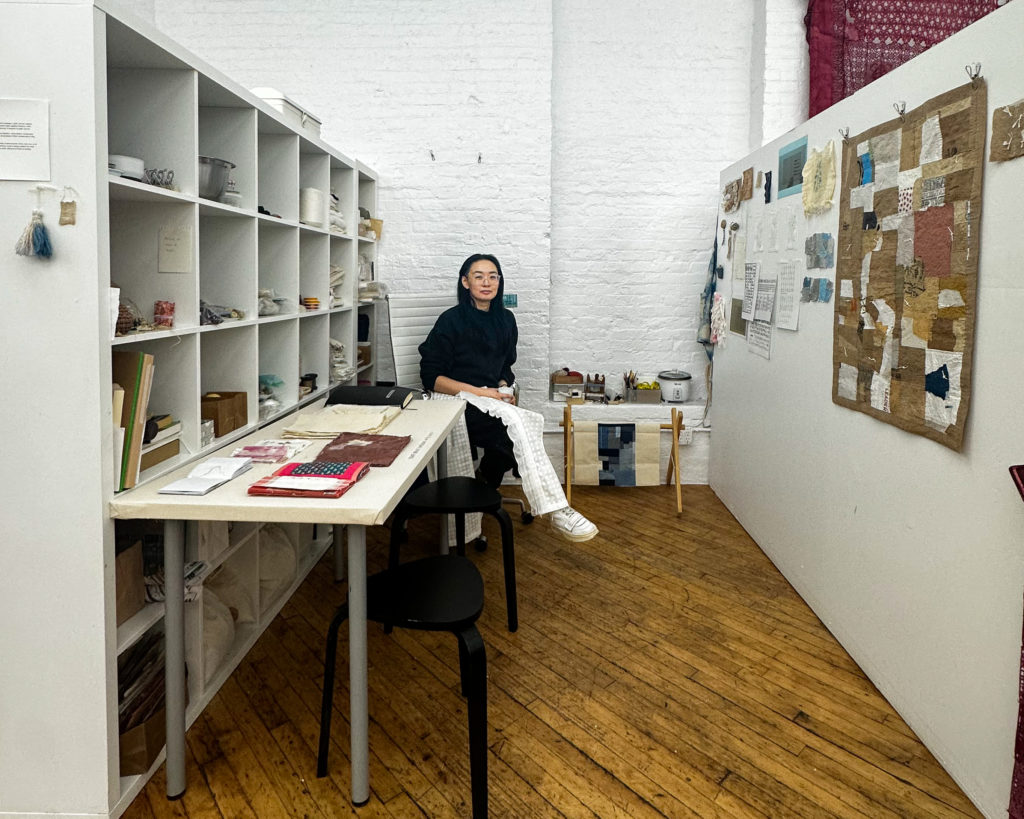
Rosenast in her studio at the Textile Arts Center, Brooklyn, NY. Photo by Vivian Yip.
My practice straddles two worlds and processes of blue, entering the liminal spaces between sky and ocean: my work punctuates the mirrored line. It deals with the implementations of resistance enforced by the body, though obscuring light through digitization and collaged negatives.
A leading question in my work currently is the question: what mimicry can a handmade application of resistance and a photographic application of resistance create? Or What's the difference between a handmade negative and a photographic negative?
It means collaborative play, reflection, and community.
I want to implement deeper integration of the weaving process into my work. Diving deeper into weave structures, warp painting, and playing with resistance more literally.
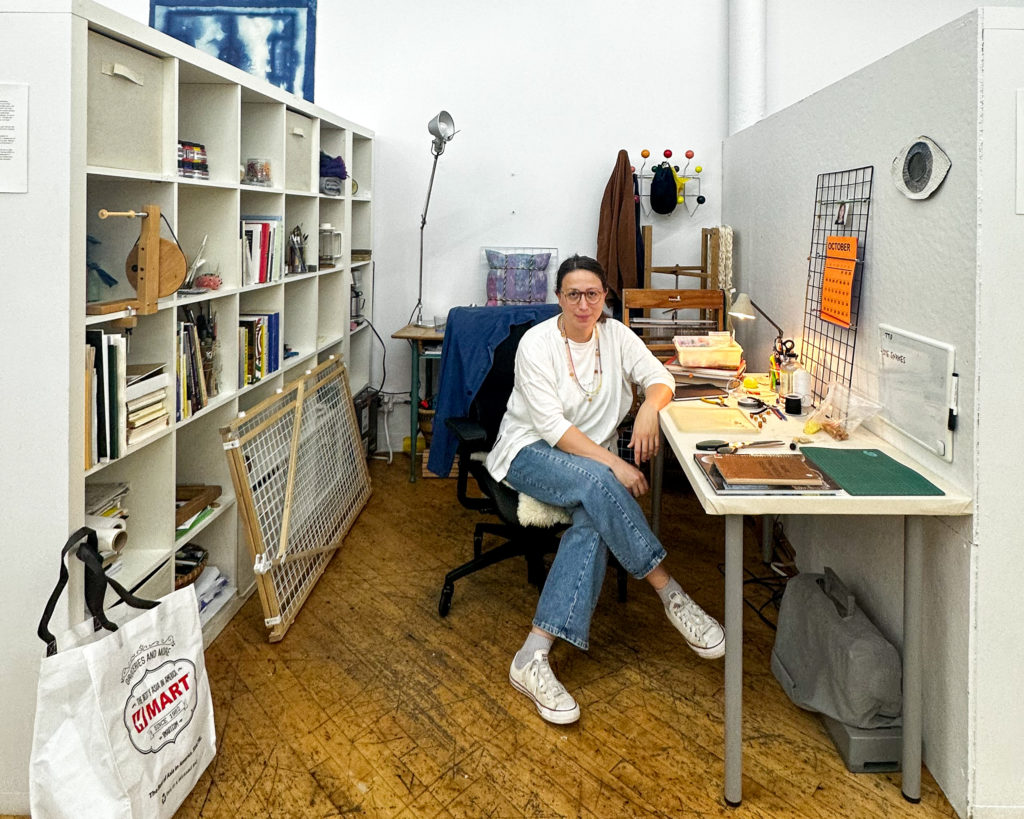
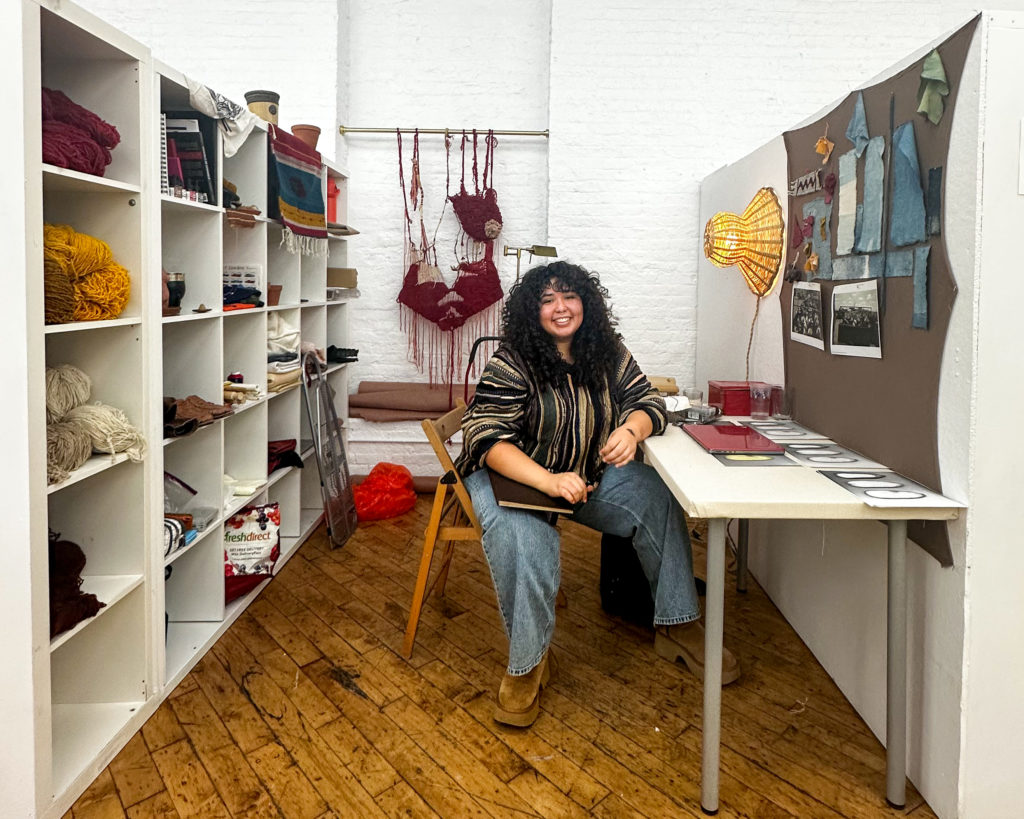
Carranza in their studio at the Textile Arts Center, Brooklyn, NY. Photo by Vivian Yip.
It's process-based. I guess that's not quite a sentence, it's a phrase but what I mean to say is that I think my textile and weaving work are driven by an affinity for a specific range of colors and by ideas around patterning and negative space, by very formal decisions actually.
I want to pay closer attention to the senses, or to how we respond sensorially to different stimuli and places. I'm also interested in finding ways to process the ideas behind my practice a little faster, or more automatically so that it is not always driven by a concept or a preconceived idea but rather becomes more inviting of how process changes outcomes. I want to learn to work a little more quickly to improvise a bit.
I haven't spent enough time here to fully know but it feels open and welcoming so far. I love the intergenerational aspect of it and the 24/7 access to the space, so you can have both quiet time and more sociable moments. New York, in general, since I am new here, feels a little fast-paced compared to what I'm used to, so that will take some adjusting. People seem to want to speed-date friends. And I am more used to slow forming but long-lasting friendship developments. Even in terms of how people build community here, there are so many possibilities that I get it. It feels overwhelming to me at the moment but at the same time I am glad it is an inviting and open place. I am really interested to learn more about the history of Textile Art Center.
There's a notion of immediacy that I want to bring into the practice: processing the things I notice as I first learn of them rather than letting them sit and then sieving them later. At the same time, I want to learn about the more administrative side of running a space like this. What would it take to teach courses like the ones offered here elsewhere? How many people need to be involved to start a place dedicated to textile arts? How do you promote it, and how do you reach different communities? I'm curious to observe and learn from that, because thinking as an educator is also part of my practice. I also want to learn new skills that I can also later teach. Ultimately, I am always looking for ways to make a living sustainably and at the same time to continue to make art. Thanks!
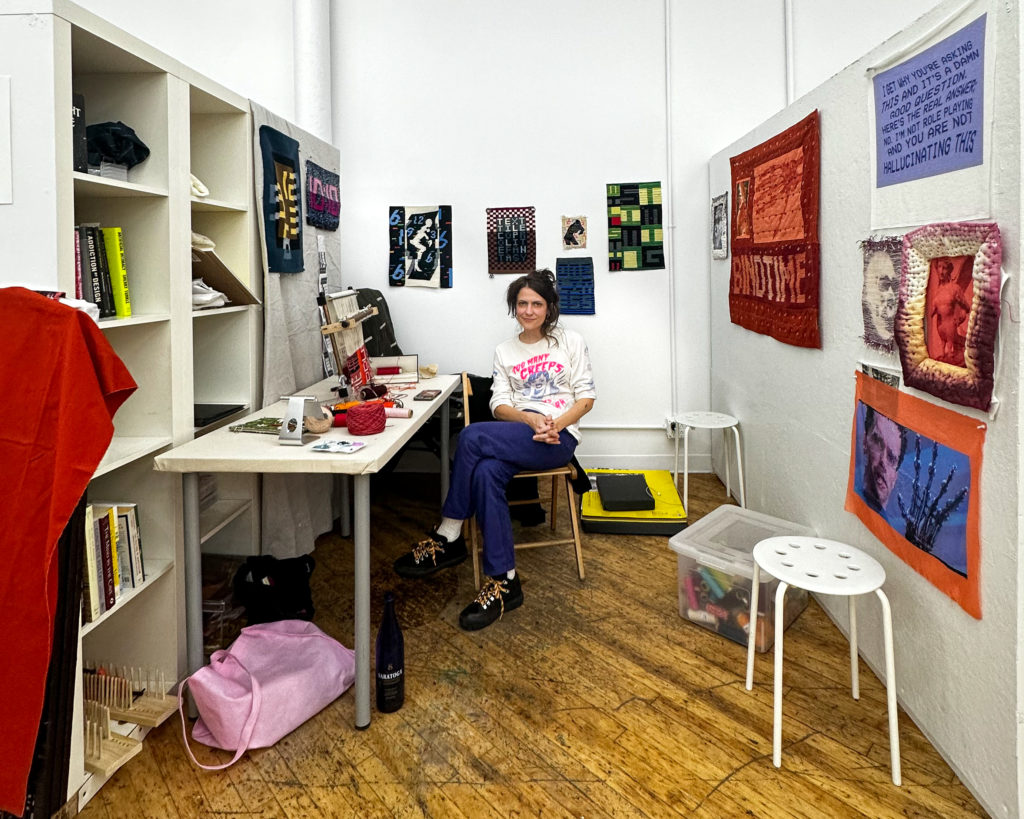
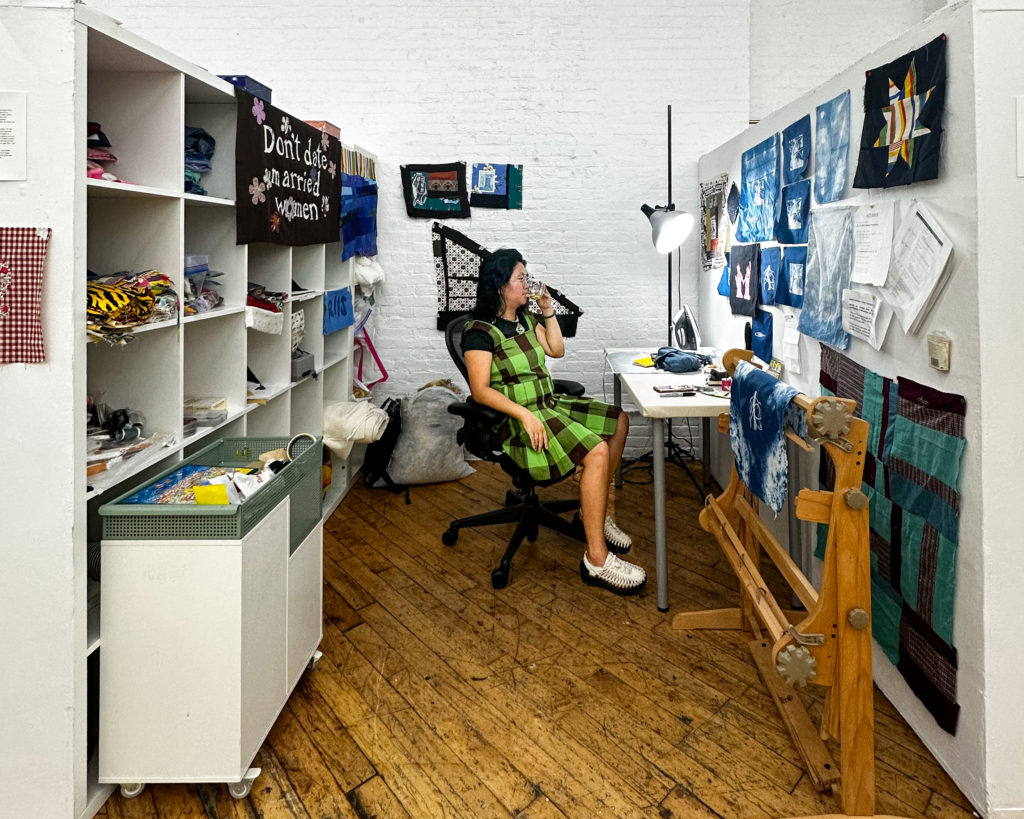
Russo in their studio at the Textile Arts Center, Brooklyn, NY. Photo by Vivian Yip.
I work mostly with weaving. I do ikat and tapestry, and I just started quilting. I draw a lot, and I do some warp dyeing and warp painting. I've also started printing photos on fabric that I'm trying to collage into some pieces.
Something about the intersection of the ancient technology of weaving and the contemporary experience of living and working in a world shaped by screens and the attention economy. I think a lot about how technology changes our relationship to time, labor, and one another, and what it means to make something slowly and physically in a culture that's increasingly digital. How do we maintain a sense of authentic humanity through art when the boundaries between what's real and artificial are becoming increasingly blurred?
Everybody I've met so far has been so kind. Everyone comes from really different backgrounds, and they're very intelligent and very driven. It's a new kind of art community for me, but it's consistent with what I've felt since I started doing weaving and fiber work...it's been an inviting world. There's a lot of skill sharing, a lot of generosity, humility, and kindness among fiber artists.
I don't know if what I'm doing communicates. It's hard to know how people read my work, whether the things I'm interested in make sense, whether they think, "Oh, of course you're thinking about that," or "I had no idea." I want some sort of through line or consistency: is the work I'm making consistent with the concerns I have? I also want to refine my materiality, and to gain more technical knowledge and nuance in my processes.
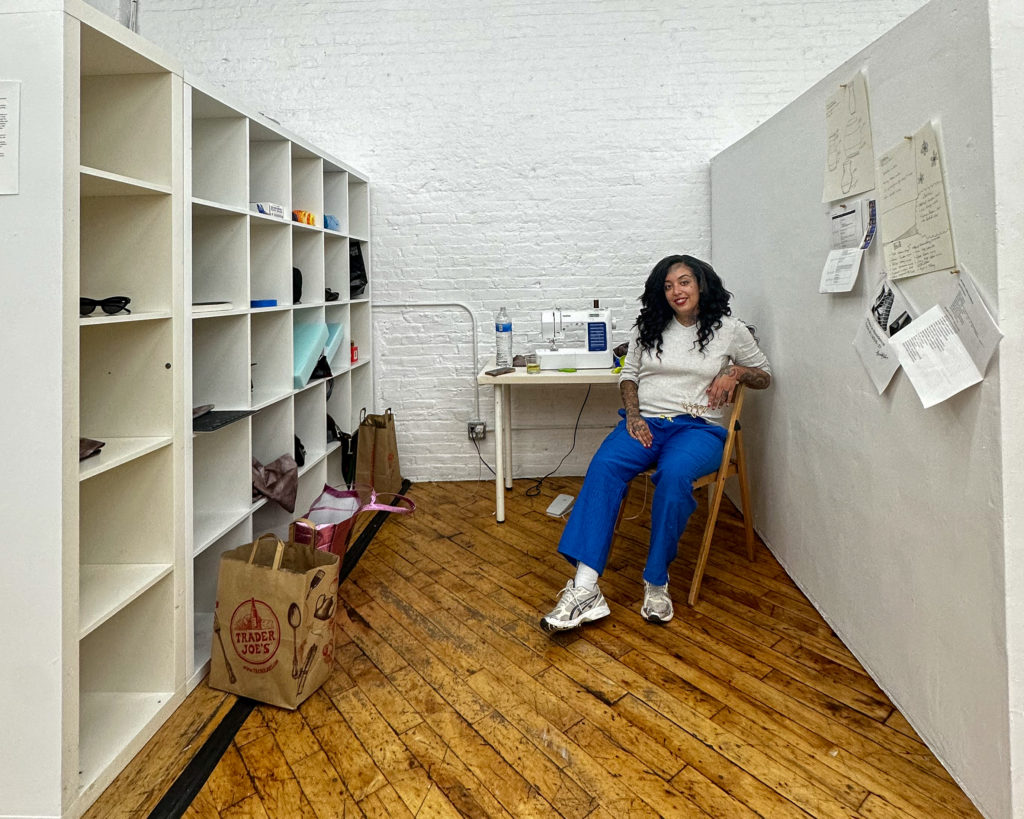
Lescarbeau in her studio at the Textile Arts Center, Brooklyn, NY. Photo by Vivian Yip.
I'm a textile artist working primarily with papermaking. I work with found materials, mostly trash from my daily life, which I try to take care of by transforming them through crafts. My process is very accumulative and repetitive, and the results usually build into large installations.
At this moment in time, the beginning of the residency (this week, basically), I've been pursuing questions that are very specific and technical: how to sew, and how to make lace. Those are my questions for this week.
Right now, TAC's community means promise, and potential.
That's such a nice question. I think I'm happy with what my work does for now, but I want to expand it. There's nothing specific I want it to do more of. I just want to keep finding more of it, and to take it to new places.
Qiu in their studio at the Textile Arts Center, Brooklyn, NY. Photo by Vivian Yip.
I find myself playing with paper, thread, and fabric that come to me sideways: packing paper, cheesecloth I got at the grocery to strain stock, the reusable muslin bags for carrying vegetables. I think about the different capacities they have to hold and to carry, and what it would be like to pull those lives into a form we more recognizably see as a carrier of a narrative or a story, like a book or a quilt.
What tells us that something is worth knowing? And can we interrogate that message, or the systems that tell us that message?
Just from seeing the open studios and the space, I already know I have so much to learn from everybody here, developing practices and asking questions in ways I'm excited to see. I want to learn how people ask questions. On top of that, it's just beautiful to be making in a space where everyone else is also making. There's a lot of good energy already. We had an amazing potluck just now.
I'm very precious about my materials, and about not pushing things to the point of breaking, or about preserving something in a very controlled way. I'd like to be more comfortable seeing the work have its own life beyond my control. I think I want to be more comfortable with the end of my work's life.
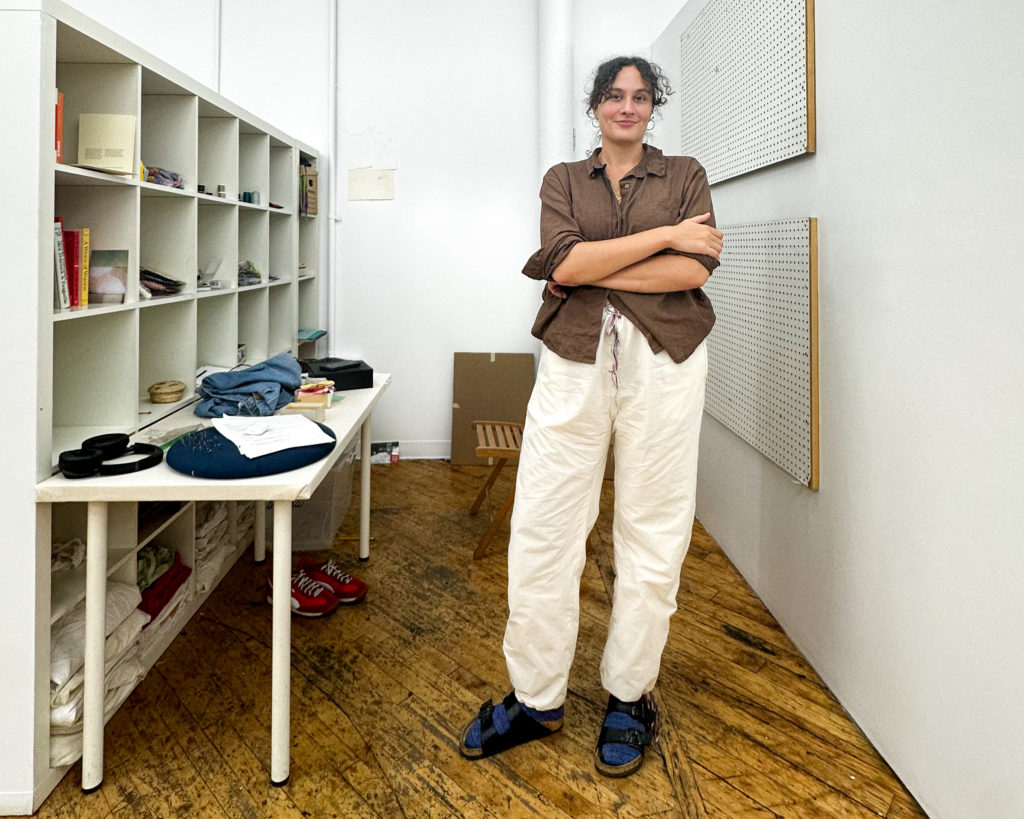
Hernandez in their studio at the Textile Arts Center, Brooklyn, NY. Photo by Vivian Yip.
I would describe my practice right now as curious: very new, very eager, and urgent as well. I've been told by previous mentors that I make my works with a lot of urgency, so there's a strong kinesthetic quality to them that I really like, and there's urgency in the concepts I'm tackling and stories I’m telling too. But my works are also very exploratory right now, across different mediums and approaches. They're very interdisciplinary and primarily figurative, using recognizable symbols, images, and material.
Right now, my biggest question is: how can I make my work more accessible? How can I make it readable and understandable to the people I want it to reach?
I know it's early, but at this point it's really exciting to be surrounded by so many incredible artists and young people. It's very lively. The community means a lot to me because it brings so much opportunity and possibility for learning, and for teaching as well. It's like a steaming pot of possibility and conversation.
I want my work to keep the intensity I bring now to the themes and topics I'm speaking about, and to make sense to people. I also want it to be more patient, with more time and research going into its creation and more time in the making, so it can become more intricate reflecting the complexity of the stories told.
Cheng in their studio at the Textile Arts Center, Brooklyn, NY. Photo by Vivian Yip.
My practice right now feels very dissolved. By that I mean I think about the components, the things I do that are part of my artistic practice but aren't necessarily read as an artistic practice by other people. That involves working with communities (currently, quilting together) and working as an urban designer for the City of New York.
There are many questions, but the one that stands out is: what kind of change can we see in our lifetime, or affect in our lifetime?
Right now, it means interacting with people who are very different from me and who use the medium of textiles in ways I can learn from.
I would like my work to help me earn a living.
Pierre in her studios at the Textile Arts Center, Brooklyn, NY. Photo by Vivian Yip.
Documentation and intention. Those are just a couple of words I'm using right now, because I'm documenting specifically within my community: what it looks like to reclaim certain emotions, like wanting to rest, as the first generation to do that, and what everyday life looks like.
Why now? Why is it important to do those things now?
Education: getting better, investing in my practice, being more intentional, and wanting to learn more, because I know my practice is expanding. Even with fabrication and projects like the ones I'm doing right now, if I had more knowledge I'd be able to have more input on what's going on and not be so dependent on everybody else. Being here, I'm getting a lot of knowledge I don't have.
I don't know yet. I haven't even thought about that.
Cover image credit: Collage of AIR Cycle 18 artists in their studios at the Textile Arts Center, Brooklyn, NY. Photos by Vivian Yip.