

Vivian Yip (they/them), Artist Programs Intern at TAC, spent time with current AIR resident Z.S. Qiu (they/them):
VY: You spent over a decade writing about art: reviews, features, editing at The Brooklyn Rail, a dissertation. What was the catalyst to transition from writing to fiber arts?
ZQ: I feel like this is the question at the core of my work, and also that I have trouble finding the language for my work and what I’m doing. I don't think the writing and art practices are sequential in my life. I see them as parallel things that run closer to the surface at different times in my life, their relationship as sympathetic forms of construction. I think it’s why so much of my work now is about language.
VY: Which artists, teachers, books, or places changed the way you see art? Were any of them from your art history training, or from your years writing about other artists?
ZQ: I don't know that I could name specific catalytic moments, but there were moments when I felt like I belonged to someone, or to a practice.
Recently I've been taking a class with Shirin Salehi on illegible books and illegible text. The artists she's brought into the conversation—Cui Fei, Xu Bing, Mirtha Dermisaches, Maria Lai among them—think about the relationship between writing, the body, and material, and it all came together in a way where I felt, oh, these are my ancestors. We don't belong to any one fixed community. There are also ancestors who work in fiber arts and dye arts whom I might not have met directly, but I feel like I know their descendants.
I'm still very ambivalent about my art history training. I feel fortunate that I was given the resources to meet the work of so many artists, but I'm in the wake of finding ways to be with that vocabulary and lens. But in the past 2-3 years I had been teaching college classes about things that feel very dear to me—research ethics and how we engage with historical subjects or persons who are the survivors of incredible violence, as well as how we have come to recognize something as worth knowing. An aesthetics of knowledge and knowledge production.
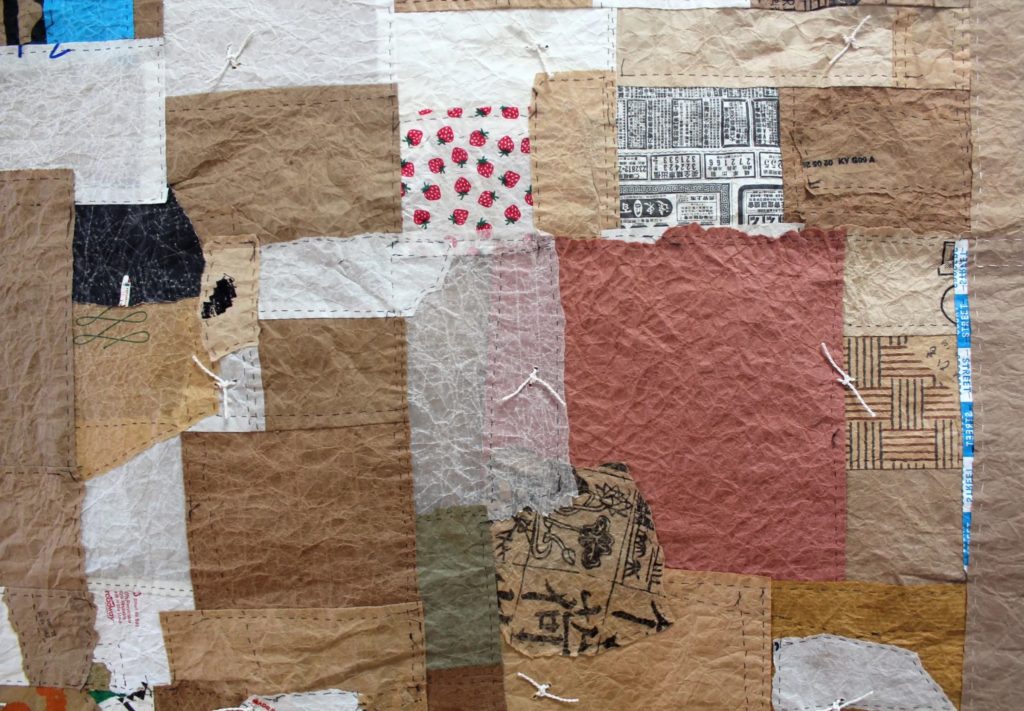
VY: Which materials and tools do you rely on, and why? Pieces in your Still Night Thoughts series like bar rag and cheesecloth use humble, working textiles. What draws you to them?
ZQ: I'm really drawn to materials that don't have a single maker attached to them—materials so ubiquitous that they pass through many people's hands. That connects to the kinds of art making that are influential for me, which are often about transmitting knowledge and wisdom and aren’t attached to singular authorship.
That carries into the fabric I'm drawn to: fabric made in named or unnamed factories, by named or unnamed hands, in China, across Asia, in all the places where we exploit the production of humble fabric and humble paper. A lot of fabric I use was designed to be used and discarded after a finite period of time–including cheesecloth and rags, or muslin, or dropcloth canvas. I'm drawn to the same thing in paper—envelopes, mailers, packing paper, wrapping paper. These are papers that had a single purpose, to protect something, to carry something from one place to another, to absorb the damage or the stains of something, and then be “finished”. I wonder what it means sometimes that I hoard so much paper.
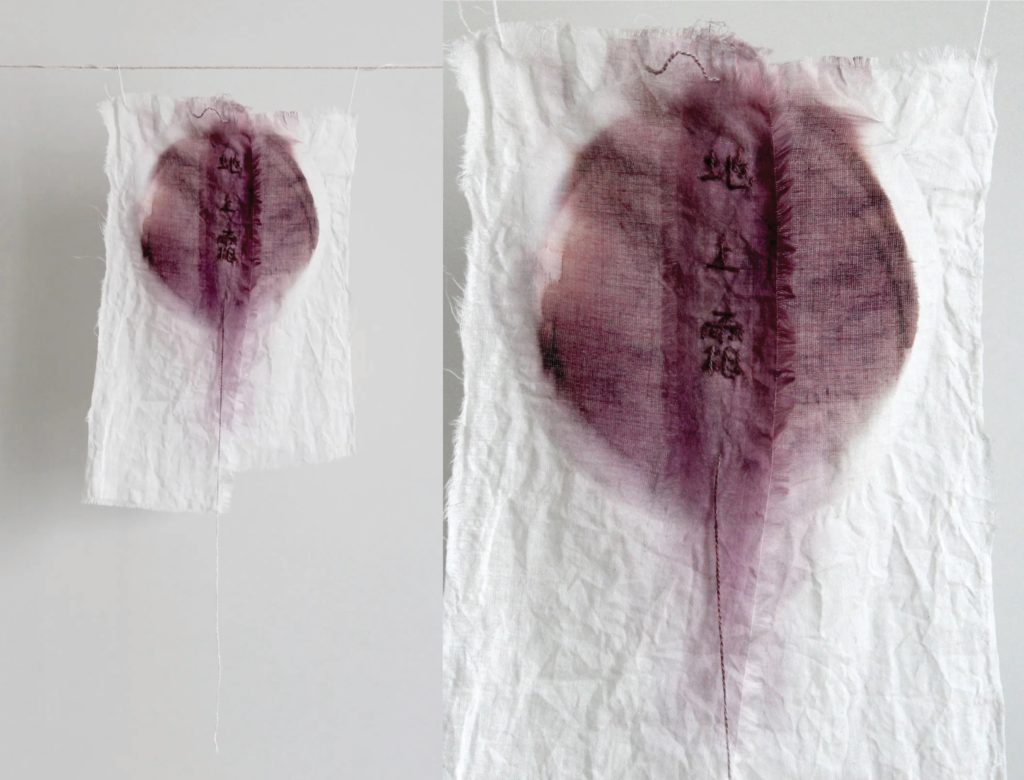
VY: Can you describe the moment your Still Night Thoughts series began? What drew you to create a series based on Li Bai’s poem "Quiet Night Thoughts", was it one many Chinese speakers memorized as children?
[Author's note: "Quiet Night Thoughts" (靜夜思) is a four-line, twenty-character poem by the Tang dynasty poet Li Bai (701–762). The speaker sees moonlight before his bed, mistakes it for frost on the ground, raises his head to the moon, and lowers it thinking of home. It is among the most widely memorized poems in the Chinese-speaking world.]
ZQ: Since I started working with this poem, so many people of the Chinese diaspora have come up to me and said, I know this poem. It's a ghost in my memories. I learned it as a toddler, I am told. I don't think I ever knew the name of the poem as a kid—or if I did, I didn't retain it the way I retained its twenty characters, which I was taught to recite without ever learning to read. I was very young and barely understood what I was saying. That's true of a lot of the people I've spoken to.
When I was becoming reacquainted with my Chinese more recently, convinced I was very bad at the language, I learned that in the long history of Chinese language formation and literacy, lots of people were "bad" at Chinese. I felt less estrangement, and more belonging, in that. And I remembered that I knew this poem. I looked it up, and I've been trying to copy and learn it again as characters, which is different from remembering and reciting it as sounds. I am once again learning language through repetition–and this time it reminded me of learning to sew or weave or spin or knit. I’ve been thinking lately that so many of the ways we were told to learn share something with how we are given punishments as unruly kids: copying or reciting things over and over.
VY: You've been thinking about "repetition, memorization, punishment, madness, destruction." Where did that line of inquiry start, and where is it taking you?
ZQ: It started when I was trying to reteach myself Chinese for I don't know how many times—I've started lessons at least five or six times in my life. It always begins with repetition. Copying lines along a grid was the foundation of how I was taught Chinese writing. I also remember tracing cursive alphabets in elementary school in New York, but I don’t remember having the angles or lengths of my handwriting analyzed quite in the same way. I have memories of Chinese copybooks with lots of red corrective ink.
From my art history, repetition also has associations with obsession; with melancholia, or a grief you cannot fully grieve, so you keep returning to it; with madness; with stuckness. There's a really porous wall among all of those things. Sometimes we use repetition to help us retain something, but sometimes repetition is also what keeps us stuck in a particular time or place.
VY: Your bio describes "the limits of language to hold knowledge or grief," and language is a constant motif throughout your works, what draws you to highlight language?
ZQ: In the way I was trained—in gathering knowledge through material and visual fields—we often still defer to language as the source and authenticator of knowledge. Archives, sources, scholastic expertise as presenting and publishing. A lot of my research in grad school was about the formation of disciplines and what they recognized as their fields of knowledge, and how written language specifically operated as a standard of authority and authenticity, especially in colonialist political projects and evolutionary anthropology. Leading from that, I've been interested in the book as an object-form that historically signifies knowledge as a kind of legible power. I suppose that’s why I’m interested in unreadable books or what a “failed book” might look like.
VY: What do materials do that make language feel limited? How do you see language already living within the materials you use?
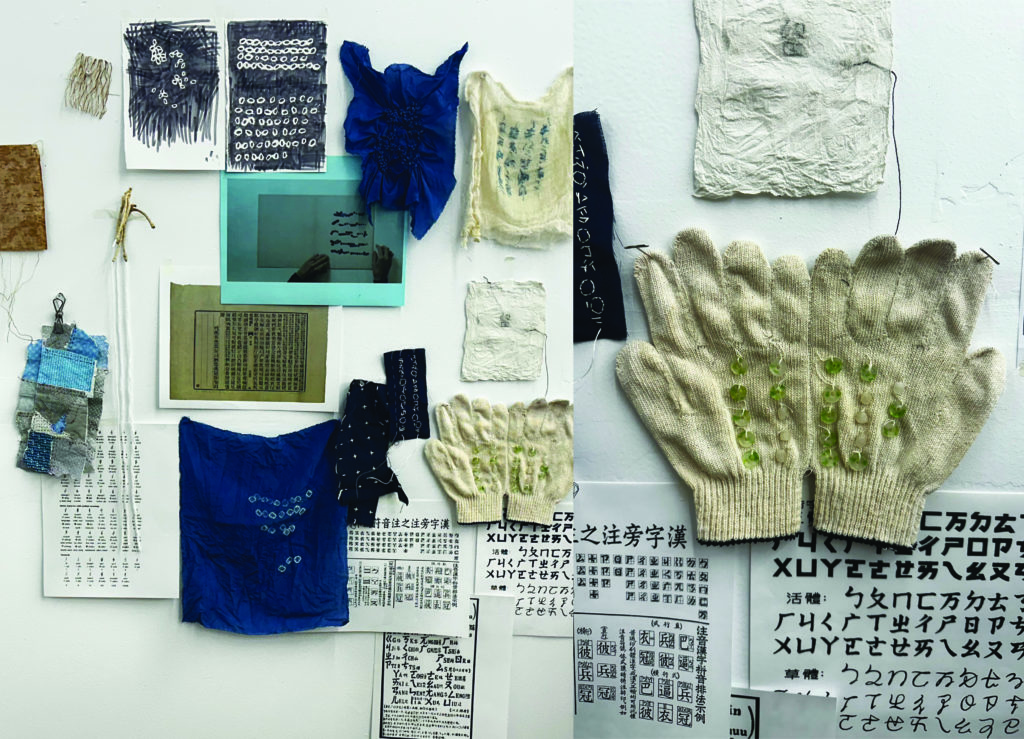
ZQ: I love the idea of there being language in the materials already, and I think that's very true. A long lineage of writers and theorists have connected weaving and the construction of fabric to writing, coding, or counting—as an analogy, or as a direct index. I think that's beautiful, though it's not always what I'm working with. I’m not sure that language is limited for me, I think I just wonder what questions we ask of language compared to what questions we ask of material or image. Maybe this is densely threaded through the Renee Gladman I’ve been reading, and the way that drawing and writing have this co-extensive relationship in how she thinks.
Then samplers! There's a whole history of learning to read and write, and of demonstrating one's literacy, through fabric—but the act of stitching on a sampler is so unlike the act of writing. I'm thinking about how the stitches we use to articulate language, or the strokes we use to make marks that resemble language, can misfire, or be used elsewhere to generate writerly signs that aren't specific to any language.
Because I work with fabric and paper, these two materials feel like siblings in their word-bearing history and in my work. They're thought of as objects of surface importance–meaning that bear meaning, or design, or images. They have a front and a back; they flip and turn. But I’ve been thinking about language as something that gets physically lodged in these materials. Words felted between sheets of mulberry paper, friction between fabric and thread as the only thing holding a word. Lately I’ve been sewing without knots, including in Still Night Thoughts.
VY: You taught writing workshops for TAC's residency program from 2018 to 2020, and now you're back as a resident. What's it like returning in a different role?
ZQ: Teaching here changed the way I thought about teaching, and about writing in relation to art making. I also loved the communities I saw and the range of experiences brought together in those meetings to focus on a shared question. I thought, oh, I want that. So I really do feel honored that the Textile Arts Center has let me back in and let me be a beginner in so many things.
VY: If you could keep only one of your own pieces, which would it be and why?
ZQ: When I first read this question I had an answer, but if I really think about it, I'd be okay not keeping anything. I want to commit to that. I'm trying to use things I can return to the earth; I don't need any of these things to outlive me if they don't want to.
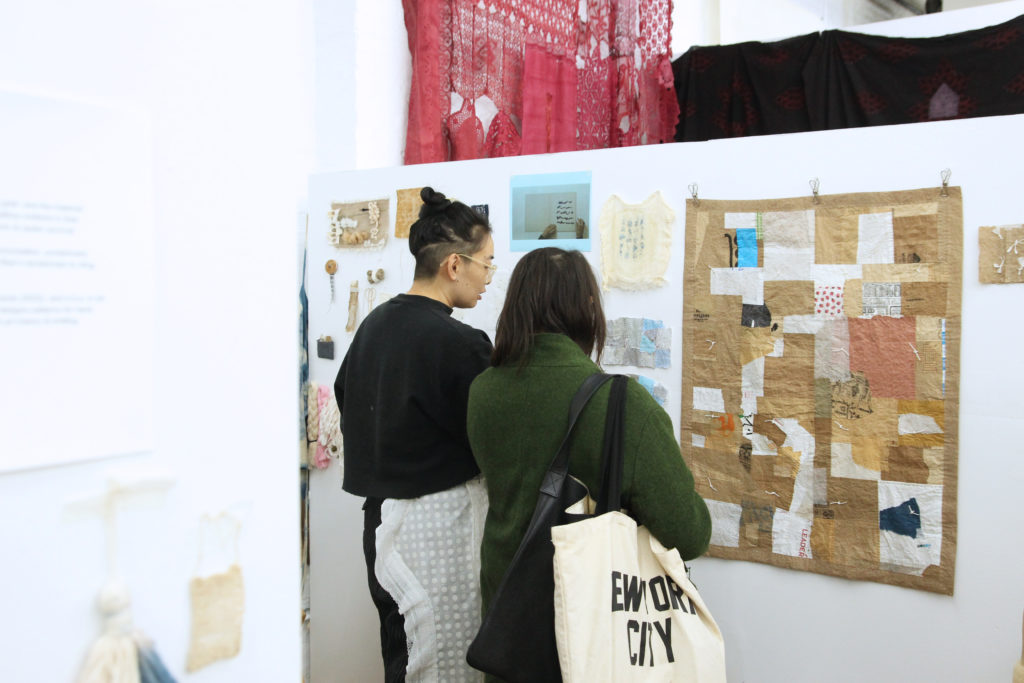
Z. S. Qiu is a writer, textile and fiber artist, and educator based in Brooklyn. They received their PhD in 2022 from the University of Pennsylvania in art history. They are a 2026-2027 cohort of the Interdisciplinary Art and Theory Program in New York. http://zsqiu.work
About the AIR program:
TAC AIR combines studio access with a rigorous interdisciplinary curriculum, and regular critical dialogue, providing residents an opportunity to learn and explore the textile medium, and an alternative to traditional higher education programs. The residency culminates in a group exhibition produced and hosted by TAC. Since 2010, TAC AIR has graduated over 100 artists and designers whose work continues to further textile art within the fashion, fine arts, design and art education fields.
Cover image credit: Qiu in their studio at the Textile Arts Center, Brooklyn, NY. Photo by Vivian Yip.