

Vivian Yip (they/them), Artist Programs Intern at TAC, spent time with October WIP resident Patricia Miranda (she/her):
VY: As a child you stated that you used your imagination as a place of escape. A lot of your art now has slits that let us see inside but never enter. Is that the same space?
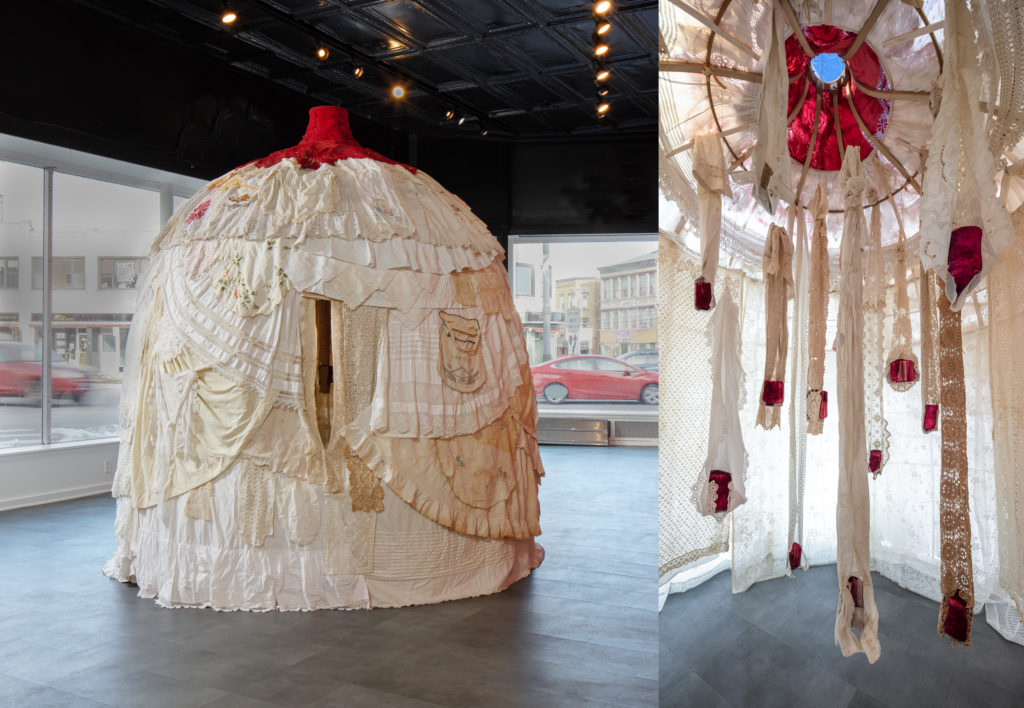
PM: That's fascinating that you made that connection to this skirt. I love that. I don't think I made that connection. Part of the idea of the skirts is all of the metaphors, the gathering under the skirt, hiding under the skirt, hiding things in skirts, sheltering under your grandmother's skirt. They are very much like shelters. That's definitely part of my idea. I didn't link it to that childhood thing, that's so exciting for me.
With the skirt pieces, I'm thinking of them as bodies, proxy bodies, metaphors for bodies, and metaphors for the way clothing architects a body. Every oppression contains a liberation; People are still loving, and creating, and being joyful, and making things inside even very oppressive situations. I'm particularly interested in the idea of interior economies that circulate inside domestic spaces.
I think of clothing as a metaphor for architecting identities, of protecting the body, and also as domicile. With the skirts, you can't enter, and that's really important. The opacity is a conceptual idea, a space you can look into but you can't occupy, as a protected space. You can see but you can't access. I'm thinking of this on feminist terms, in relation to women's bodies, and the way that the home can function as a protected space. Of course, a home can be an oppressive space, too. The space is a political statement: you can look, but you can't enter.
VY: In your artist statement, you name legal and religious control over women's bodies as the reason this work feels urgent. Was there a specific event or day when that urgency entered a particular piece?
PM: My whole life! But I became super conscious of it in the workaround 2012. The Missouri Republican Todd Akin, said that if it’s a legitimate rape, the woman’s body will just reject it. At that time, I collected 11 or 12 pages of completely inaccurate and deeply problematic statements that Republicans had said about women’s bodies. Around the same time, Lisa House-Brown, Democrat from Michigan, said the word “vagina” on the House floor, and was silenced.Republican leadership ruled her comments a violation of House decorum and refused to recognize her to speak. It’s a body part, and she was silenced.
At that time I was with a group of women artists, sitting around a table, and each one of us had experienced some kind of sexual violence. We said, “Let’s do a show.” We called it Legitimate Vagina. That title would mean something quite different now, because of trans rights and other relevant conversations, but at the time it was directly related to those two political acts: saying “legitimate rape,” and not being able to say “vagina.” We put on a fierce exhibition at MAPSpace in less than eight weeks before the 2012 election, , and included a panel called Pussy Talks. I think that’s the moment when I really wanted these things to be visible in my work. It’s always been urgent in my life, but that’s when it entered the work.
VY: Science runs through your work: the carminic acid in cochineal, the tannins in oak galls. How much chemistry do you control, and how much do you leave to the vat?
PM: I joke that I’m an intentionally sloppy dyer. Since most of the textiles I use are repurposed and donated to my project The Lace Archive, it is important that the history of the donor, the stains and evidence of use, remain in the cloth. The textiles are different fibers, different qualities and ages, and react differently to the dye in the same pot. I am also not making clothing or products that need to be reproduced or washed, so I can be experimental. After working with natural dyes for over 25 years, you develop a kinship and understanding of mordants, acidity, alkalinity, et cetera. I can play with the chemistry, and be responsive moment to moment as I dye to how each cloth responds. I don’t filter the dye. My cochineal textiles have the cochineal dust still in it. For me, that visceral quality is important to the content of the work. When I put the fabric in the dye, I don’t know exactly what will happen. Not only do I not know at the moment, they all fade differently too. I dye each textile four or five times, drying and dyeing it over again, so that I can get the color I want. That’s something you’re not going to do if you’re doing any kind of production.
VY: Do you compose on the floor, the wall, or a table? Jason Stopa noted how carefully you handle the negative space in Lamentations for Ermenegilda. How do you decide where the gaps go?
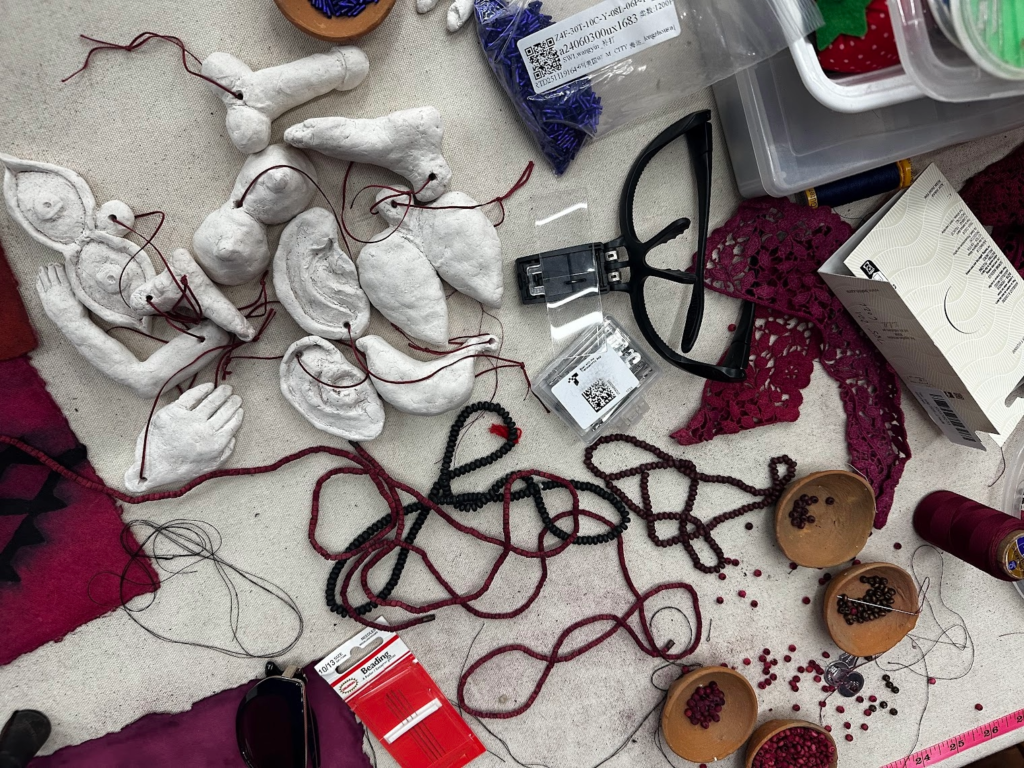
PM: I work on the floor. I work on the wall. I work on a table. Sometimes I work in a chair. Whatever is necessary. A lot of it is on the wall. I think it’s dictated by the material. Sometimes when I’m starting a wall piece, I’ll pin up a bunch of pieces and just start sewing them together.
As you know from working with textiles, there’s a whole craft to it: this fabric will stretch in this direction, you have to cut on the bias, that kind of thing. I don’t know pattern making. That’s not something I have any experience with. I look, I move things around, and there’s a point where I’ll obsess over whether something goes here or there. Then you put it up, and it comes together, because it’s more than the sum of its parts.
VY: Is there a recurring point in making a piece where you get stuck, such as a certain stage of sewing or a certain scale? What gets you through it?
PM: It’s just many years of learning how to trust. When I first started this work, I wanted to make large work, and I didn’t really know what it was going to be. I would say to my students, “I prefer a colossal failure to a mediocre success,” so I had to walk my own talk. When I was first making the big sculptures, I had a show coming up, it got dangerously close and I didn’t know exactly what I was making. But I had to keep trusting. It might turn out really awful, but in order to make the work I wanted to make, I had to trust the process.
I don’t want to be tyrannical over the work. I let the work tell me, and I also ask . I think the work has its own desires, and sometimes they’re different from mine. So I ask, “What do you need? What do you want? What do you desire? Where do you want to go? What do I need to do to follow you?” At the beginning of the process, I have to keep pushing, pushing, pushing. Then there’s a point where the work turns around and looks back at me. Then I think, okay, now we’re doing it. Now it’s up to you. My job is not to get in the way, to support, to figure out a way to make it happen.
VY: You've worked hard to show that lace goes beyond "grandma's doilies." What do you most wish people understood about the labor inside a single doily?
PM: Everything that is made in the world is made from human labor. Even AI is constructed by human labor. I think what our political structures do is very intentionally make certain labors visible and certain labors not visible. It’s a way to value some labor and not others. I want the work to keep visible the labor involved in every created activity. I don’t want the labor to be hidden. Making labor visible is really, really important to me. The large works are artifacts, evidence, of so much hidden labor, mostly the labor of women.When I started making the work, I thought I had to sew it perfectly. Then I left pins in the work, and pins are contingent. They show the labor. They also show that this is an object continually in the act of becoming.
I want the work to be large, to take up space, to make this gendered labor undeniable.
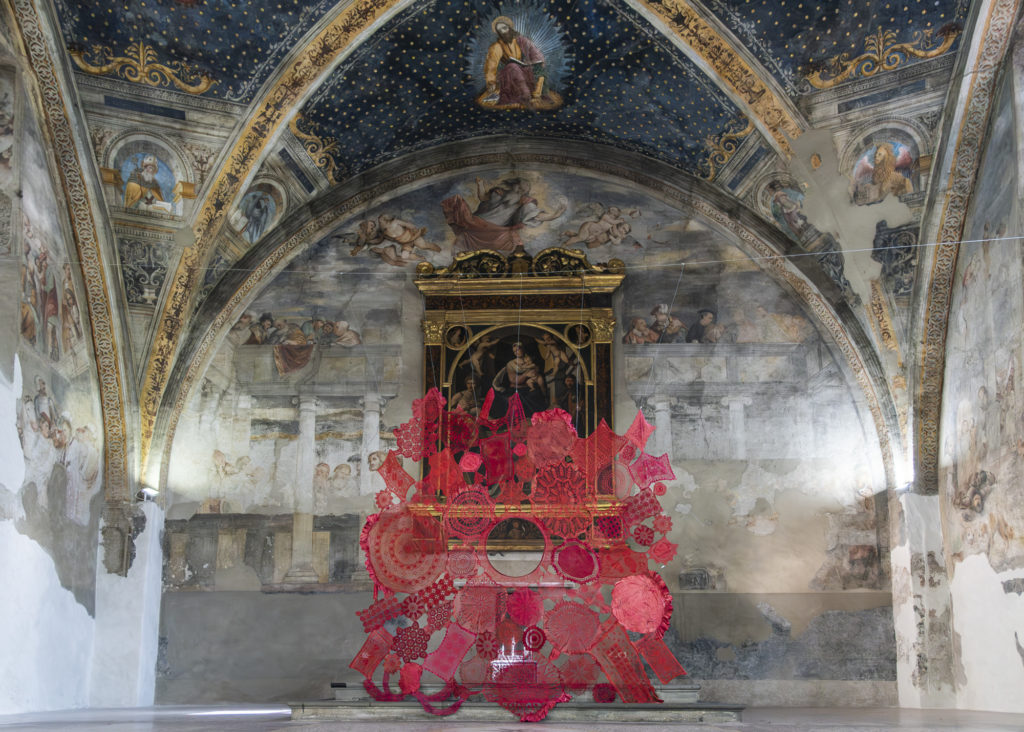
VY: Your newest titles have moved into Italian: Legato al Respiro, Ciò che Trattiene / Ciò che Rilascia, Supplica. What changed when you made and showed work in Italy, at the RUC residency and Respiro at Museo Camuno in Breno?
PM: Those pieces came out of the show I did in Italy last fall, so part of it is simply context. The audience was Italian, and not everyone speaks English, so the titles needed to meet the place in its own language. We also produced the catalog in both Italian and English.
The project was a collaboration with my partner, the artist Christopher Kaczmarek, and was inspired by the Sardinian artist Maria Lai. I’ve known her work for a long time and assumed she was better known here than she was. Legarsi alla montagna was a piece she made in her hometown of Ulassai, a rural town in Sardinia. She had a huge bolt of cloth torn into strips, and the entire town moved it through the streets, across balconies, through everything, and then climbers carried it all the way to the top of the mountain. So the wrapping video and the wrapping performance were both an homage to her, and to mountains. That was a first for me. I’m not a performance artist; I lecture, I teach, I do a lot of public speaking, but I’m really a behind-the-scenes gal. It was an incredible experience.
What surprised me was how similar the audience’s response was to what I see here. The textile tradition is still very present in Italy, although like here most younger women don’t make lace. Yet some women do still make lace, and practically everyone’s mother did. Here the connection can be more direct for some people and more distant for others, but one thing the lace archive has taught me is that almost every family has a box of textiles in the closet. In Italy, women got it instantly. They would come in and say, “my grandmother, my nonna.”
VY: Lastly, could you please leave us with three words that describe your current series.
PM: Softness is really important to me. Monumental, fierce, softness.
Patricia Miranda (she/her) is an artist, curator, educator, and founder of the artist-run orgs The Crit Lab and MAPSpace. In 2021 she founded the Lace Archive, an historical community archive of thousands of donated lace works and family histories. She has received grants from the Barbara Deming Fund; Ruth and Harold Chenven Foundation; Northern Manhattan Arts Alliance; two artist grants from ArtsWestchester/New York State Council on the Arts; an Anonymous Was a Woman Covid19 Relief Grant, and was part of a year-long NEA grant working with homeless youth. She has been awarded residencies at the RUC Rural Contemporary Residency in Italy; the Constance Saltonstall Foundation; I-Park Foundation; Weir Farm Foundation; Vermont Studio Center, and Julio Valdez Printmaking Studio. Recent solo exhibitions include: Five Points Art Center, (Torrington, CT), the Olin Fine Art Center (Washington PA), 3S Artspace (Portsmouth, NH), Jane Street Art Center, Garrison Art Center (Hudson Valley, NY), ODETTA Gallery, and Maine Window DUMBO (NYC). Two-person and group exhibitions include Museo Camuno, (Breno, Italy); Spartanburg Art Museum (Spartanburg, SC); Dunedin Fine Art Center (Dunedin FL); HV MOCA (Peekskill NY), The Lyman Allyn Museum (New London, CT), Northern Manhattan Arts Alliance (NoMAA), Williamsburg Art+Historical Center, The Clemente Center (NYC). Her work has been featured in PiùValli TV, Movida Terre Camune Magazine, Art New England, Hudson Valley One and Brooklyn Rail.
Cover image credit: Miranda in her WIP studio at the Textile Arts Center, Brooklyn, NY. Photo by Vivian Yip.