

Geovanni Barrios, Artist Programs Intern at TAC, spent time with current AIR 17 resident Seyoung Hong:
G: I feel that as people who work in crochet and knitting, we have similar brains. Do you form a vision, and then execute a plan? How do you approach your projects?
S: It’s half and half. I sometimes will have an idea of how I want it to look at the end, but during the making process, it doesn't turn out how I thought it would. So then I end up doing something different. Or maybe the fabric I'm using doesn't want to become what I wanted it to be.
G: And so lately you’ve turned to the power of numbers: building small and building a lot.
S: I have been working pretty modular for a while. Making a piece out of a bunch of smaller pieces is new.
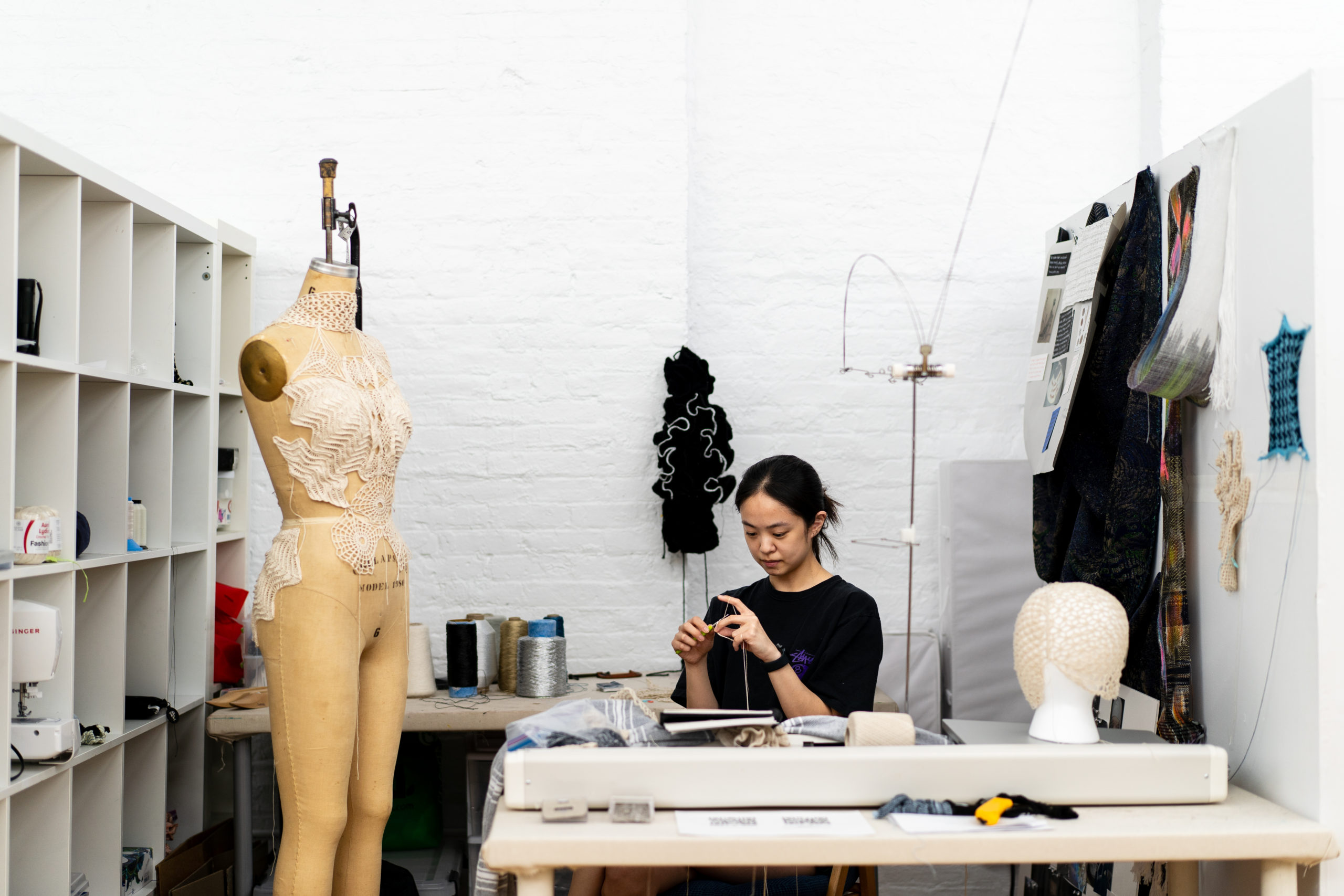
G: So is this “coral” the smallest module you have worked with?
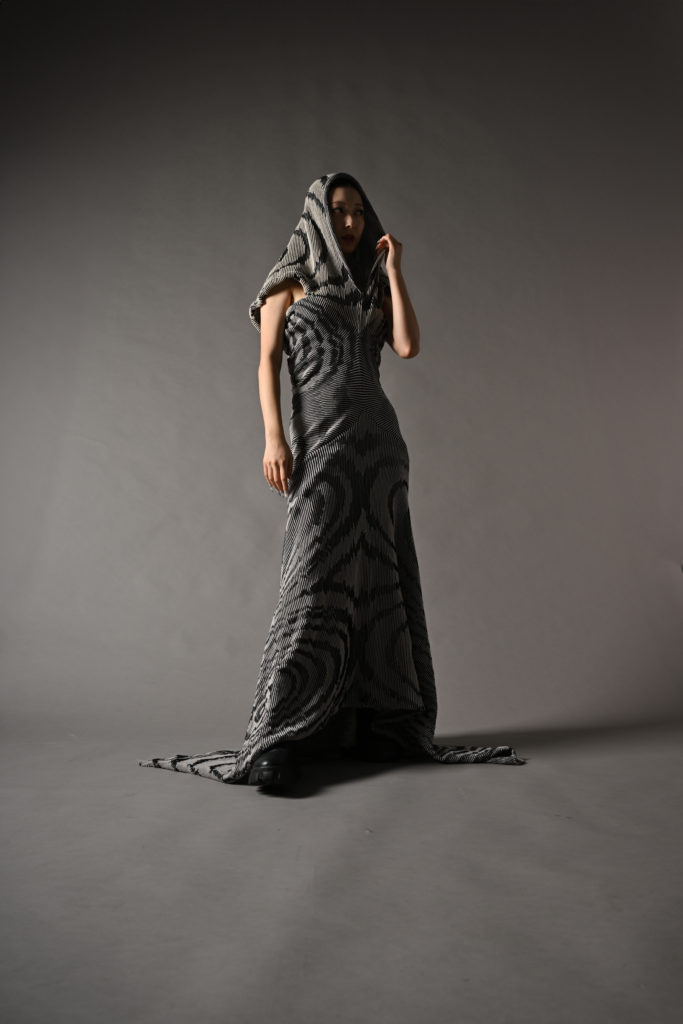
S: Yeah, this is the smallest piece of a module that I've worked on. Normally, if I'm knitting, it's one big piece. One row at a time, or maybe a couple multiple big pieces. This dress was made from two big panels.
This piece is the first I made from small units. It’s very different from what I usually do. People said it looked like a cocoon. Now the outside is looking more like coral, but I have been experimenting more with hyperbolic crochet.
For example with the manifold, I was following a pattern in a mathematical paper for how to make a crochet Lorenz manifold. Hyperbolic crochet expands exponentially, so the shape flows in unexpected ways. I couldn't figure out how to mount it, so now it's just flat. In the beginning, I was adamant about constructing it as outlined in the paper.
G: I’m going to refer to it as the ‘coral’—it's so beautiful. I'm really impressed by the form and shape it's come into. I saw it in all of its modules, and to see it disconnected and then put together to have a form is really incredible.
In making new sculpture works, where the work is informed so much by the amount of labor that you're doing, and the modular nature of crochet and knit. How does that inform the work that you're producing?
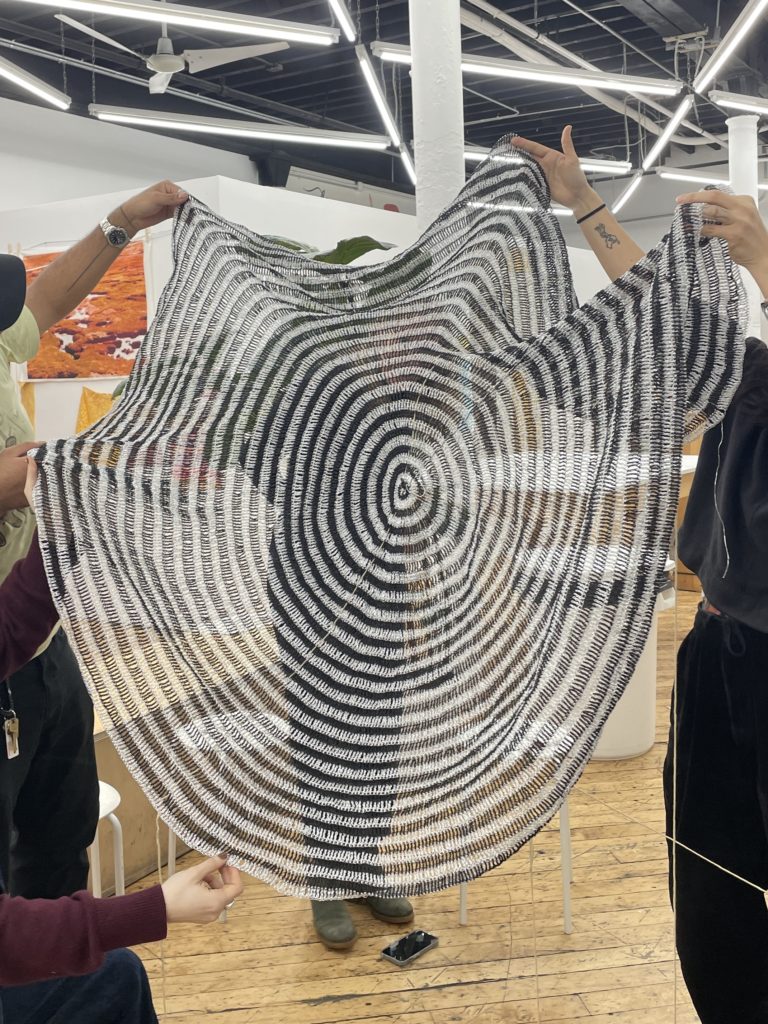
S: My old garments were never particularly wearable in the sense that they weren’t very functional. And since they were also knitted or woven, they also took a lot of time. My knit bodysuit was all fully fashioned on the domestic machine. So there was no cutting and sewing. It was like making it to fit the pattern piece. I've always been used to very strenuous and labor intensive work. But I didn't realize as my work was getting exponentially bigger, that the time necessary was also growing exponentially. The first twenty rounds went by pretty quickly, but as the work got larger and wider, I would take days for a single round.
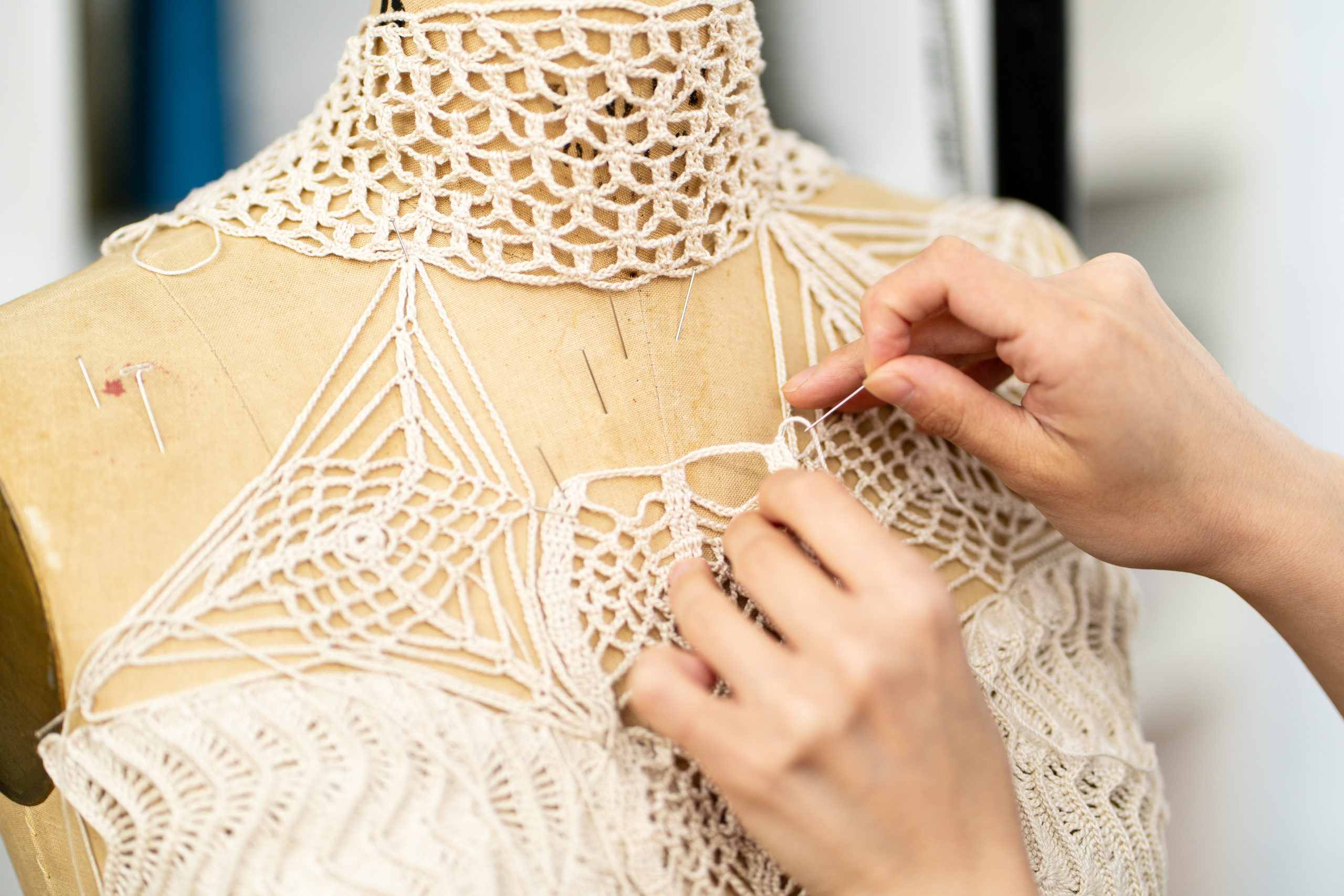
G: It reminds me of how the universe is infinitely expanding, but we also know that it's expanding at a faster rate. What's so exciting about your work, is that it is seated in an interest of that expanse and the mathematical, but also becomes about the processes and the consequences of expansion. It is cool to see how much you progress from one day to the next.
S: Thank you. When I started making these floral patterns, I thought, “Oh this is going to be great. I can just produce them super fast.” Then I started timing myself to see how long it was actually taking me—I’m not as fast as I thought! In some of my previous work, I used to want to put every single technique I knew, so my knits would be super packed with different techniques, and stitch types. But then, when you're looking at the whole piece from far away, you can't really tell. So then I was like, oh, actually maybe simpler is key. I have been looking at Raul de Nieves’s work and the way he uses beads to emulate crystals has inspired me.
G: What have you taken from seeing the other artists here at TAC, have you borrowed any ideas from their approaches to working?
S: The biggest thing I have learned is to not take everything so seriously. I can make something and I may not like it, but there is value in still having made something or just to try it out. I also enjoy hearing outside perspectives and different ideas for what to do with my work. It has been really good for me to think through installation as a new phase of my work and the limitless possibilities there.
G: Is there a technique that you've learned at TAC, that you want to keep working with?
S: I took the painted warp class and that was really a paradigm shift, because our instructor was clear that there are actually no clear goals in the work. We even dressed the loom in the opposite way from what I learned. I’m enjoying the freedom of improvised techniques.
G: Could you describe the theme that you were engaging with, and where you're moving towards now for the final exhibition?
S: It started with Annihilation by Jeff Vandermeer. And I also watched the movie that was made at the same time as [Vandermeer] was writing the book. The book and movie explore cosmic horror and the idea of a new weird genre. Within the new weird, is the idea of embracing something that's super big and super scary, and the human mind can't comprehend it. Old cosmic horror—like Lovecraft who wrote Cthulhu—his whole thing was, there is no point in fighting it. Just give up. While the new weird considers that the monster is also trying to live, and maybe we have to change to live alongside it.
The new weird genre is engaging with anthropocene monsters and suggesting that we have to embrace it, because we made it, and so... we have to deal with it now. In my past works, I realized that the central theme was about the form of a very powerful woman. Powerful in a way that she's not actively trying to cause harm to other people, but rather she is able to protect herself in case something happens. I did a project on the Radium Girls, and, like, how the corporation was poisoning them but didn't tell them, so they had to literally go to court while their bodies were falling apart to try to get payment [for wrongdoing]. I made a collection of garments that had holes in them but was still a dress. Or in that same collection, I made a vest that was the same shape as a fencing costume—like a protective garment.
My most recent project was about outer space. So I've been focusing on outer space as my subject for some time.
G: Do you want to go to outer space?
S: [Laughing.] No. Whoever else can figure that out, I don't need to go make the discoveries. I'd be happy knowing them later.
G: Oh, but you have no interest in seeing it?
S: I mean, of course I do, but… the thought of being up there? You have no control.
G: Well, but that's the critical question! You don’t like to give up control, and your work is about controlling the material. You're talking about this big, scary, out of control thing, and you want to be in complete control of the work you're making, which I admire.
S: I like knowing everything that's happening. I want to know, you know, every possibility, so that I can be prepared. Obviously, things are gonna happen that you can't be prepared for. So, another big shift is just… whatever happens happens.
G: Now that you're trying to execute for the final presentation, is there a constraint or another avenue of inquiry that you're interested in exploring? What does the route to your final exhibition look like from now?
S: After that last group crit where we turned off the lights and used flashlights to see through my material. There is this shadow play happening that I’m really excited to continue exploring. And the material, even though it’s very much craft yarn acrylic, there are these tiny sparkles in it. So I’m working with metallic yarn, to hold up my shapes much better.
G: But you’ve abandoned the machine, when did that happen?
S: I was stressing myself out with the process of drafting a pattern, and then calculating the increase and decrease on the machine. In all of that, I was remembering how traumatic it is to work with [the knitting machine]—it can sense if you're stressed out. If you’re even a little distracted or the tiniest not paying attention, it'll drop a stitch or the needle will break all of a sudden. And… I did not want to do that right now. Lately, I’ve been thinking in terms of making all the elements in one medium, so crocheting and focusing on handmade would be stronger.
G: It must be exhausting on your hands, and you have to stay loose and nimble. Could you describe your daily rhythm? How do you keep yourself from burning out from that?
S: Once I figure out what I want to do and get excited about it, then it's very easy to just keep going. And I'll turn on a show to watch in the background and just keep watching until I'm done. I will say that my new metallic “yarn” has been doing some damage to my skin a bit because it's so stiff and strong.
G: How does that make you feel? Even if it is subconscious, it must change how you work with it.
S: I just wrap it in a Band-Aid. It's taxing. Even with cotton, the friction is not nearly as intense, but over time, it can etch itself into your hand and make a permanent line. I'm hoping it’ll just callous over.
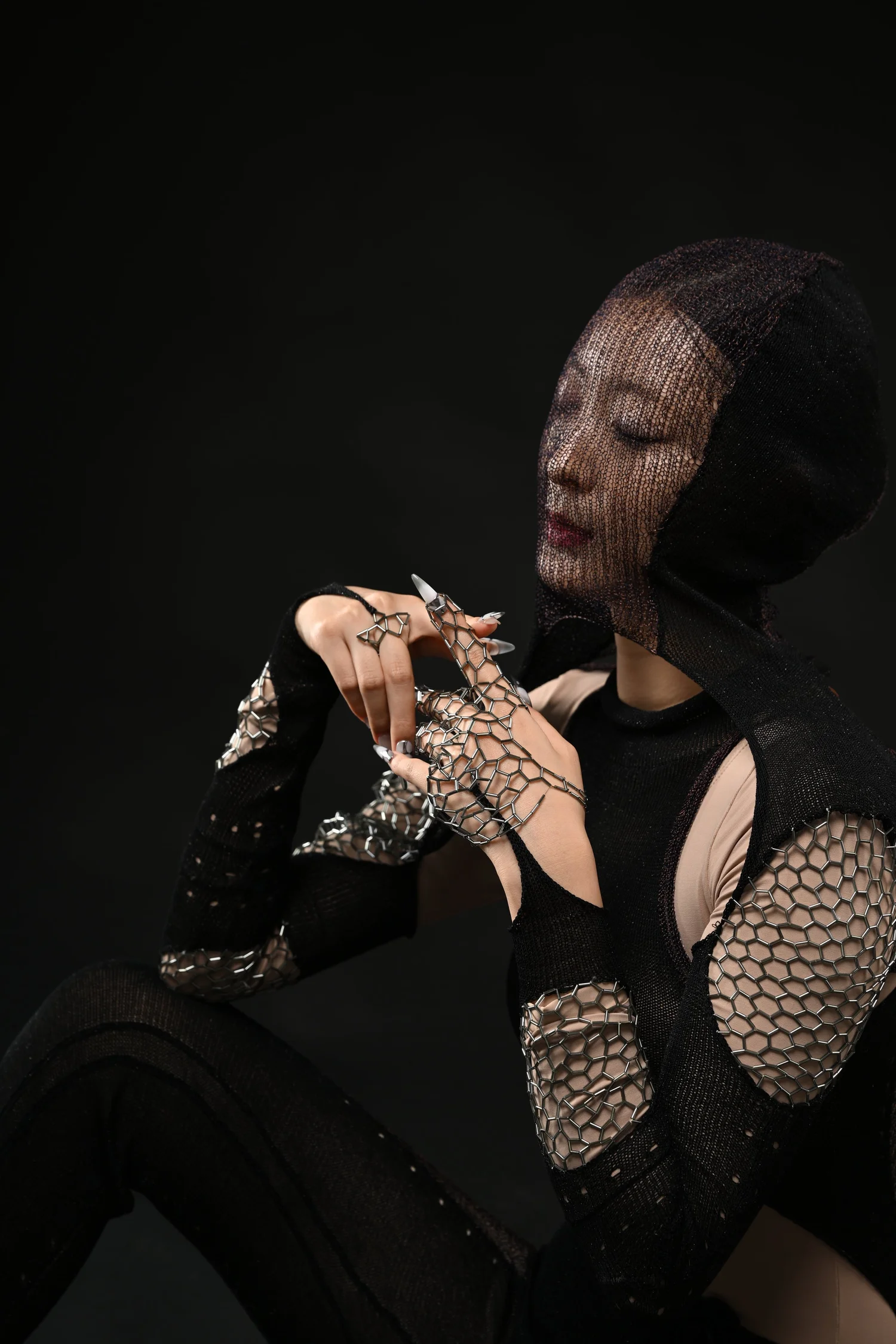
Seyoung Hong is a visual artist from Washington DC. A recent BFA grad from Rhode Island School of Design’s textile program with a concentration in environmental studies, her work focuses on materiality and the conveying of information through art.
About the AIR program:
TAC AIR combines studio access with a rigorous interdisciplinary curriculum, and regular critical dialogue, providing residents an opportunity to learn and explore the textile medium, and an alternative to traditional higher education programs. The residency culminates in a group exhibition produced and hosted by TAC. Since 2010, TAC AIR has graduated over 100 artists and designers whose work continues to further textile art within the fashion, fine arts, design and art education fields.
Cover image credit: Seyoung pinning and position the panels on the verso of her latest sculpture. Photo by Geovanni Barrios.