

Geo Barrios, Artist Programs Intern at TAC, spent time with May WIP resident Ye’ela (Ela) Wilschanski:
G: We met in your basketry class here at TAC—a month ago already! What stood out to me the most was how earnest you are in considering the relationship basketmakers have had historically with the world around them. How does working in craft inform your relationship with the world?
E: Thank you! I like to be surrounded by objects that I have created. They contain the energy of all the hours and days and months that it took to create them, and that energy lives with me now and in the future.
Craft has existed in the world for so many generations, in so many different cultures. In my current life, I'm called an artist. The institutions I work within are called art galleries, artist- run spaces and artist residencies. In previous lives, they had other names and structures. In Hebrew, the word for “art” (omanut) and the word for “craft” (oomanut) are basically the same word. They share the same root with “trust” (emun), “practice” (eemun), “nurture” (omna) and “true” (amen).
G: What are you making now in the studio? And how does that connect you to other people?
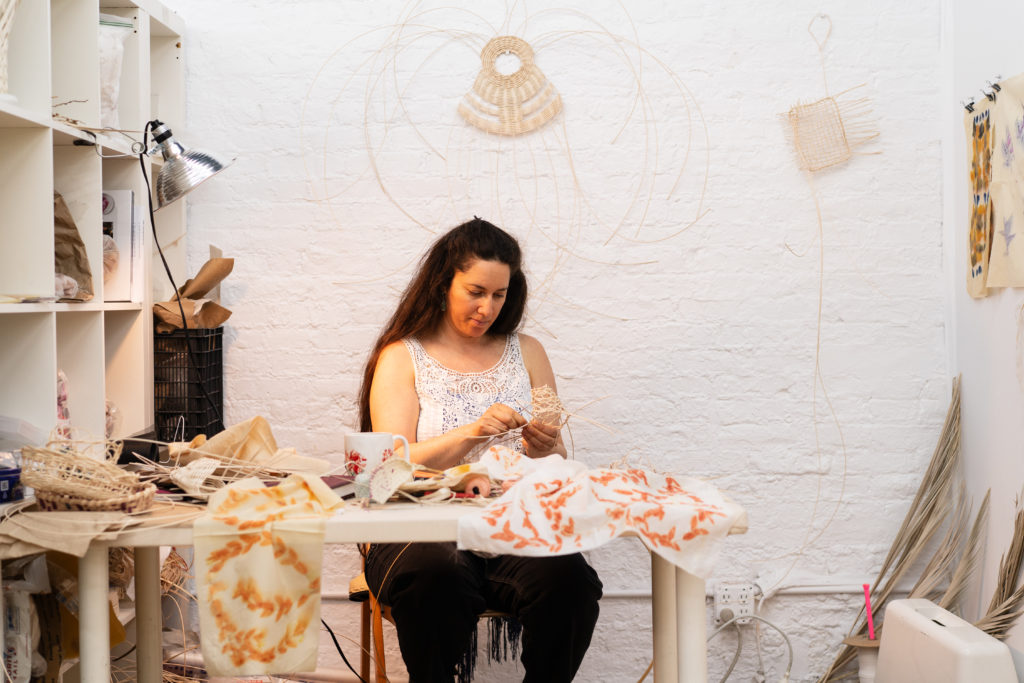
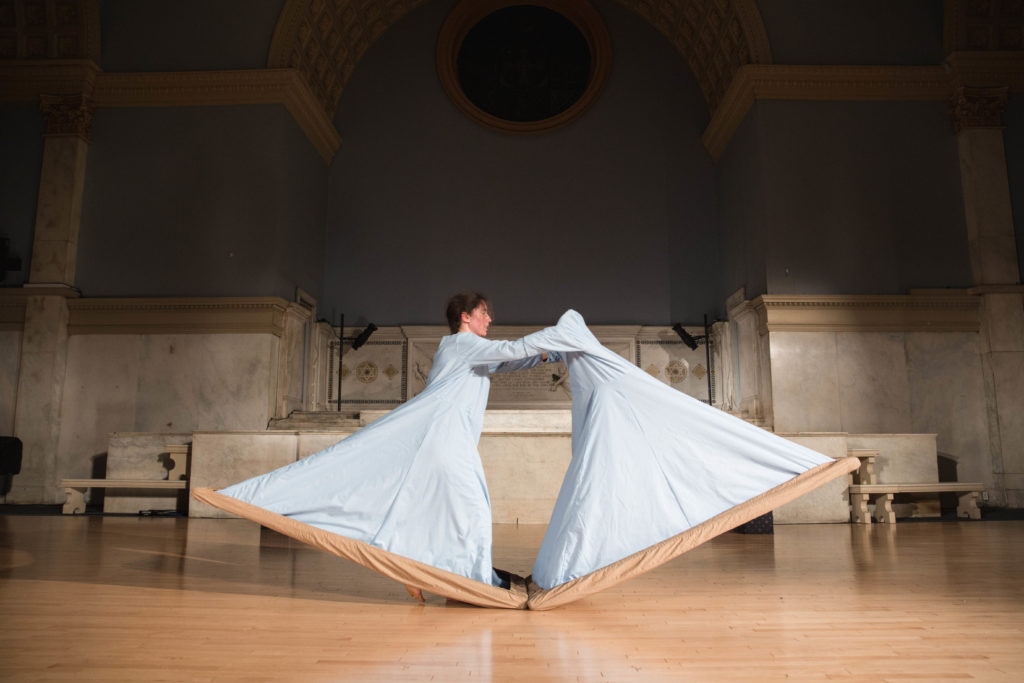
E: In my practice, I work with fabrics to create time-based architectural-garments. I sew wearable sculptures that partially follow the shape of my body and partially relate to architectural/domestic forms such as a door. In this residency, I'm trying to figure out how I can create designs on the fabric that would contribute another layer of information to my future performing/installation work. I’m experimenting with patterns created through needlework, dye and steam printing leaves.
The other material I am working on during the residency is Lulav, a date palm frond. It's used as part of the festival of Sukkot, the festival ahead of the rain season. The traditional ritual includes blessing and shaking the Lulav in all directions. It is special for me to weave with a material that was cherished and taken care of during the week of the festival, before it was given to me. I have used Lulav as a sculptural element but currently I’m trying ways to incorporate Lulav and embroidery on fabric.
G: How is this way of crafting to develop relationships different from your being a teacher or being a performer?
E: I was a nature tour guide for most of my adult life. Claiming a “stage” on a mountain top/forest/ archaeology site was the circumstances that developed my performative voice. Then I took what I learned in the day job context into my art practice. Instead of providing stories about karst or pollination, the content is my own point of view and life experiences. My performances are visual storytelling with a beginning, middle, and an end but I have freedom to create visual sequences that don’t follow verbal communication templates. I create a system that makes sense within itself.
When I was a tour guide, my goal was to provide confidence and comfort so I could disappear and the people would have their immersive experience in nature. In my current day job, I teach ceramics and basket weaving. It may be similar. I want to support my students to develop their own unique handwriting and aesthetics.
G: As a student of yours, it's clear to me that your style is more encouraging exploration in general and offering a multi-use toolkit. Then it’s about letting the student use that information the way they'd like. Can you please say some more about the leaf prints that are hung in your studio?
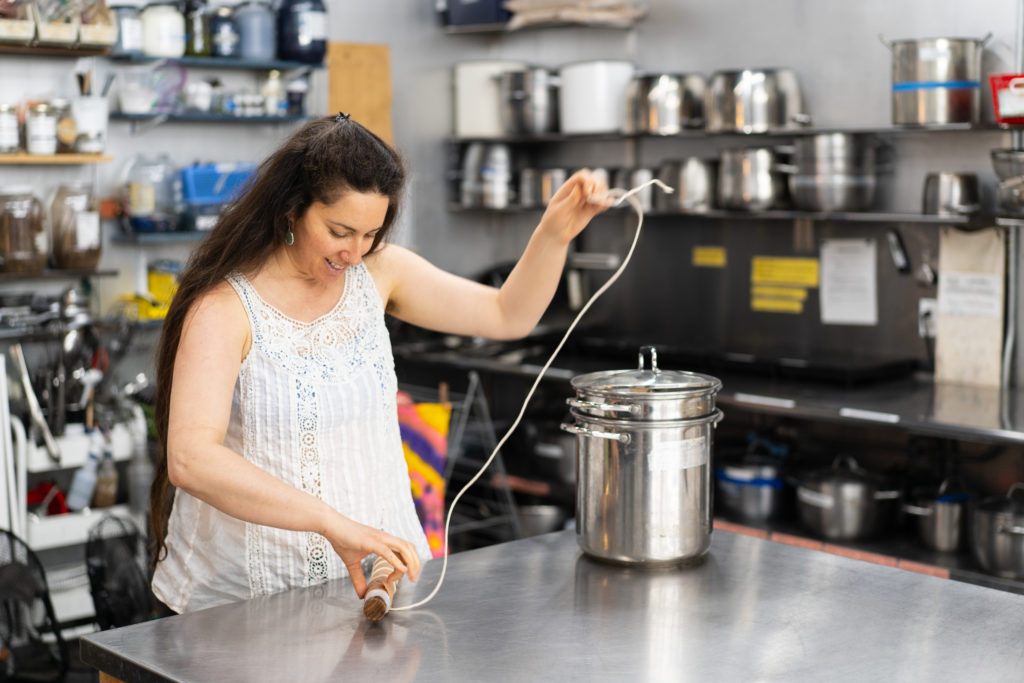
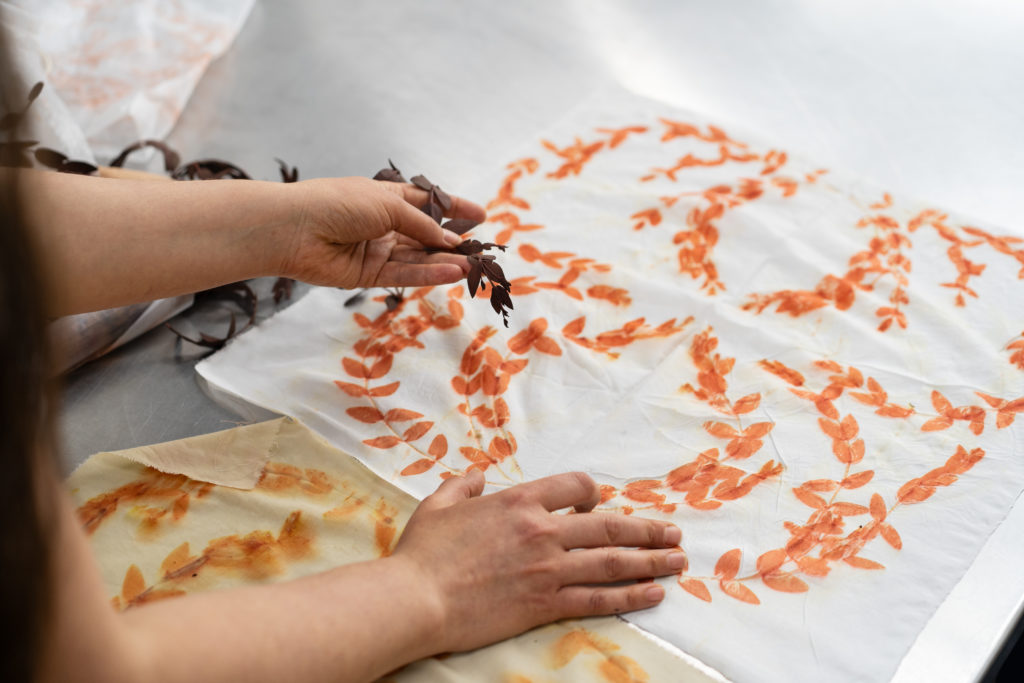
E: First, I prepare the fabric with a mordant, then I create a composition of leaves on the fabric, roll it on a wooden rod and place it into the steamer. The plants transfer their color onto the fabric. Each print is unique and each time I open the roll I get excited and surprised. It's like being an audience to the leaves.
G: Is it a relief to not be the principal actor of the performance? Was steaming your priority for this residency at TAC?
E: Also when I’m performing, even though I created the design and sewed it, I’m kind of an audience myself. The garments are smarter than me and each time I perform I’m surprised to learn new possibilities. I would say it's joy, not relief. Being an audience to my own work keeps the work alive, at least in my own experience.
My priority for the residency at TAC is to expand my toolkit. Printing with leaves is so interesting that it’s become the majority of what I’m dedicating time to in the residency. It has also changed how I walk in the streets beyond the studio. I’m paying more attention to trees and getting to know what color qualities the trees around me hold.
Wilschanski’s primary medium is sculpture, layered with performance, installation and video. Her time-based architectural-garments carefully construct geometrical forms, evoking frames such as window, book and table. These transformative wearable items the artist enters into, suggest structural shifts in both the artist’s body and the garments. As the artist moves within and reconstructs relation to these fabrics, not only does the form change, but also the appearance of her own body in them, as it (dis)appears in between these layers. Through her choreography and combination of mediums, Wilschanski examines the notion of functionality and corporeality in an environment she creates.
Ye’ela (Ela) Wilschanski, she/her is a Brooklyn based artist. Solo exhibitions / performances include Union Gallery, Wagner College (NY 2025), Parent Company Gallery (NY 2024), The Border Gallery (NY 2022), mhPROJECTnyc (NY 2021), Das Schaufenster (WA 2021) and A.I.R. Gallery (NY 2020). Group exhibitions / performances include Essex Flowers Gallery Flower Festival (NY 2024), Long Story Short Gallery (NYC 2021) and Movement Research at The Judson Church (NY 2019). Awards include Vermont Studio Center Fellowship (VT 2025), LABA House Of Study (NY 2024), NYSCA/NYFA Artist Fellowship Craft/Sculpture (NY 2023). Wilschanski holds a MFA from Hunter College (NY 2019) and a BFA from Bezalel (Jerusalem 2014) including a semester at SMFA Boston (MA 2012).
Cover image credit: Ye'ela in her studio at the Textile Arts Center, Brooklyn, NY. Photo by Geovanni Barrios.