

Julie Schumacher, past Artist Programs intern at TAC, spent time with June WIP residents Katie Coughlin and Cat Mailloux:
Julie: You both have separate art practices—how did you meet, and is this your first collaboration?
Katie: Cat and I went to the same graduate program at Ohio State University, and we both have sculptural backgrounds. I'm primarily a ceramicist, while Cat works with all media. Our commonality is that we both love working with textiles.
This is our second collaboration. We collaborated for the first time in 2024, and we hope to continue our collaborations every two years or so if we can.
Cat: In the in-between time, we have our individual practices that exist on their own, but have enough overlap that it's really worthwhile to collaborate, expand ideas, and have more working hands behind projects.
Tell me about your individual practices.
Cat: I'm a textile artist very influenced by sculpture scale, like installation and space. I learned quilting and sewing as a kid. Then, throughout my art education, I was introduced to sculpture and was really interested in how we orient ourselves to space—how we feel larger or small compared to objects or architecture that we're moving through—as well as, personally, how I respond to place and time and memory. So, my practice now is focused in textiles, really leaning into fabric, color, sewing, quilting, and some garment-making processes to create both two-dimensional and three-dimensional fabric forms that somehow mark my relationship to time, space, place, and memory. Some works are two-dimensional in the sense that they're more like fabric collages, utilizing quilting techniques and existing as abstract color compositions that draw from patterns I create from my environment. I also have a parallel practice still in development that is more large-scale, installation-based, that uses fabric more like architecture, whether it's like an insertion of textiles into an environment or a discrete fabric object that exists on its own. But my work always comes from a response to space, personal experiences, and personal experiences of spaces, as well as using fabric structurally.
Katie: I have two parallel bodies of work. I'm primarily a ceramicist and create functional pottery with a focus on form and color. In tandem with my ceramic practice, I create performance works where vessels are created alongside sculptural objects to expand and incorporate the human body. I focus on the everyday gestures of people and how our movements can shift based on our habits and the spaces we reside in. It’s a study of intimacy and tenderness of the everyday. The vessel, whether it is in clay or a three-dimensional form made from fabric, sits at the center of my studio practice.
Since my performance works are large-scale and take up much of my creative and emotional energy, I don’t have the capacity to create them constantly. In between the performances, I keep a daily clay practice. This daily engagement in material allows me to maintain a studio practice and keep my hands and mind working.
I’d love to hear your thoughts on collaborations in general.
Katie: I think when you're working alongside someone, whether collaborating, being studio mates, or processing through an intense program together, you gain an understanding of a person in a very different and deep way. I feel like when you understand someone's work, you're understanding the truest sense of how they see the world. The opportunity to gain this deeply personal insight into someone else’s mind is rare and connects you to them in an extremely intimate way.
Tell me about your collaboration process.
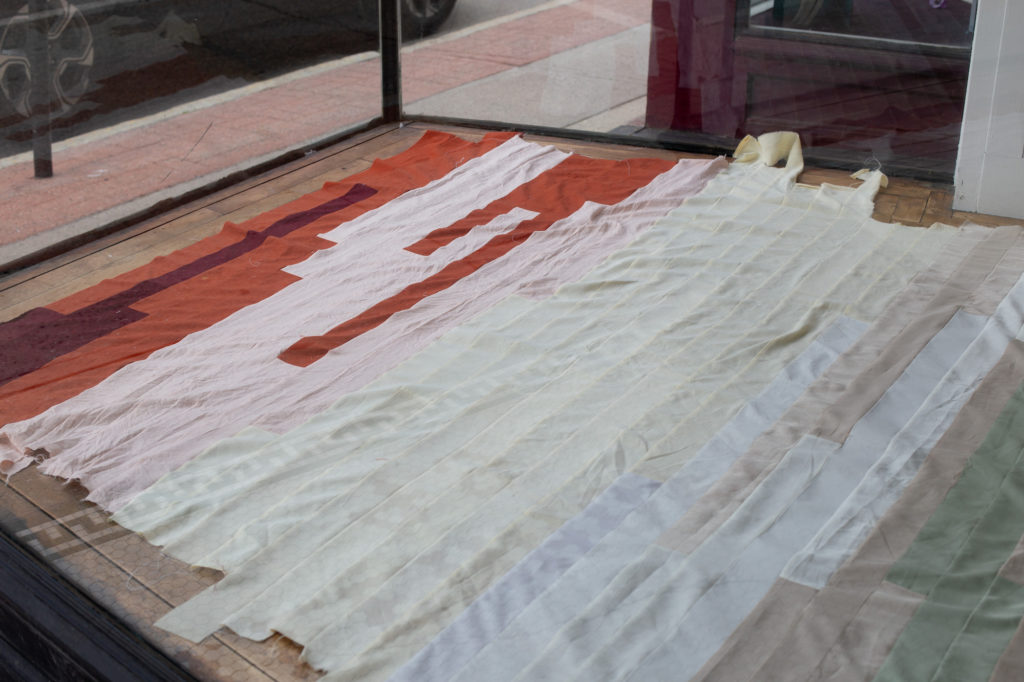
Cat: When we initially collaborated, it felt super refreshing because most artists really just work individually. A lot of other creative areas, whether it's music or writing, you're typically working with a group of people or an editor, who's really helping you form the work. And that's just not as true for visual artists. So, it was really refreshing to collaborate and have somebody else's ideas beyond just your own, which can then be folded back into our own individual practices.
We actually think about it a lot as being in tension with each other—this productive tension. Most often, we're either trying to articulate an idea so the other person understands it, or we're actually disagreeing with each other about something. So it's, like, this pull against each other. And it's very generative.
Katie: And then it's really nice because sometimes one of us gets really excited about something that propels the idea forward. Sometimes, when you're working by yourself, it's hard to keep yourself going and not get stuck.
We have had to learn to over-communicate our ideas with each other because the other person isn't in our head. So we can be thinking, having a conversation about something, and believe we're on the same visual page about it. But then, we realize we’re totally opposite in the vision of what the other is talking about. Like, we could be saying, Okay, we're both going to sew these seams together. We both do it, bring it back, and realize that one person did it differently from the other—which has happened—we just understood the directive differently. So there has to be A LOT of communication.
How do your individual art marking practices come together when you work together?
Cat: I think about it as being two voices that are singing together, where it's creating a third sound that's, like, not accessible unless they're happening together, too. That's how I think about our collaboration. We get to ideas and forms I just access on my own.
Katie: Much like Cat’s studio practice, my work draws from personal experiences and memories, and just a few days ago, I realized our collaborative work is not based on anything specifically personal, which is a nice thing—it gives us a release from too tight of an emotional connection to the work. It's a little more neutral, and this allows us to be a little more expansive in the starting point of our collaborations than a personal memory or an experience permits.
What are you exploring during your TAC residency? And can you tell me about the project/performance you're hosting?
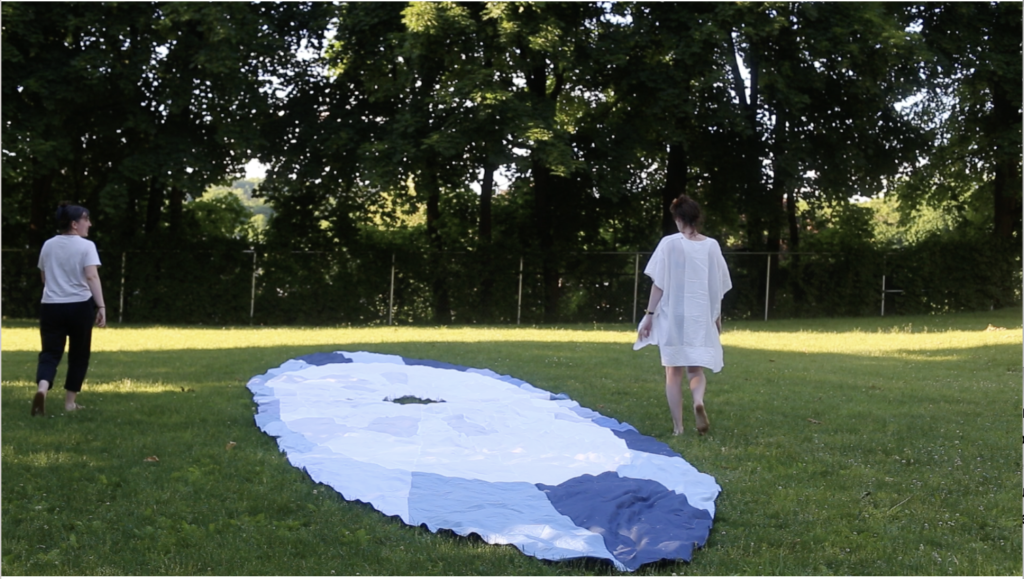
Cat: For our residency project, we're going to create a large-scale picnic blanket with a circular, radial design. We’re going to hold an open-house style picnic at Prospect Park on June 21st, which is the end of our residency. It's also summer solstice, the longest day of the year, where they say that the sun, when it reaches its zenith, seems to pause for a moment before it continues its orbit.
At the picnic, people can come individually or with their families and participate in unfolding the rays of the picnic blanket in order to accommodate whatever space that they need, unfolding sections to sit on. As more people arrive, they will continue to slowly unfold the circular shape of the picnic blanket.
Cat: In thinking about the concept, an idea we kept coming back to was the folding or unfolding of bed sheets, which is much easier when you have somebody to help you. And it's kind of like a dance that you perform with someone else, this moving apart and coming back together, like convention and expansion of an object.
Katie: Both of us are looking to have a little bit more joy in our work and, maybe, just more joy in the world at the moment, to allow whatever we create to have a sense of play to it. But we're most interested in how this form gets navigated by the unfolding and folding of the blanket.
Cat: Also, thinking about spaces of parks generally, especially in a big city, it's this idea of creating or finding an oasis for yourselves, even while you're surrounded by many people. A park is a small natural space that you get to decide how you want to use it. And the people who go to the park are shaping it, making it what it is. It’s much like when you go to a beach, and it's crowded, you lay out your beach towel, and you negotiate with the people around you to carve out your own space, while also being in a very similar type of community with each other. And there are different decisions you make, like how much you talk to the people on the towel next to you? How much do you not talk? How do you make more space when another family comes? Those are moments of making collective spatial decisions, while being in relationship with essentially the strangers around you.
Katie: We wanted this gathering in the park to have a purpose; we are formally interested in what an insertion of color into a landscape looks like. So we are also interested in this idea of a big circle being laid out on an open field at Prospect Park on its own. What does that look like visually? And what does that again do for people as they're looking at it? It becomes an object of comparison for them to think about the scale of the trees or the length of the field or the size of the people walking across it—it gives something for park-goers to also measure their surroundings about and heighten their awareness of where they are in space.
Can you tell me about the materiality of the “blanket” and how you’ll be making it? And how does this composition reinforce its concept?
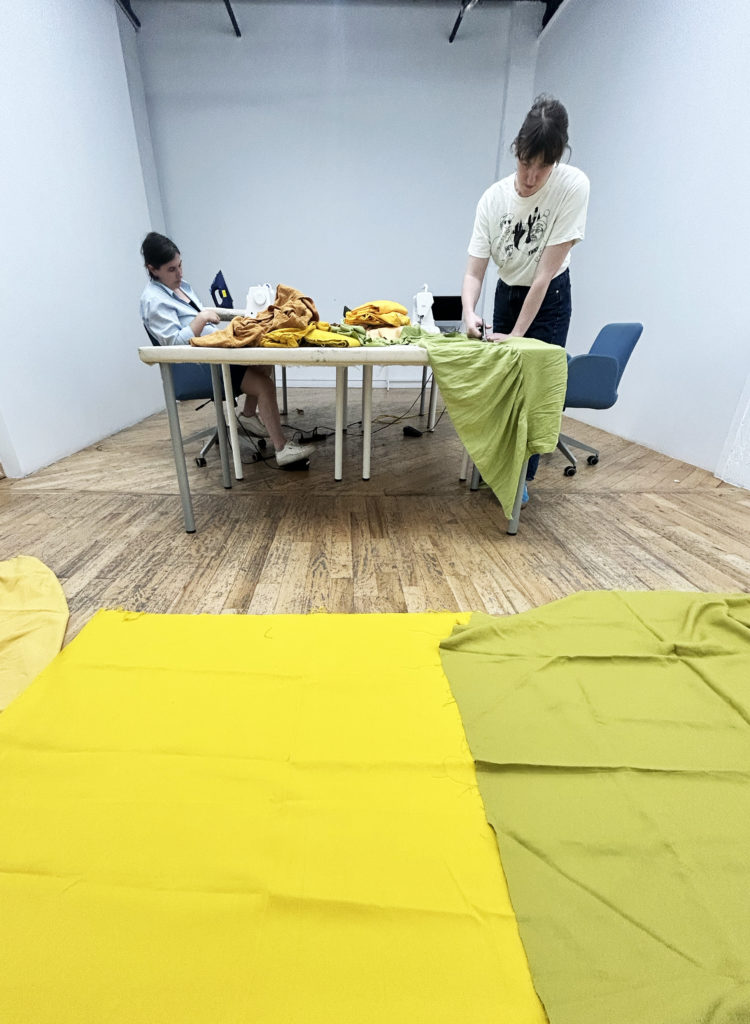
Katie: We try to use all found fabric, so we spent the day scavenging bed sheets, cotton button-up shirts, dresses, etc.
Cat: We've been looking a lot at color wheels, so that was kind of part of the genesis of the circular shape as well. We’re thinking a bit about color matching in terms of matching color to landscape, and responding with similar colors of earth, sun, ground, and sky. This event, being in part a response to the movement of the sun, we're thinking about bringing the yellows of the sun down to the ground through yellows. Also, we’re thinking about the analogous colors of yellow and green on the color wheel, potentially some brown and dusty purples that can cut through the yellows and greens to respond to the ground.
In terms of process, we’re both pretty meticulous. An Achilles Heel is that we care deeply about craft. We work slowly and carefully. We typically use a lot of time-intensive techniques from garment making, whether it's, like, a French seam or a flat felled seam, which doubles the time of making something.
Katie: Good craftsmanship to me is just a version of showing care. And we want that care to be represented in the visual language of the work. So, even though it's not a functional object, it feels like a beautiful robe or a pleated skirt. It has that same kind of material quality, even though it's not any kind of functional or quantifiable object in itself.
What other conversations do you hope this project will generate?
Katie: The title of our piece is Standing Sun | Standing Still, and that is a play on the Latin term solstice, which means “sol”—meaning sun—and “sistere,” to stand still, or stillness. I think it's so hard for us to have time to pause, and summer feels like the time for it—to be a little more lackadaisical. The heat can be an excuse to slow down. So, that's a big part of it, too—just having a moment for yourself, or a collective moment to individually rest, but also to rest collectively. That slowness is important to us.
Katie Coughlin:
Katie Coughlin received her MFA from The Ohio State University(2018) and her BFA from Alfred University(2010). Her work pulls from remembered observances; through a slow dive into material (primarily clay & cloth), old memories soften and fold into my self-defined rememberings. Harnessing traces of memory to expand and incorporate the human body, vessels are created alongside sculptural objects. Katie has been an Artist in Residence at Red Lodge Clay Center and Watershed Center for the Ceramic Arts. She has received multiple awards, including the Outstanding Student Achievement in Contemporary Sculpture Award from the International Sculpture Center, the Warren Mackenzie Advancement Award from Northern Clay Center, and a 2020 NYSCA/NYFA Artist Fellowship. A native New Yorker, Katie returned to the city in 2018 and lives and works in Brooklyn. She recently opened a neighborhood teaching studio - Ovington Pottery, in Southern Brooklyn.
Cat Mailloux:
Cat Mailloux is a fiber artist working across quilting, sculpture, and installation, based in Columbus, OH. She is an Associate Professor of Studio Art at Cedarville University and holds an MFA in Sculpture from Ohio State University. Her work has been exhibited nationally in galleries such as Women Made Gallery (Chicago), Skylab Gallery (Columbus), and the Museum of Herzegovina (Bosnia and Herzegovina). She has attended residencies at Vermont Studio Centers, PADA Studios in Portugal, and Walkaway House in Massachusetts. Mailloux is the recipient of grants from the Greater Columbus Arts Council, Cedarville University, and The Ohio State University.