

Geovanni Barrios, Artist Programs Intern at TAC, spent time with current AIR 17 resident Alessandro Levato:
G: So you have this exhibition?
A: It’s part of the Trans Art Fest at Coil & Cord. It’s a small multidisciplinary queer-owned space in Brooklyn. The show is cute.
G: What are you showing?
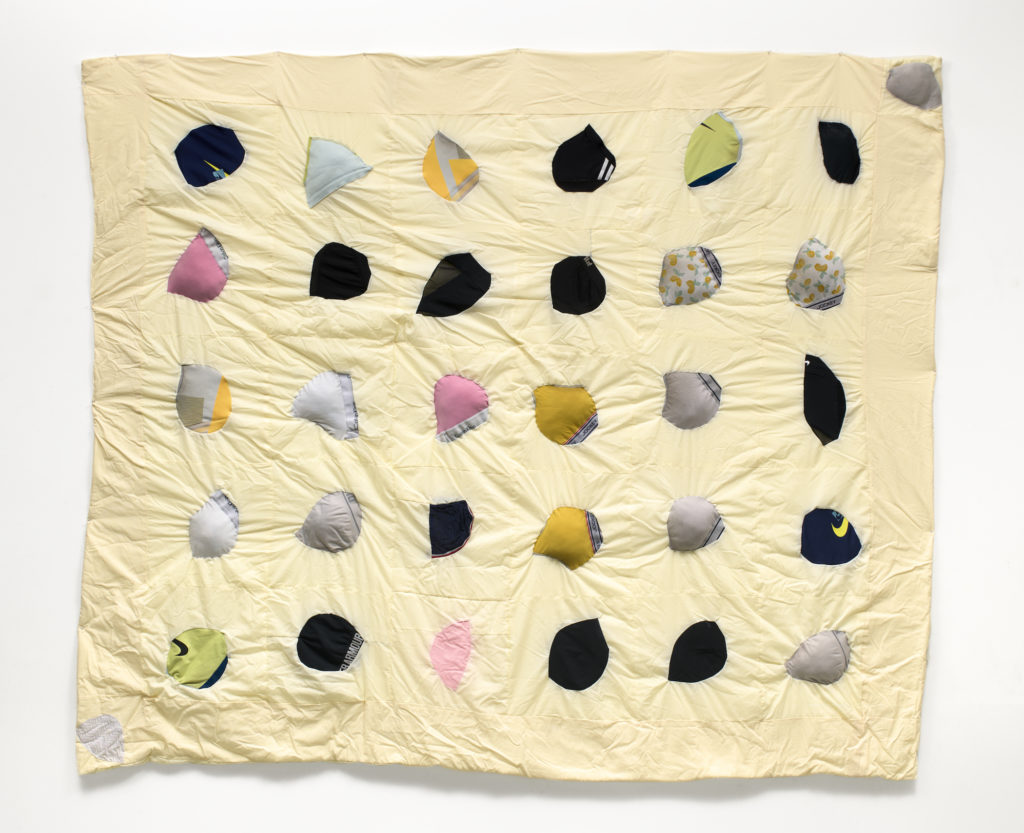
A: My ‘Boob Quilt.’
G: Is that its official name?
A: No, the title of the piece is Phantom Boobs > Singular, but it's literally a boob quilt. It’s all of my old bras with the straps cut off and separated into single boobs, shaped and sewn individually within a three part patch. Seams mimic the surgery cut lines on my chest, some boobs are stuffed others like the sports bras lay flat. I would say it's a pretty cool piece. It shows off a lot of wear and tear, deodorant stains and stretch. I was wearing some of them for 10 years.
G: Woah. When did you realize that you wanted to make a work using the things you had been wearing? Had you done projects before that used your clothing?
A: This was after top surgery so I just had them all lying around. I no longer had any use for them but I was so connected to them still. I couldn’t just get rid of them, I had my comfort ones, painful ones, lacy ones I was building and editing my collection for years. Similarly, I’ve always felt very connected in this way to quilts; there are comforting soft quilts, heavy warm quilts, summer quilts, sick quilts. Quilts, just as bras, have laid over me through all of my memories. We have history. So I thought maybe I can combine them to turn this mentally painful appendage holder into a covering of comfort.
G: By way of interpreting an object. And how does your printmaking practice come into play for the work you're making now?
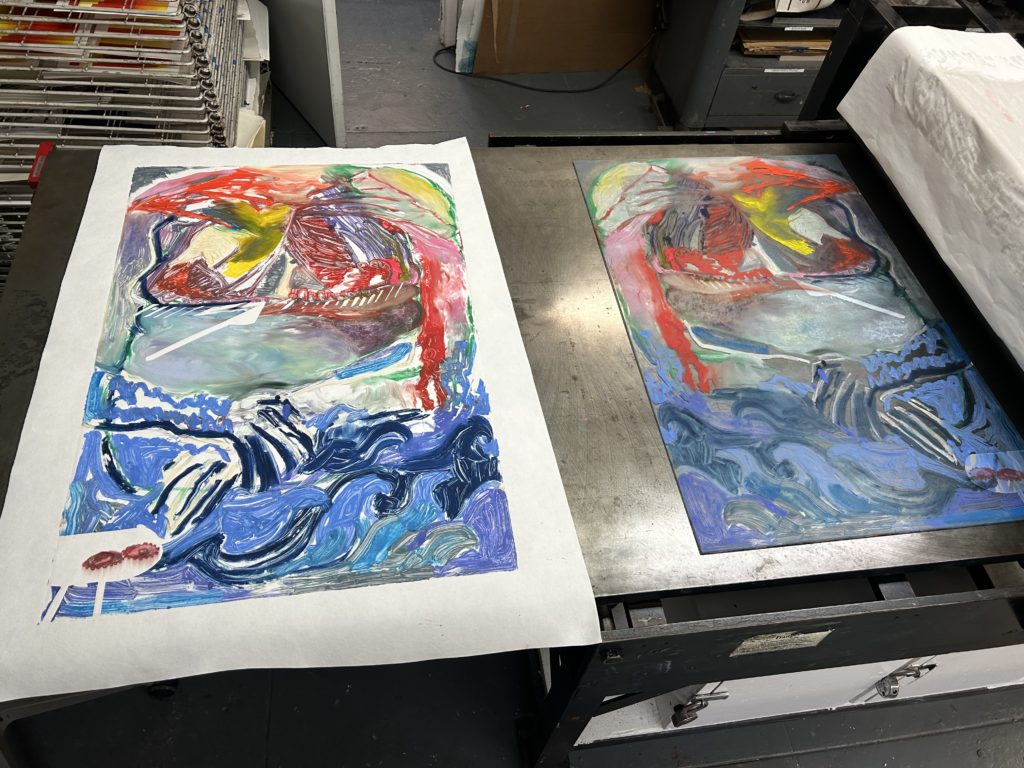
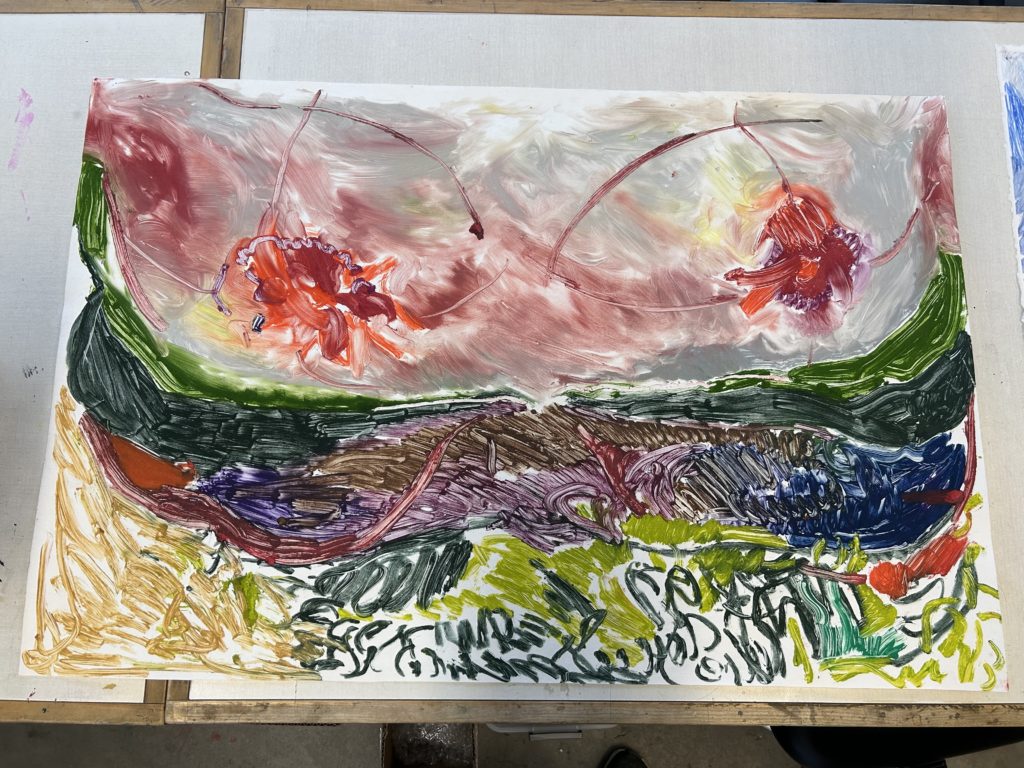
A: Basically, I studied painting all of my life and I didn’t really find printmaking until later on because I always thought it was only for precise people. But I totally fell into printmaking once I took a class during my MFA with a master printmaker, who runs Robert Blackburn Printmaking Workshop. From there I started working on monotypes nonstop. I used oil sticks so that it was as if I was still painting with oil paint, but just on a different surface. I’ve been immersed in printmaking ever since.
This boob quilt was a one off thing on a separate line of thinking, but now I want to explore how those lines intersect.
G: What's the time frame for when you start something and finish to completion?
A: It happens at the moment of my time with the [printmaking] press. I take an hour or two thinking and I just start working right on the surface of the plexiglass. Then, within three or four hours after printing a few images, I’ll hang it up to look at for a few months until I figure it out.
G: Figure what out?
A: Figure out the image. Why I made that image, what I was thinking in certain areas, why the image/s are in this specific order. What does that mean? Sometimes I can’t get it for a while, but I don’t push it. I have to give it time and then the answers come when I least expect it. Like random times I’ll wake up at 4am and be like, ‘That's what connects it!’. Or I’ll be walking out the door and it will pop into my head.
G: That process of transforming it into a quilt does not happen over a matter of hours. How long does that take?
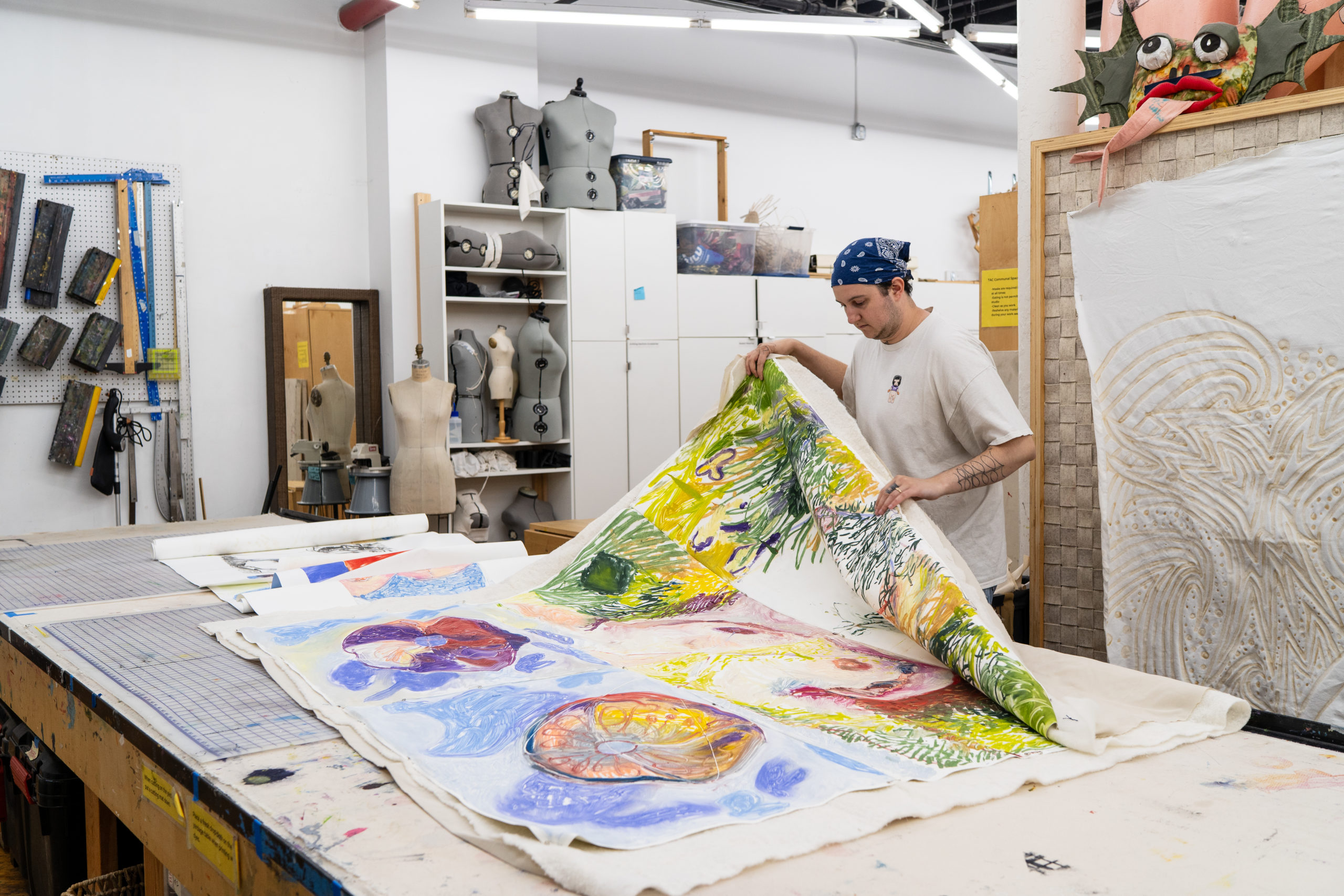
A: Sometimes I’ll put the print away for a while and then revisit it with a quilt intention. Maybe it will click in my head and I’ll just know what it needs. Quilts could be a weekend or it could be two years.
G: What parameters do you use to establish a project and how do you see it through? I like to plan and execute, what’s your style?
A: I plan out a bit in advance but things change while I’m working through it. I figure things out as it's being made and most of the time it has all of these given connections that I don’t see at first but make so much sense.
For some prints I deconstruct the plexiglass plate image using solvents and squeegees and mount it 3 inches in front of the piece to disturb the image the viewer sees. It not only distorts but creates multiple images wherever you view it. Multiple identities… and it leaves an in-between image - the phantom.
G: Could you describe the color field that you work within? And what materials you use?
A: I use mostly oil sticks because they are essentially large crayons and I can make a big box of color very quickly. I like to use pencil either on top of the print or the plexiglass to make really fine lines. Sometimes watercolor crayons on cutouts. I work primarily on Evolon AP paper, which is a sort of fabric-paper. It keeps the oil stick prints archival while still allowing me to print on a surface that is similar to paper but can be used like fabric.
I work with very vibrant colors, but in my eyes they are mute and simple colors. The color range depends on what hue and value mixture matches the feeling if I turn that feeling into an object. I know it sounds wild but in my head if I’m drawing a pole standing in the ground, I’m first thinking a) do I feel stuck in the ground, am I the pole? b) why am I only envisioning a pole in the ground? What’s at the top, what kind of pole is it? c) does the pole feel like it needs to break out of the ground? Things like this, then I’m thinking what temperature is the pole, cold metal. But then, what temperature is the pole if I’m grabbing it with all my strength and squeezing it to break it in half - fire engine red. That's how I choose color.
G: Are you making a print and reusing the image or is the monotype for you really a one and done thing?
A: Sometimes I can get a ghost [second] print, and sometimes the ghost is closer to my intention. I’ll pull multiple plates on the same large sheet of paper to create an image. I have to plan where the plates line up as I can only print one at a time because of technical concern. I pull a print move down and cover the paper where the image is put down. My next plate runs it through, since the press bed is only so big but I like to make large works. The pigment is still wet so it’s a dance of pressure and rolling and alignment.
G: How did developing this process influence your subject matter?
A: It's a lot like drawing game exquisite corpses, when you fold the paper in thirds and different people draw different sections of the body but the body still lines up as one mismatched body.
G: Because of the way you have to reset and reprint and rework.
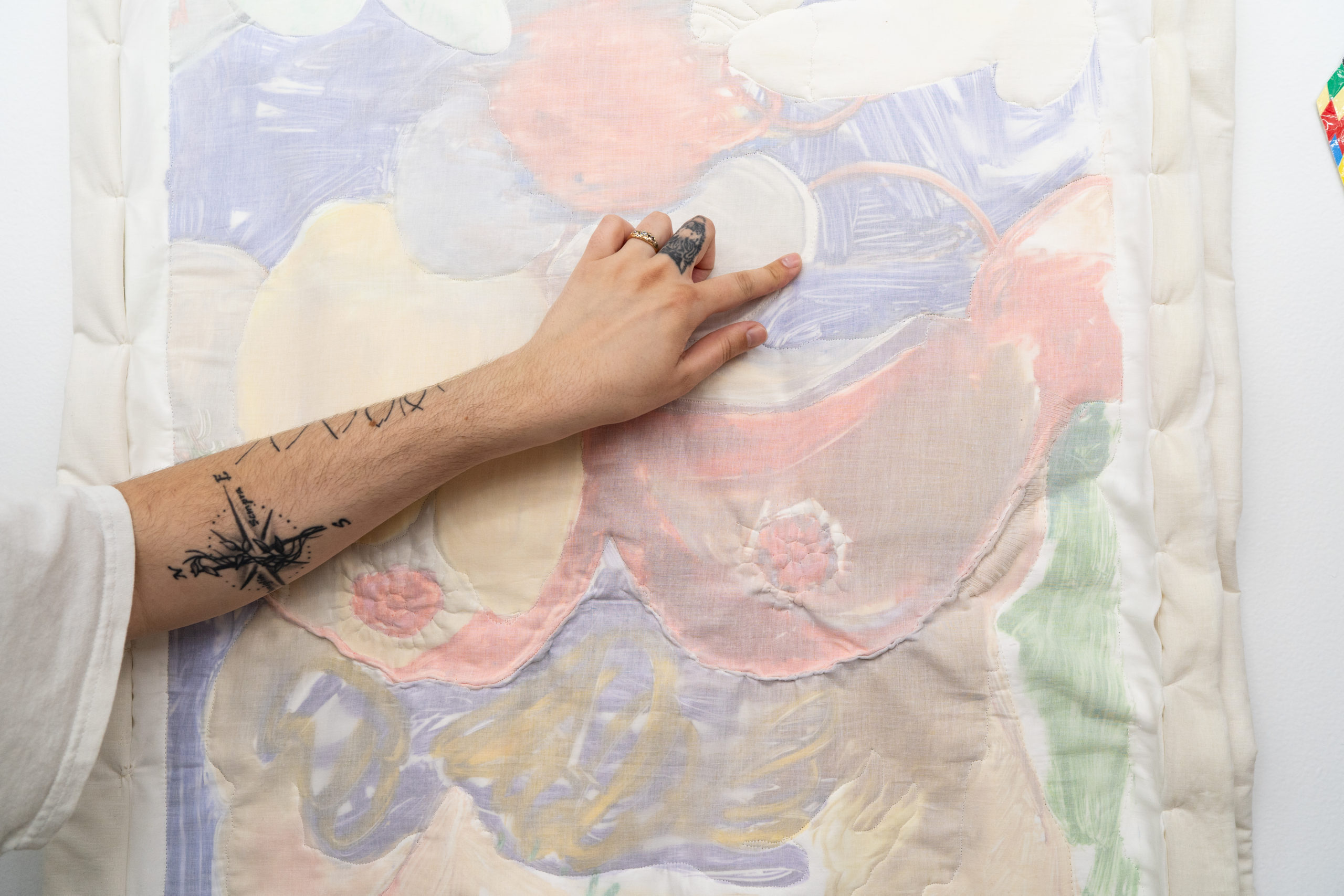
A: And separate. The subject matter is about my body. Through self-portraits but also fantasies of the body in imaginary places. There is a lot of greenery and landscapes, and meshing the body and landscape as one. Where the overgrowth comes up and takes over the body. Consuming it, but also repurposing it and regenerating it.
G: Hearing you talk about this element of the naturalistic body, is your use of vibrant and bright colors playing into that fantasy element?
A: The bright colors play into a bit of both. I’m taking the given “out of the tube” pigment colors and using them to create their own world or environment - transforming *cough* them beyond their given color into something new.
I have always made work about my body. When I focused mainly on painting I was working through religious environments that I experienced. I went to a Mennonite school for middle school and high school as a girl (this is very important to note), and the role of women was very well defined there. The exquisite corpse drawing shows three explicitly defined images combining with one another that our brains register as a new full ‘body’. It also really shows the division between my brain and my body—how they aren’t necessarily connected in prescribed ways.
G: Thinking about those religious triptychs and how they tell stories by panels across time, do you feel your work tells the story of your body across time?
A: There are so many iterations of feelings and images that can be created. It is just a matter of piecing them together over time instead of just one instant. Which is how my body operates.
G: What processes have you learned here at TAC that you’re employing in your practice more?
A: I am definitely turning towards quilts more and finding ways to bring together printmaking and quilts. I have executed soft sculptures, functional and non-functional quilts too. The tactile and soft nature of the materials have been very influential in the way I want to move forward.
G: What is ahead of you in terms of your work moving forward? What’s next?
A: I have some quilts that I am wrapping up in the next couple months. They combine my prints within the patchwork. I’m just going to stick to a steady incline of producing and enjoying making.
G: Is there a misconception about your work that you want to dispel? About the way you work or the work itself?
A: ‘The art world’ whatever that means passes right over the importance of trans artwork and the irony of an artist making multiple pieces literally called a ‘body of work’ and a person having multiple iterations in their existence. Those two combined and they still only see cis men. I guess this is more of a misconception that I want to enforce within myself.
I can choose when/if I want to conform to other people’s [the art worlds] sensibilities, for example, cloud pen15’s. Simple symbols that automatically influence people to see my work as landscapes. Little do they realise how much body dysmorphia is in that cloud. Trying to conform is my misconception to my work that I want to dispel from myself. People are just gonna think what they are gonna think. I like to focus my efforts on community and people who can actually see my work.
Alessandro Levato is a transgender interdisciplinary artist living and working in Brooklyn, NY. Their work explores their queer trans body through tactile, visual, and auditory forms, often incorporating materials like monotype paintings, audio and video documentation, cyanotypes, quilts and parachutes. Growing up in Lancaster, Pennsylvania, they witnessed rigid gender binaries within the Amish community, and now use large-scale, process-driven and material-influenced work to document real and phantom embodiment. They have received the Elizabeth Greenshields Foundation Grant (2019) and The Elizabeth Foundation for the Arts, Robert Blackburn Printmaking Award (2022). Their work has been shown in group shows at Equity Gallery (2022) and Trotter & Sholer Gallery (2023). Alessandro attended Mudhouse Residency (2024) and The Penland School of Craft Winter Residency for printmaking (2025).
About the AIR program:
TAC AIR combines studio access with a rigorous interdisciplinary curriculum, and regular critical dialogue, providing residents an opportunity to learn and explore the textile medium, and an alternative to traditional higher education programs. The residency culminates in a group exhibition produced and hosted by TAC. Since 2010, TAC AIR has graduated over 100 artists and designers whose work continues to further textile art within the fashion, fine arts, design and art education fields.
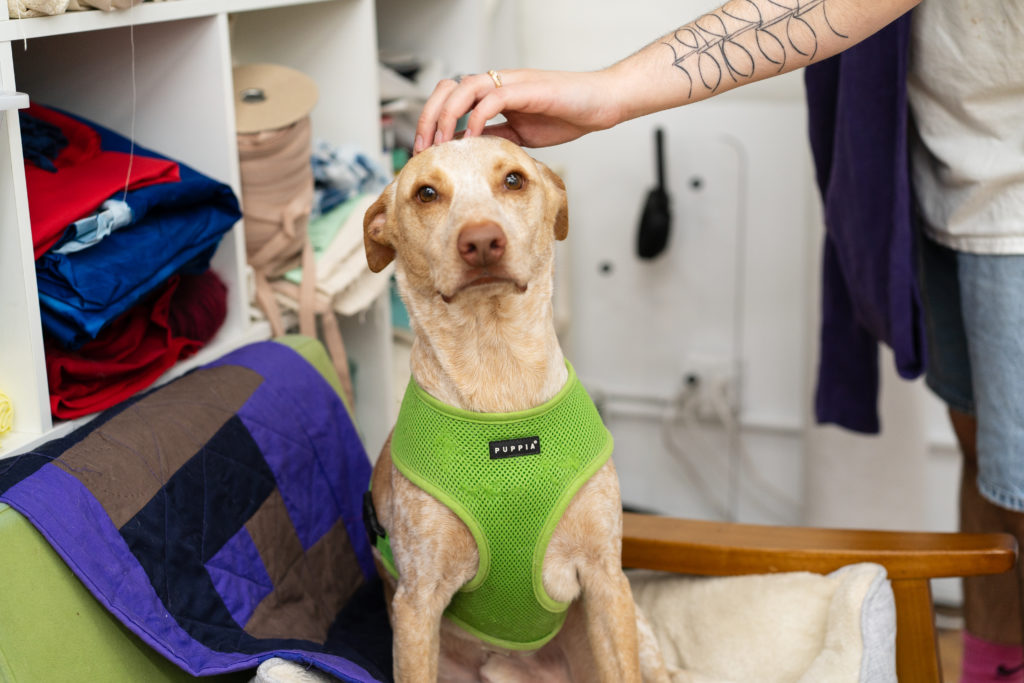
Cover image credit: Alessandro at their AIR studio with Lucci. Photo by Geovanni Barrios.