

Geovanni Barrios, Artist Programs Intern at TAC, spent time with current AIR 17 resident Diana Eusebio:
G: You wanted to show me something you’re working on?
D: Yeah, I'm working on these two large pieces over here.
G: Are these from when you were in Miami?
D: Yeah, I worked on them for my last two days there. Right before coming back [to New York]. I'm preparing for a show in Peru. I'm showing with mueve galería at the Pinta art fair in Lima, Peru, which they run every year. I am leaving soon.
G: To Peru?!
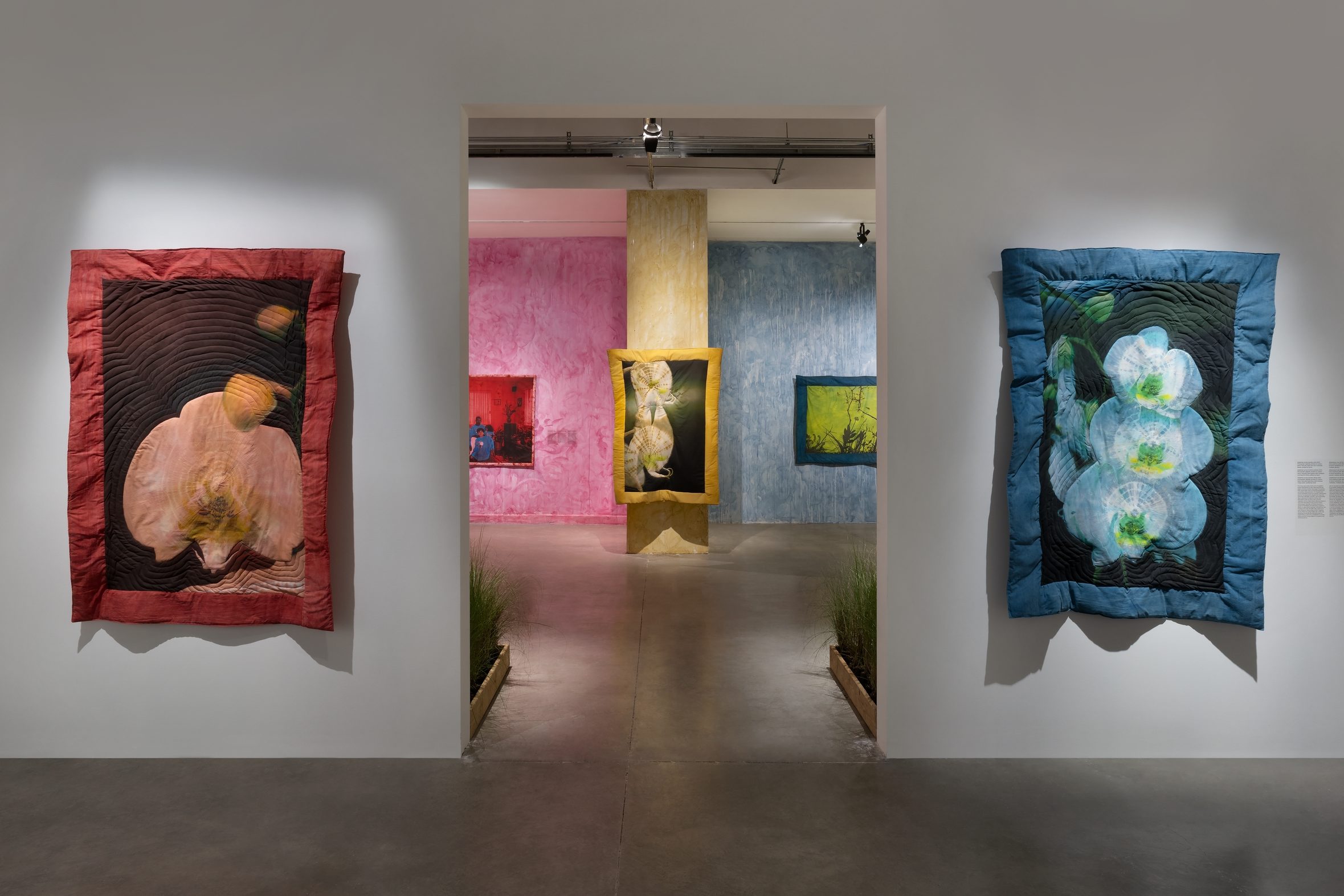
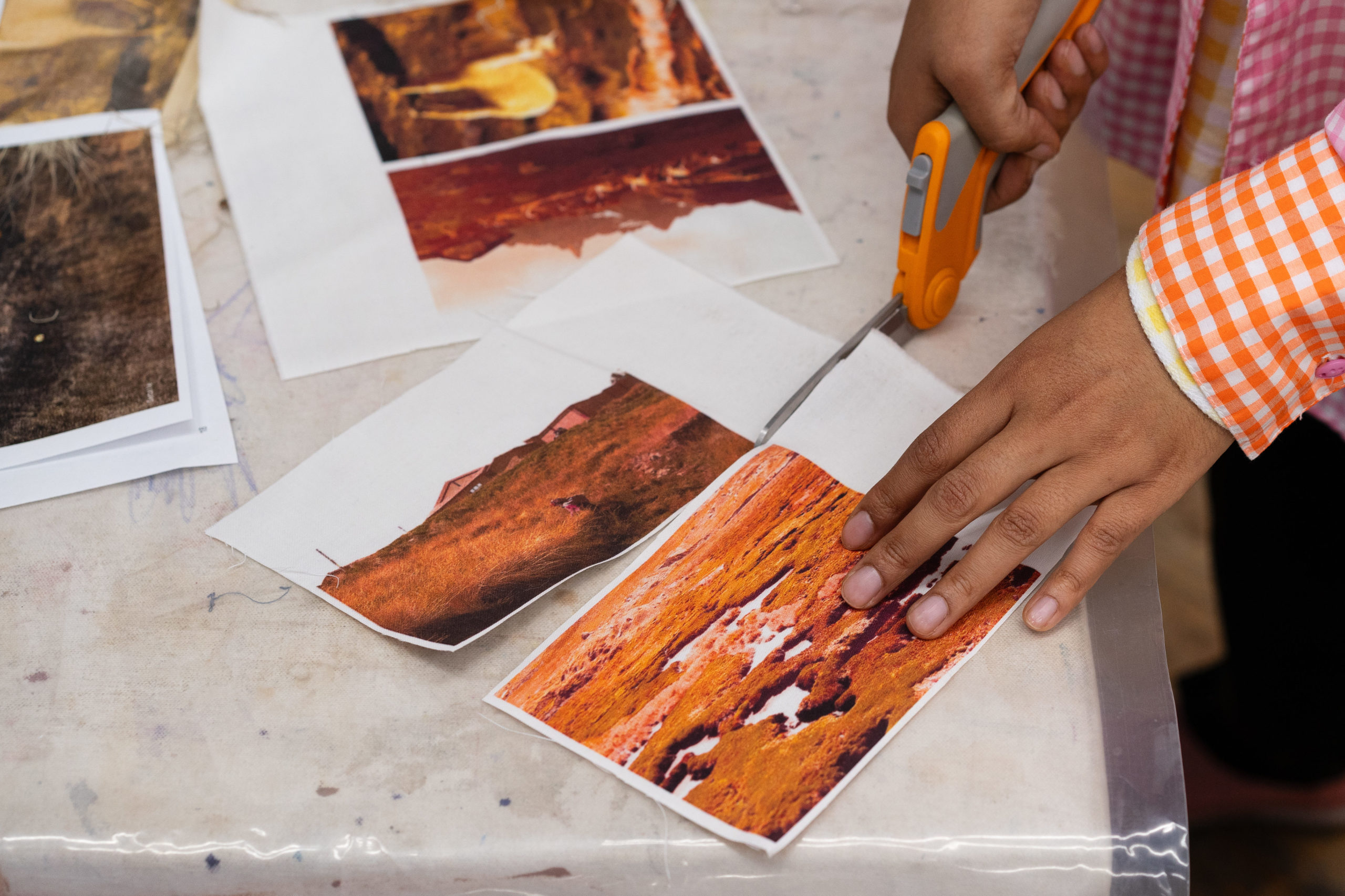
D: Yeah. I have a lot of work from the museum that just came down, but I'm gonna show some more. I wanted to make new stuff with the images of Peru that I took a long time ago. This is a photo I took in 2022. I was hiking for four days in the mountains near Cusco. And I took a photo of this indigenous woman who was walking through the mountainside. I liked the tall grass and her being mixed in there.
I dyed it with cochinilla, which is from Peru, and then indigo, in an ombré way. I just finished quilting it last night. This [other piece is] actually an image I created with AI of what the indigenous people would be like in Key Biscayne. I realized from looking through the Key Biscayne library archives, that there are no depictions of indigenous people in Key Biscayne that are peaceful. There was a lot of fighting for land at that time, so there are paintings of indigenous people attacking the lighthouse and trying to take their land.
G: That’s what I was talking about earlier about the images that Spaniards insisted were faithful depictions of what native peoples here were like. These publications, these paintings, these drawings would all go back to—ostensibly Spain—and they would circulate among courts and the Conquistadors would be like, “Look what the savage native is doing. They’re just fighting.”
D: They were presenting a case to whoever grants them power?
G: Yeah. Requerimiento was the sort of Spanish ‘Manifest Destiny’ and was the legal pretext for a lot of violence. It was Spanish depictions of the “violent” native that was used as evidence of native barbarism. With that, the Spanish insisted they needed to instill God on native people.
How do you feel about having a real picture of a native person and having an image that is imagined by an algorithm? It is trying to conjure up some reality based off of images that can be falsities—drawings that were sent to the Spanish court—anything that was made up to justify violence.
D: Yeah, because the photo is based solely from inputting a prompt, I had to write it many ways, many times, and clarify details to avoid certain things. It's important to do that because [we] start to have agency on how we're depicted. Otherwise it's just defaulting to those databases and the information that's out there in history.
G: How do you go about narrowing down from the pictures that you collect?
D: Sometimes I have an idea in mind and I go and I try to take photos in a general theme. But for this, at least for the photo I took in Peru, I just found a lot of beauty in the moments I was experiencing and I wanted to document it.
I was hiking for four days and it was so serene. All I could do was talk to my family and take photos on a small digital camera, like an insignificant point-and-shoot. It's just really cute and whimsical taking photos for fun. That's how I go about my work. I find a moment when I feel peaceful and calm.
I can take a photo and then years pass before I return to it. Now that I'm doing this show in Peru, I was reminded of these hiking photos. [This] photo of the alpaca was another cute moment. [This other photo] is a sign from this restaurant called Norkys—like the McDonald's of Peru—but it’s like pollo a la brasa. I remember being in the restaurant in Lima, and going to the restroom to wash my hands before eating. So I passed by this little area of decorative plants, and it was like, “Cuidamos las plantas - Norkys.” (We care for plants - Norkys). I thought that was hilarious. But it also shows how much more care is ingrained in the culture compared to here. You would never find that here.
G: People have such a different relationship to nature in North America compared to people in Central and South America, and the Caribbean. Do you think of the passage of time in reference to your relationship to nature? What do you think about the way your process is shifting to seasonal time with growing the natural dyestuff you work with?
D: Yeah, that's real. I’m not at a point where I can reflect on it yet, because this is, in a way, my first growing season. I think it happens after I'm out of an environment. So far, I've gathered that I feel a little bit less inspired because of the lack of access to nature [in New York]. That's why traveling has been so big for me. I feel more aware of how important location is to my work.
G: When we were both in Miami—we went down during the peak of the snowstorms up in the Northeast. We talked about tropical euphoria. I just felt instantly better there. I struggle to make work about the natural world here in New York. In a way that I don't experience when I'm in Miami. When I was in Miami, I kept feeling like I wanted to make something. I want to draw the world that I'm in.
D: It’s the same way when I was in Peru, walking through the mountains. I was finding beauty everywhere in these day-to-day moments. It inspires you. You don't need to seek it out. When I lived in Maryland for undergrad I felt the same way, from a tropical place like Miami to the Northeast. This experience reminds me a lot of that. There is a disconnect that bothers me. People in the Northeast are disconnected from the plants and dyestuff that they're using—it's not anybody's fault.
G: Yeah, it's just an infrastructure problem.
D: Right. Just the way that life works here. And so, it makes me value that close connection I have in Miami. It also inspires me to tell my story in whatever way I can. Like—have you seen this plant—the achiote growing from a seed to like a tree. I remember seeing that as a young girl and being amazed.
G: Well I think about that little girl that came up to us at your exhibition. She ran up to you all excited about how she recognized the achiote from her family’s kitchen. You led her through a process of working the dye color from the achiote itself. It demonstrated the educational side of your process and the culture that you've built around sharing this information with others. Where does that spirit of sharing come from?
D: My first answer is always my mom. Shout out to my mom. She was a teacher. The way she taught me, I feel I mimic that in a way. And she loves plants, so she was always trying to make it a part of my growing up. She tells me stories about when I was a little girl and we would be in the garden. One time I was like, “I helped the plant, Mom. I helped the flower bloom.” And she went outside, and saw that I had opened the blossom prior to it being ready. And then she taught me, carefully and nicely. “It takes its own time.” She's always taught me about plants, and then my dad, too, because he studied agricultural engineering, and that's their thing. They bonded in the garden.
They taught me a lot of stuff and I still go to them now. They are always teaching me and it creates a sense of wonder for the world. I like to pass that on to other people because it's so fun. There's so much joy in learning about what's around you.
But then second, what I think drives me is like that same experience I'm describing in Maryland about culture and connection to how the dye plant grows. It inspires me to make stuff so that I can talk to people and share in that way. Because if not, we're just using the plant. It's a means to an end. You just want red? Okay, boom. Here's red. That's not what it's about.
G: In that way, do you think of your process as participatory? Participatory in that it is interactive and your textiles become activated by people participating in either its production or in your community. You are bringing people in to experience the process, constantly. It's really admirable.
D: Well thank you. It gives me a sense of pride. It's really beautiful. It just came naturally, though. We were even talking about it today with the workshop [for the TAC artist-in-residence]. The first question we answered was “How do people misinterpret your work?” And people are always like, “What do you mean like you make color from plants and insects?” That’s the number one question I get, and I would explain it to people by just talking to them and showing them. So I started doing workshops because that's what everybody kept asking me for. Especially in Miami, it feels like there is a need for it. There are people from all over the Caribbean, Latin America, and they all have ties to this tradition, but there is no place for it.
G: Thinking back to your photography and how you incorporate it into your textiles. Have you documented your time in New York through pictures in the same way as you have your time in Peru?
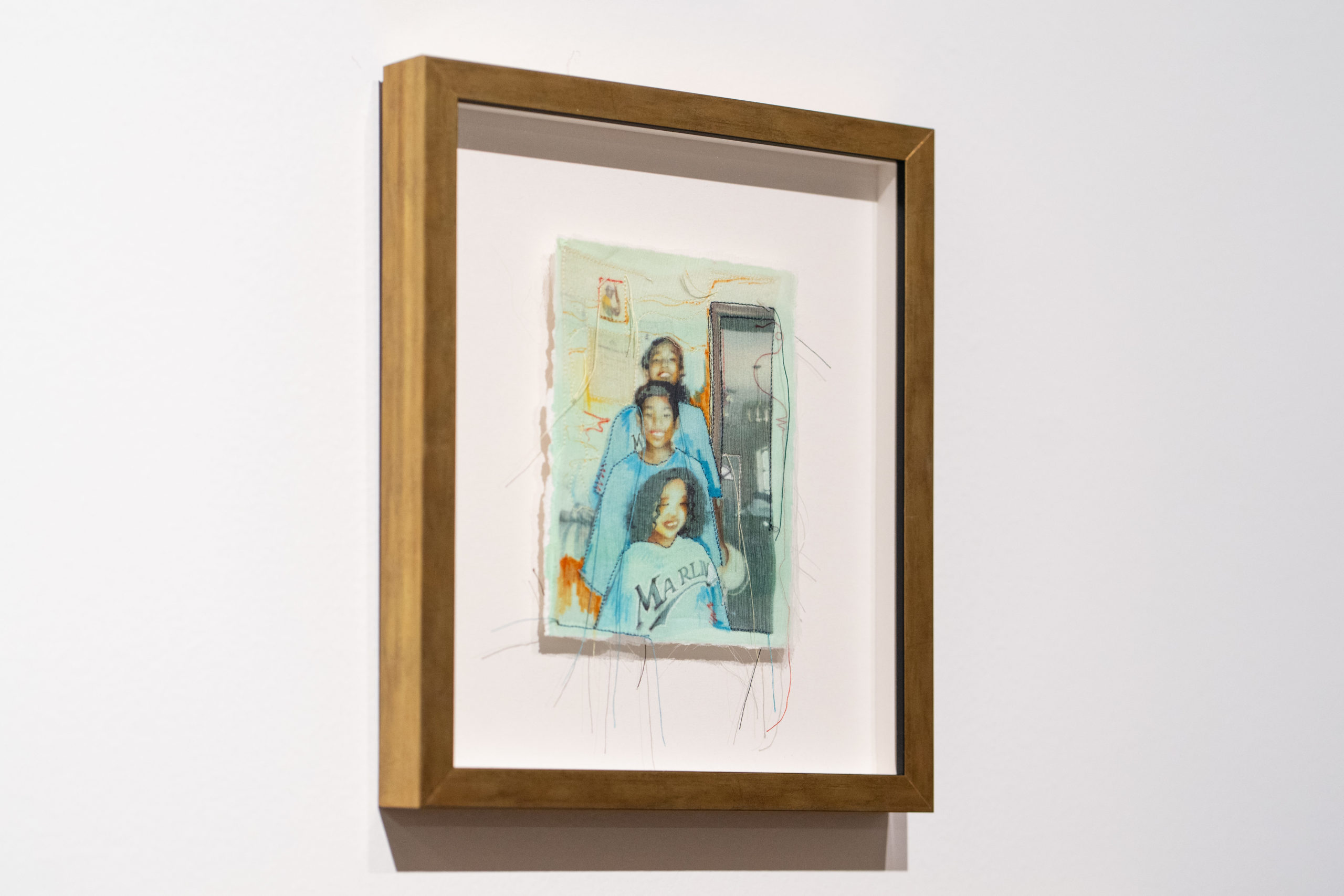
D: These are only some of the photos that I'm showing you, but then some other works—this is a photo of me that someone else took. I don't even have to take the photo. There are some family photos I've made pieces of.
Or referencing historical images. I have the image of the indigenous person scraping cochinilla off of the cacti. I've printed that on textile and dyed it with cochinilla. I have pieces from the past that are images of the first black family in Key Biscayne and things like that. I'm more interested in imagery that tells a story about the people in the places that I associate with home and trying to find my connection to it. Sort of building confidence around my family's history and storytelling because I think it is so varied from Peru to the Dominican Republic. They're just such different places. I'm the first generation to grow up in Miami so there's just so much to work through.
G: And the first generation to venture from Miami and go to new places. There's a lot of people that can relate to that, myself included.
D: That’s my ideal audience. There are a lot of people who have that same connection to place and are drawn in different directions. So for me, it's about finding a through line through imagery.
Diana Eusebio is a Peruvian-Dominican multidisciplinary artist based in Miami. Her artistic practice is centered on color and its cultural significance. She researches natural dyed textiles from Indigenous Latin American and Afro-Caribbean traditions, recognizing their connection to nature and their role as carriers of ancestral wisdom. Eusebio's fusion of ancestral and modern techniques, including dyeing and photography, contributes to contemporary cultural preservation and celebrates the rich heritage and Pre-Columbian knowledge embedded within these communities. Her work is a powerful testament to the enduring cultural tapestry of these regions.
Eusebio holds a BFA in Fiber from the Maryland Institute College of Art. She has presented her work at the MoMa, Hall of Nations, Gregg Museum of Art and Design, and Rubell Museum. Studio residencies include Textile Art Center, NY, NY; Anderson Ranch Arts Center, Aspen, CO; Oolite Arts, Miami; AIRIE Fellowship, Everglades National Park; INDEX MECA Art Fair, Dominican Republic; Deering Estate Studio Residency, Miami. Notable awards include the Obama administration’s U.S. Presidential Scholar in the Arts–the highest national honor for a young artist-and the National YoungArts Jorge M. Perez Award.
About the AIR program:
TAC AIR combines studio access with a rigorous interdisciplinary curriculum, and regular critical dialogue, providing residents an opportunity to learn and explore the textile medium, and an alternative to traditional higher education programs. The residency culminates in a group exhibition produced and hosted by TAC. Since 2010, TAC AIR has graduated over 100 artists and designers whose work continues to further textile art within the fashion, fine arts, design and art education fields.
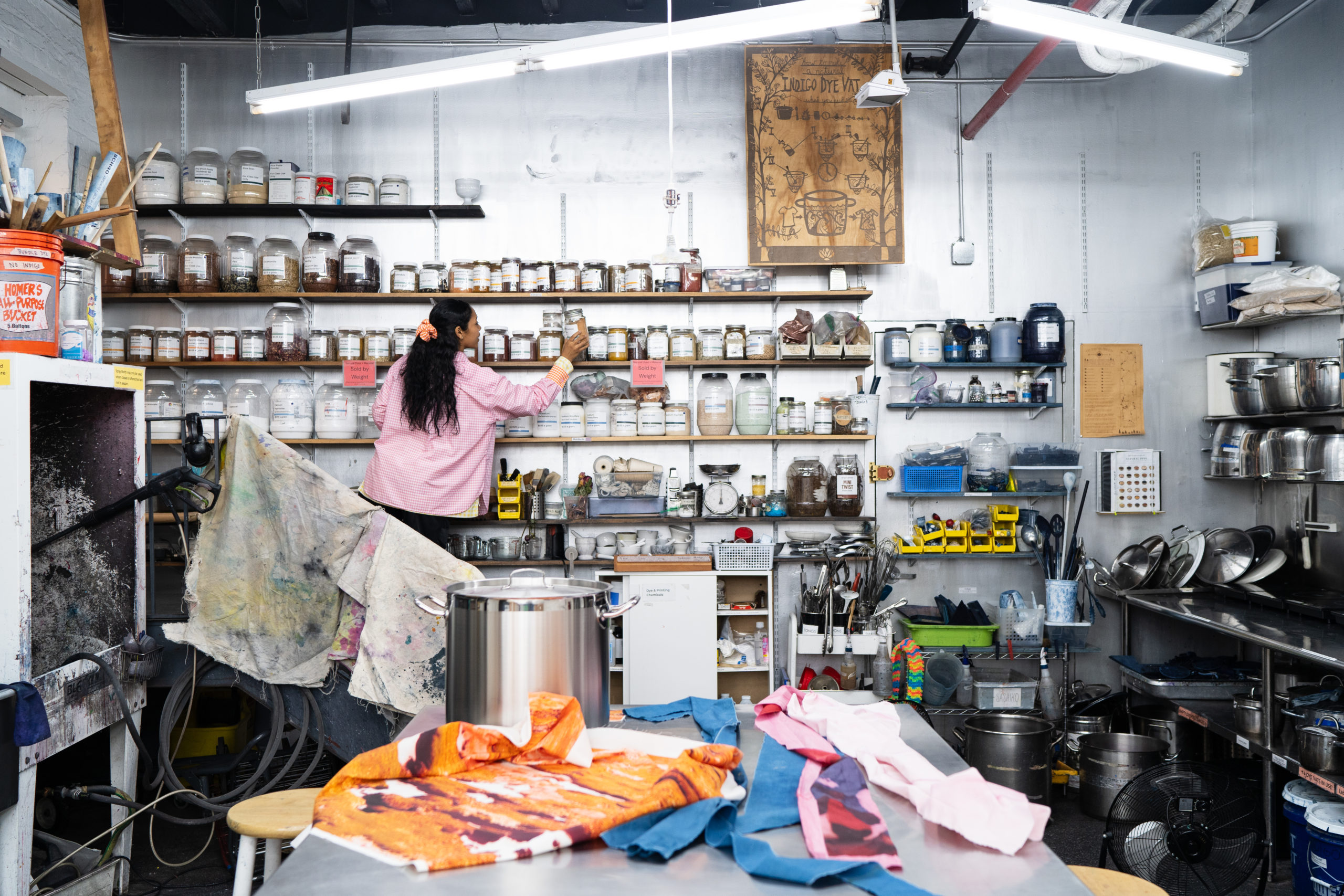
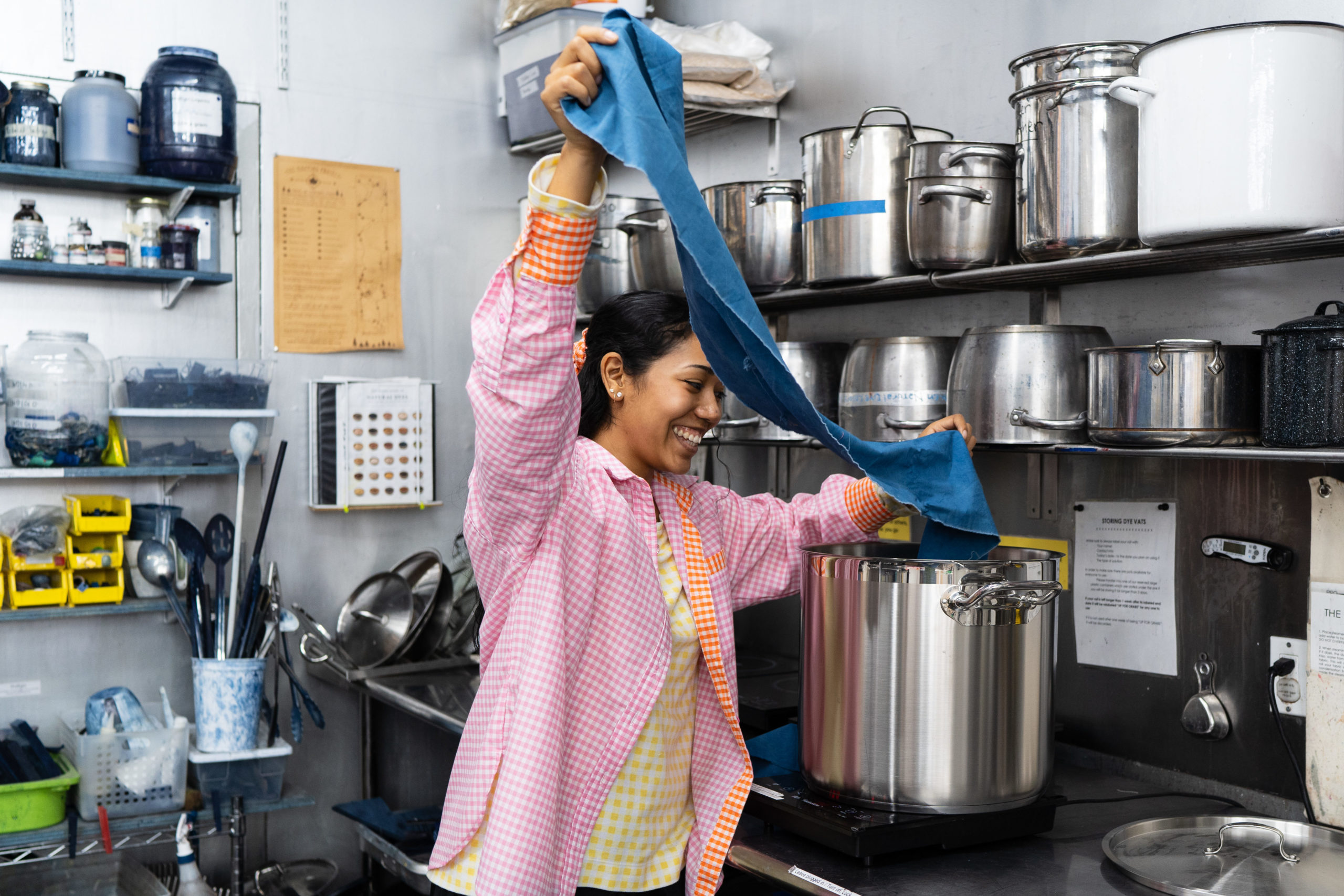
Cover image credit: Diana in her studio ombré-dyeing a sample into indigo at the Textile Arts Center, Brooklyn, NY. Photo by Geovanni Barrios.