

Romina Schulz, Artist Programs Director at TAC, spent time with AIR 17 resident Vic Liu before their AIR's final show:
R: Vic, I know you're a writer and a painter. Can you tell me what got you interested in textiles?
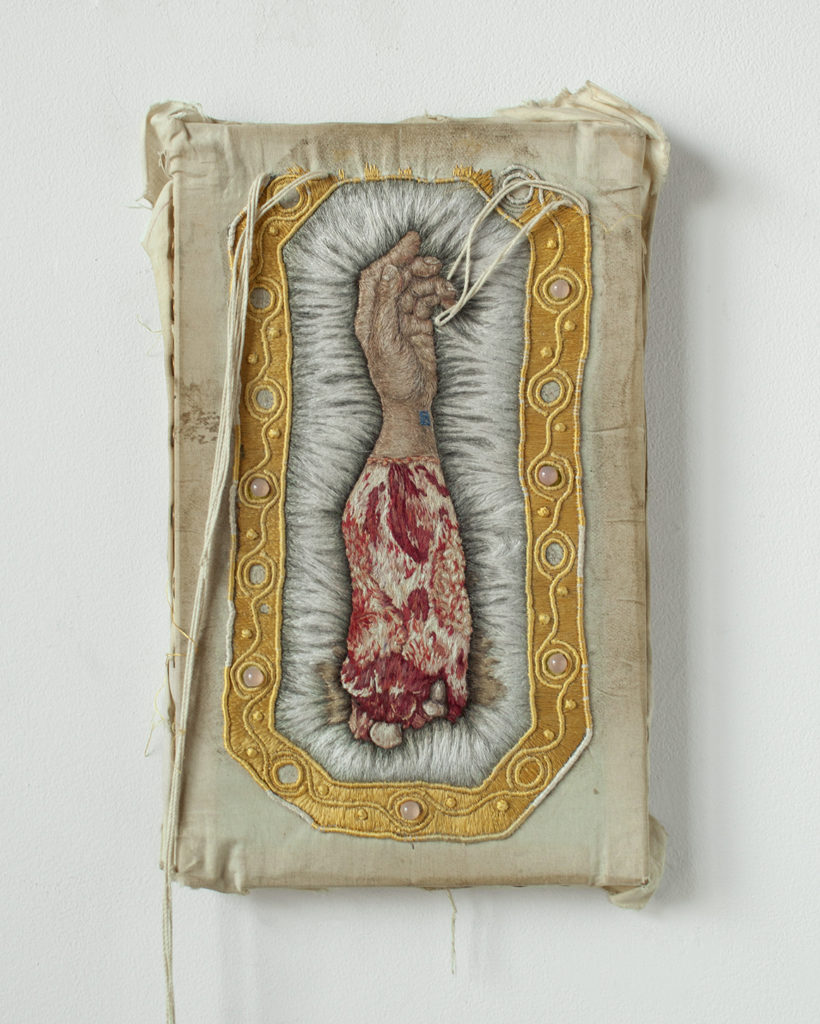
V: I've been working with textiles my entire life and I hadn't really realized how it's often demeaned as a craft rather than an art practice. I feel like I only started really exploring it as an art practice when I started embroidering and doing thread painting. But it's always been something that has been part of how I interact with the world and how I make things. So when I first started embroidering, I don't know if I necessarily knew that I was embarking on an art practice so much as it was something that I just was really curious about exploring. And then as things got more and more complex, it became more clear that it was part of the way that I make art.
R: What was your first embroidery project?
V: Probably earlier than I can remember. I think that I've been embroidering probably my entire life. I just don't really remember what I was embroidering at the time.
I remember so much of making as a kid is not quite being able to make what you envision. And part of what's so exciting about being an adult after years of practice is suddenly it becomes almost predictable. Not quite 100% predictable, but you can predict to some extent how to make something or how it will look once you try to make it.
R: I wonder, because you are an interdisciplinary artist, how do you address each of the disciplines you work with? Is your process equally when you are starting a project, being in writing, or in textiles?
V: I envision the project more than I envision the materials. Many of my projects begin when I experience a call to make something, often with the materials already in mind. It's nearly impossible for me to switch materials to make the same exact project, even though there are themes that go across my disciplines.
R: And how does that start? How is your process from a concept, an idea, and you knowing, okay, this needs to be a project?
V: Honestly, I feel like a lot of it comes from unconscious fermentation. I go through my life collecting a lot of information about the world. And then maybe years down the road, an idea for a project will come to my mind. And sometimes when it comes up, I don't even know exactly what it is responding to. But through the process of making, I start to understand what I am referencing.
R: Which projects are close to your heart right now?
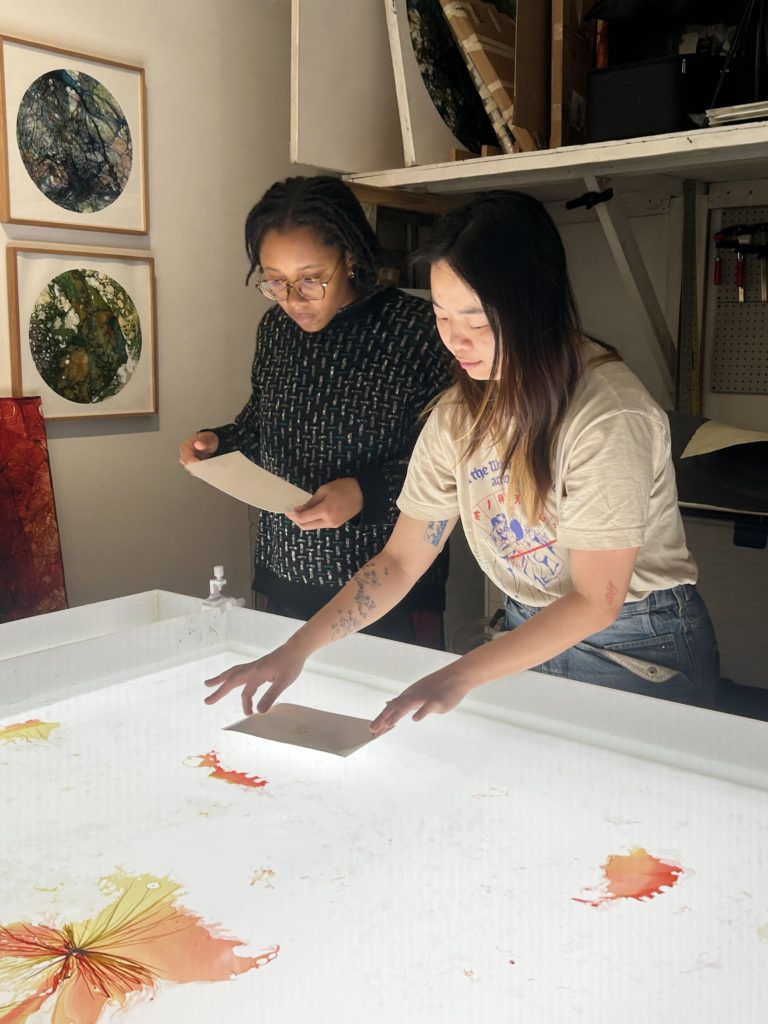
V: Well, I've been spending a lot of time embroidering this piece for the upcoming show, right? So that's probably the one that's most top of mind. I think that is because, like my previous piece, so much of it has to do with the time intensive work of embroidery–-it is a labor of dedication.
R: Because this piece is really time consuming, which most of your work is, and considering that this particular project is a critique on objects that evidence wealth, can you talk about your conceptual approach to textiles and the concept behind this current project?
V: Textiles traverse class. Textiles tell our stories in very tangible ways. They can be utilitarian, they can be decorative, but no matter what, they'll tell you a lot about the people who made it, the culture that it's made in, the resources available, and what each culture prioritizes or values. What I’ve noticed in traditions of heirloom textiles is mostly in how luxury is expressed through the intense amount of labor that is put into it, whether that is through gathering the materials, like for the silk embroidery, farming the silk, or dying silk, or making the gold wrapped wires, or the act of embroidering itself. It just takes so much time.
And so when I think about textiles, especially labor intensive textiles, the question that comes to mind is why are some people deserving of this much time and labor and care and others not? My project honors and celebrates the dignity and power of the working class by applying something that is associated with nobility, the rank badge, a piece of luxurious embroidery that indicated the rank of different nobility in the Qing Dynasty, to the classic plastic kitchen stool, something that is emblematic of the working class and can be found in kitchens across most of Chinese American and other cultures. The legitimacy and power of the rank badge is historically guarded by the inaccessibility of the materials and the labor required to make it. And so by reappropriating my labor to almost counterfeit this, I am able to redirect that power towards honoring the dignity of the everyday struggle to survive in this world, no matter how much money you have.
R: And I know this is not the only piece that you will be showing at AIR’s final exhibition. Could you speak on the second piece that you'll be showing?
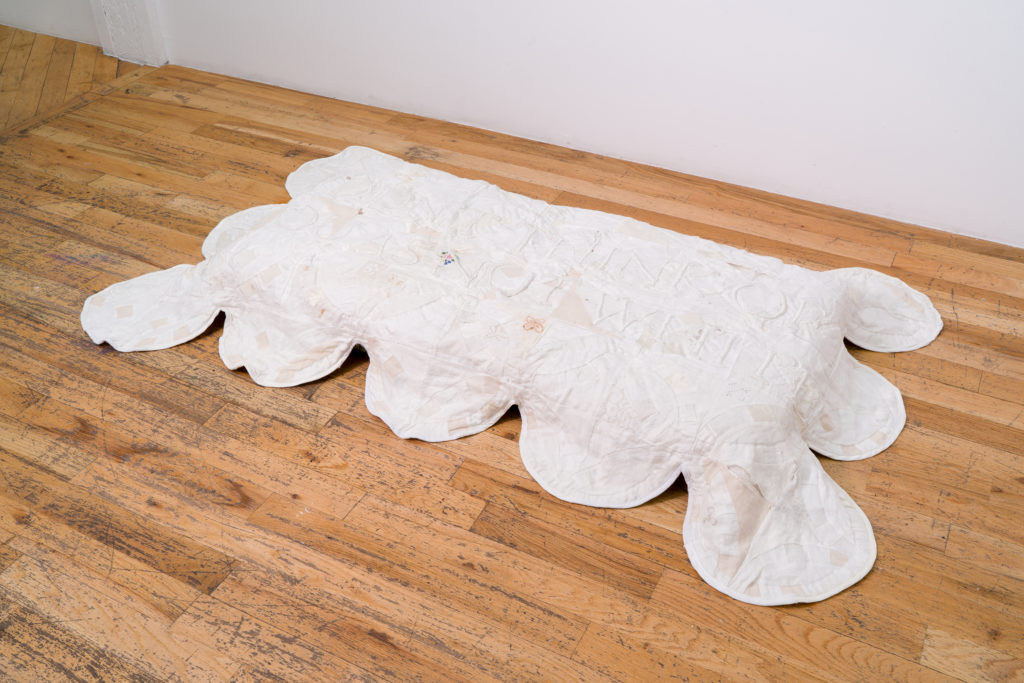
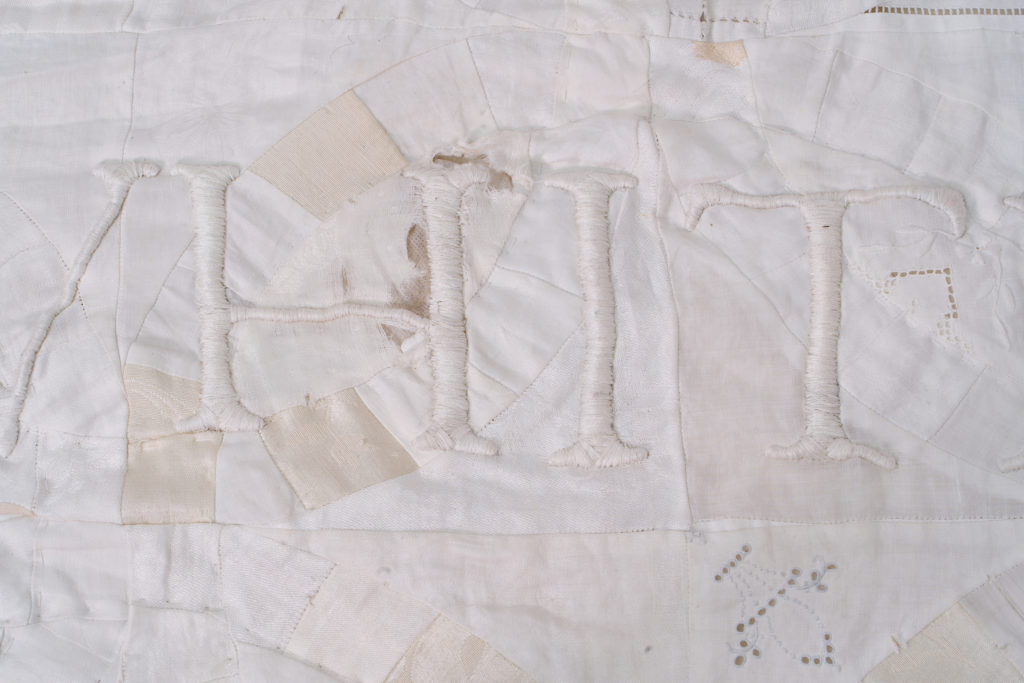
V: My other piece, titled “Table Scraps”, speaks on themes of cross-class marriage, race, and purity. Its aesthetic is far more rooted in Americana, using a double wedding ring quilt pattern. The fabric used in this piece is pieced together from vintage table napkins that I sourced from across America. On it is monogrammed and hand embroidered the words “I do not think of you as not white”, which speaks to not only the whiteness of the table napkins and the class associated with having white linens, but also race and class in America.
R: I’ve been wondering if you think your different practices intersect with each other, being a writer, a painter, a textile artist. But I do see it, and correct me if I'm wrong, in having also like a written sentence in this piece and how much you have had your paintings present in your studio during the residency. I'm imagining it does consistently intersect for you?
V: I think that all of my mediums or disciplines are the physical way that I try to bring my stories into the world and communicate them. In the end, because they all grapple with similar themes and communicate similar stories, they all feed each other because I'm constantly exploring these big questions through the making of each piece of work.
R: And thinking of your studio during the residency and your time at TAC, what part of the program did it felt that it influenced your practice more?
V: My favorite thing about working at TAC is having other people working around you. I feel that making art is something that can become quite solitary and on the flip side, so much of the textile tradition involves teams of people. The history and practice of textiles, especially in the domestic, is indivisible from the social aspect of the making, as exemplified by embroidery circles, knitting circles or tatreez circles. And so, I really appreciate that open studio hours harkens back to that practice. Textiles are inherently a social material–they are the materials we as a society make and design to shape how we present ourselves to others.
R: So true. I love that. Having that in mind, what are you looking for? What comes next for you?
V: The world is, as we all know, a very intense and hard place right now. So I am hoping to continue to work through some of the bigger questions that we face as a society through my work, in hopes of creating bridges for conversation and empathy and understanding. I feel that has been true and will continue to be true for me.
I really hope that I continue to learn new things and even more disciplines, because what really drives and inspires my work is the wonder that I experience when I get to learn. It can be so easy to fall into comfort zones as you start to get good at something, but I don’t want to stop exploring.
R: Wise words, Vic. I try to remind myself that it's okay to be uncomfortable as we learn new things.
V: And to make bad things, and imperfect things!
R: So true. Is there anything you would like to add to this conversation?
V: I am curious to see how the field of textile arts progresses as time passes. I feel like everyone keeps on alluding to a moment that it's having right now, as if it is newly trending, even though part of me believes that textiles have always been here. It makes me wonder what this renewed attention will bring, if it will perhaps change how people see the textiles around them, or will lead to new explorations. I'm curious to see what this moment brings for us.
vic liu writes, rants, schemes, paints sometimes, cooks often, embroiders, knits, and is learning cloisonné enamel (and blacksmithing and woodcrafting). They are currently working on a novel where losers lose but also love.
She lives in Brooklyn, NY with a very large dog and sometimes a small cat. They have all tried anxiety medication.
Their books include Bang! Masturbation for All Abilities and Genders 2nd edition (Microcosm Publishing, 2023) and The Warehouse: A Visual Primer on Mass Incarceration (PM Press, 2024).
About the AIR program:
TAC AIR combines studio access with a rigorous interdisciplinary curriculum, and regular critical dialogue, providing residents an opportunity to learn and explore the textile medium, and an alternative to traditional higher education programs. The residency culminates in a group exhibition produced and hosted by TAC. Since 2010, TAC AIR has graduated over 100 artists and designers whose work continues to further textile art within the fashion, fine arts, design and art education fields.
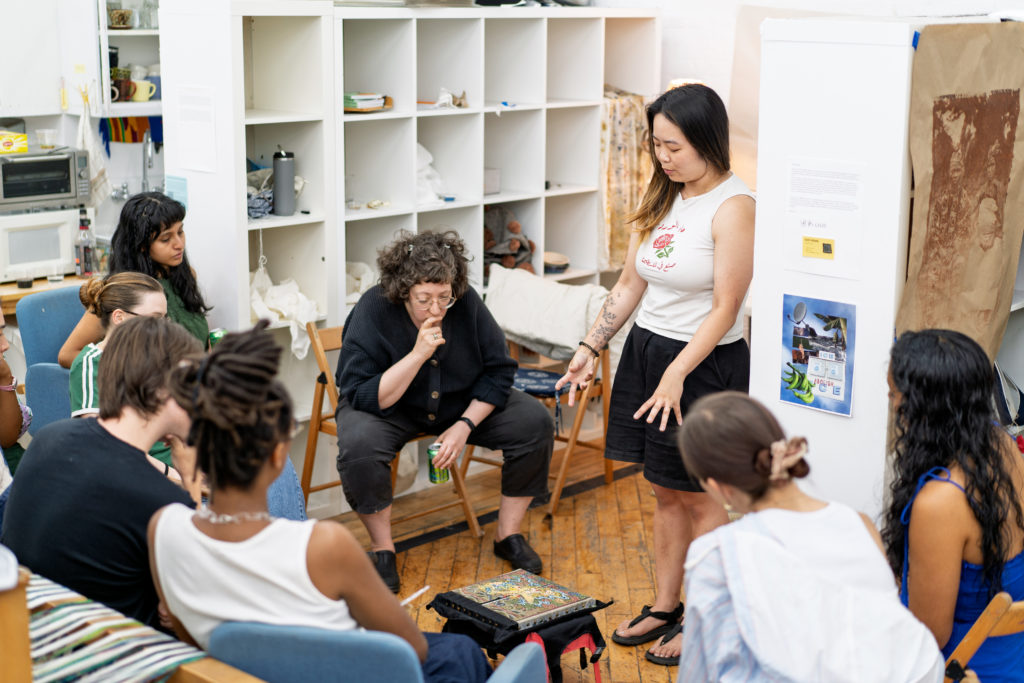
Cover image credit: Vic during AIR open studios. Photo by Geovanni Barrios.