

Geovanni Barrios, Artist Programs Intern at TAC, spent time with February WIP resident Riley Grossman:
G: Did you stay here late again last night?
R: I was here so late. I was sewing while my eyes were closing, and I thought, "This is my sign to go."
G: And you’ve finished upholstering the chair, right? Now all that's left is the machine knitting? How did you come to knitting?
R: While I was in school, it was online and I was working in a small apartment. I thought, I have to do something about this waste—cutoffs from muslins and garments. When I learned that knitting was an option that could make a garment to exact fit with very minimal to no waste, I thought, this is it.
In terms of what I make now, knit is my preferred medium. I've always used stuffing in all of my work. That especially works well with knit because of its inherent stretch. I go between making little creatures—dolls, puppets, stuffed animals—and larger scale sculptures. Knit is the through line between all of it, whether it be garments dressing the creatures or the actual fabric of whatever sculpture I'm making.
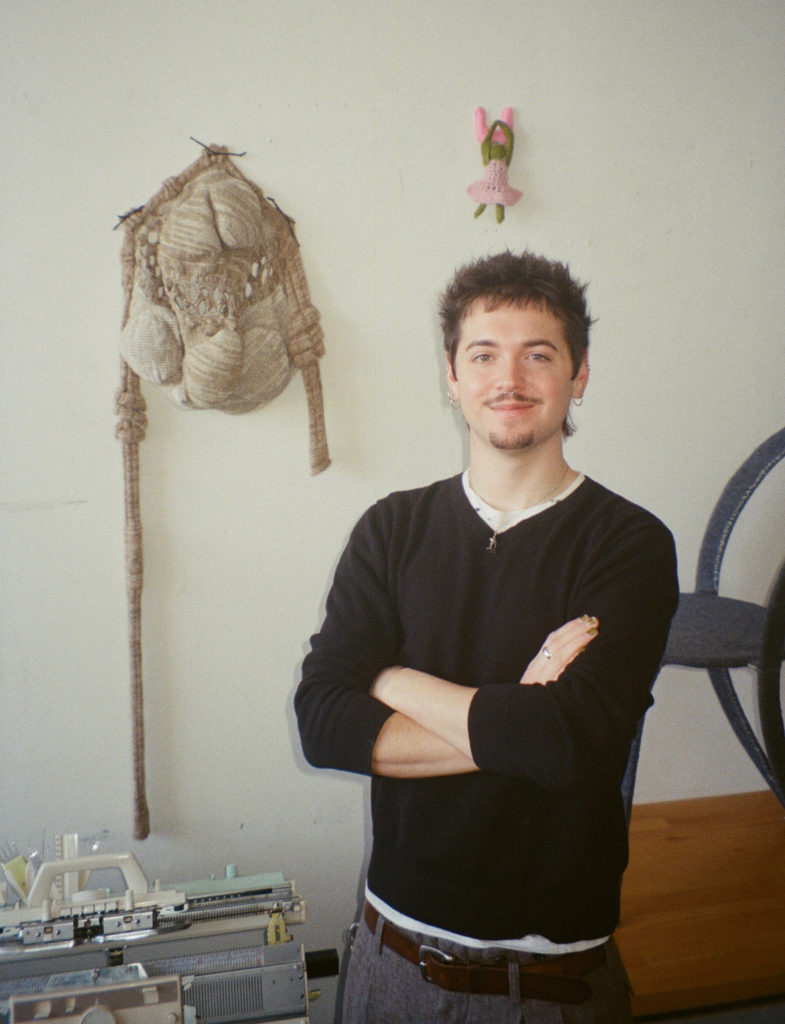
G: I know you had previously made a lot more wearable work. Why move towards objects?
R: There was this constant obstacle of creating for the body in my garment making classes, and sometimes that was a valuable constraint. I was towing the line between technical fashion and sculpture. Object making felt like the logical next step, a clearer way to explore silhouette and shape.
I'm interested in people's reactions to the inanimate objects I make. I was making seven foot tall structures and they would keep people at a distance. Not in a negative way, but it was a spectacle.
When I made my first stuffed animal, a large scale fox, everyone’s initial reaction was to reach out and touch it, to want to hold it. That switch was really informative for me. There is a line somewhere between a large, inanimate structure and this personified inanimate object. Thinking about my chair, it's my next step in that direction. Without adding eyes to it, I want to elicit an emotional reaction from the viewer—the sitter. How can they still feel moved to be close to a structure?
I was drawn to functionality and had to consider materiality more—what material do people feel invited to touch? What objects do people feel close enough to? Is a chair—one of the most common objects in our lives—enough to make someone feel comfortable interacting with it? Or will my chairs keep people at a distance because of the unfamiliar silhouette?
G: What steps have you taken so far to construct the chair?
R: It’s probably one of the most labor intensive things I've ever done, which is insane because of how simplistic the shape is. The internal armature is a premade metal chair. I found two abandoned chair frames in the hallway of my studio where people leave things they don’t want anymore.
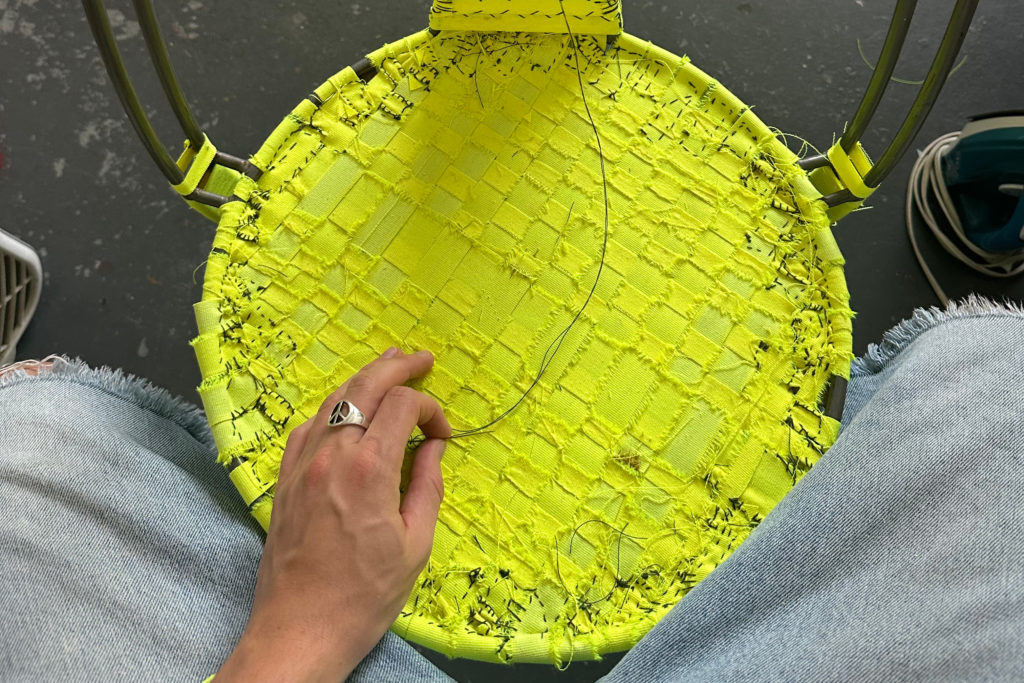
Working with found objects, I had these safety belts that I stripped apart and rewove to give the seats integrity. Then, to actually be able to sit, I attached metal mesh and muslin on top.
It has been nearly a year since I picked up these frames. They've been in the project rotation, you know. My goal for the residency was to finish them. I progressed past the second layer, a whip-stitched gray felt, to attach everything in a smoother way. The third layer was parachute stitched white pre-felt to figure out the pattern for when I knit it and smooth out any more lines. It’s very similar to how I work with garments. Everything starts with a base and there’s another layer and another layer. For this chair it has been hours and hours of handiwork.
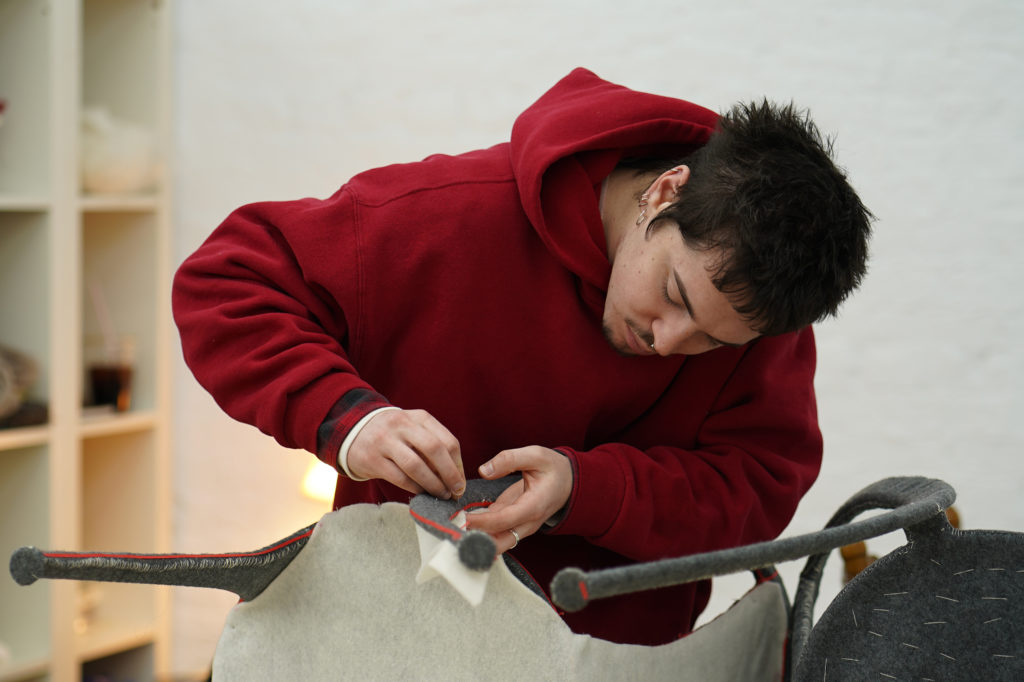
G: Thinking about your labor, do you keep track of how much work you’ve put into this project?
R: For the sake of my own sanity, I don’t. For other work, like when I teach crochet, I track my time. But this is such a labor of love and purely out of passion that I don’t think I could be quantitative like that. I just think about the chair a lot.
There is intimacy in my being the only person knowing how much went into making this. There are little jokes that I leave myself in the form of a stitch. I can tell how I was feeling that day by how tight a row of stitches are.
G: It's so compelling to see you only working with these two chairs and knowing you're not a chair designer. You're just approaching the chair as a subject. And it's refreshing because it makes the entire object just so much more personal. Given industrialization, there's probably hundreds of these chairs but you found these two.
R: I've also been thinking about the line between when an object is deemed ordinary and when it is deemed special. Especially considering the invisible work I’ve put into these chairs, how do I make something that was already discarded once valuable? I didn’t want to do that through heavy ornamentation or expensive fabric. How can I give this object so much love, care, and attention that it becomes special?
I'm sure it comes to everyone’s mind one thing they would save in a burning building. Maybe it has no value to anyone else and can be extremely ordinary, but through experiences or relationships with that object it is deeply emotional. This was an attempt to put that mirror back to the person where it's like, this is an ordinary object and my attachment with it is incredibly real. It’s a sort of alchemy.
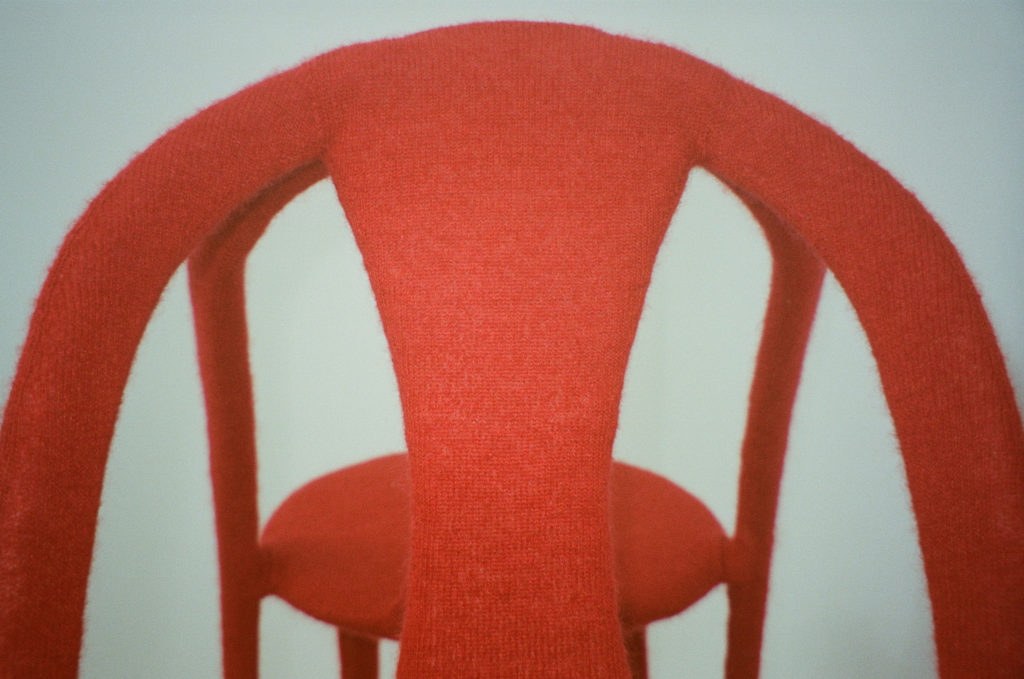
G: I absolutely agree. And when I think about your chair, I think about who will sit on it. What life do you anticipate for the chair after you're finished?
R: I'm so excited to see that. Chairs are meant to be used. My touch is imprinted on these chairs, but part of my interest is the viewer being able to leave their own mark.
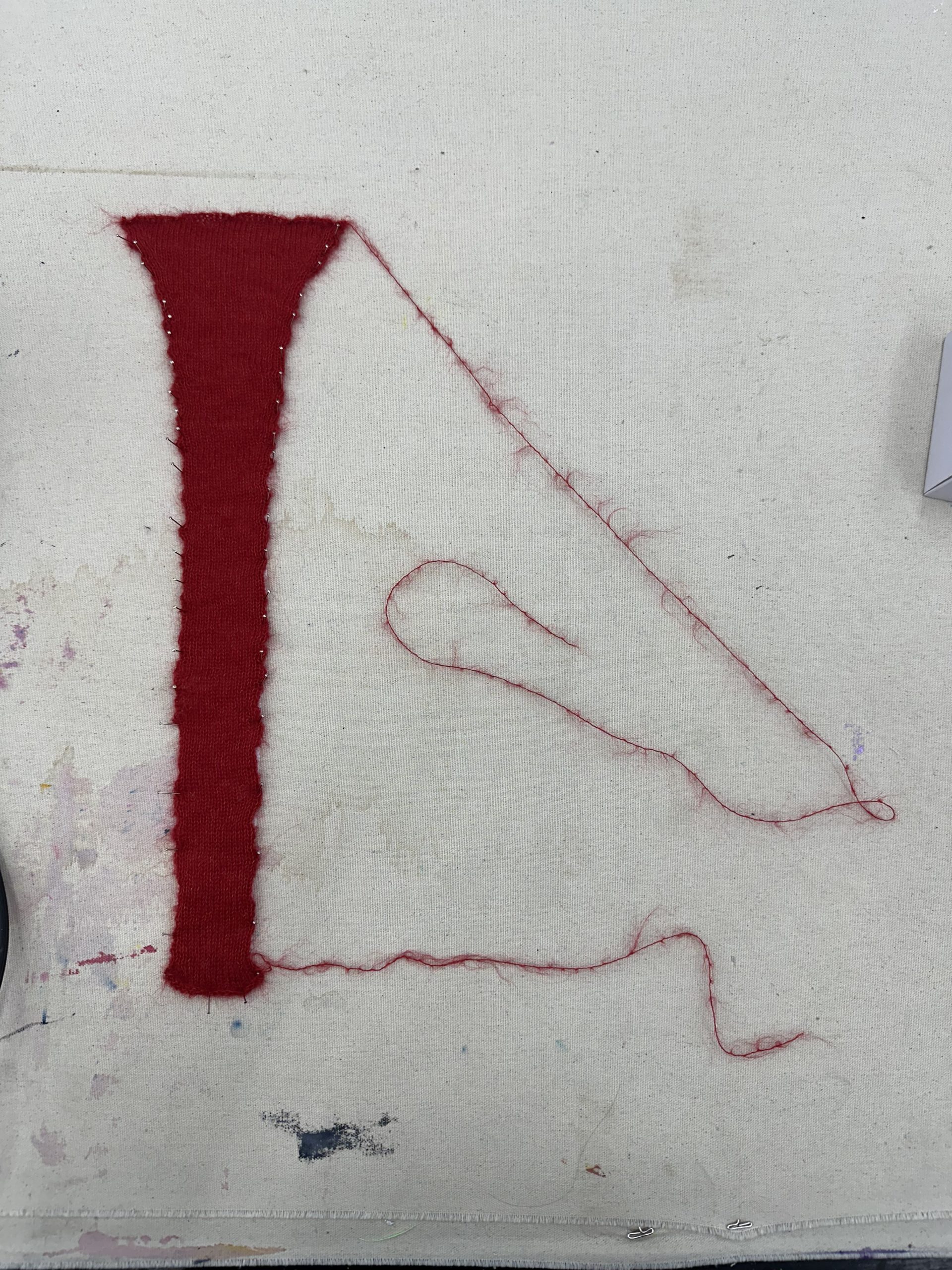
The interior materials are extremely delicate. If you pull at it, you can tear it completely. I’m excited to see how it gets distorted once people sit on it. The yarn is thin—you can still see through it. Knit as a medium holds memory. The materials I chose are meant to leave traces of use behind.
When I first had the idea of knitting two chairs together, I thought it would be a spectacle to be viewed. Because of the shape, there is a gate in the center for people to peer through. Then it occurred to me it would be almost disrespectful to the chairs to not allow them to be sat on.
G: It’ll be a spectacle to watch people sit in your chair too. Putting chairs across from each other to sit face to face is already fairly intimate.
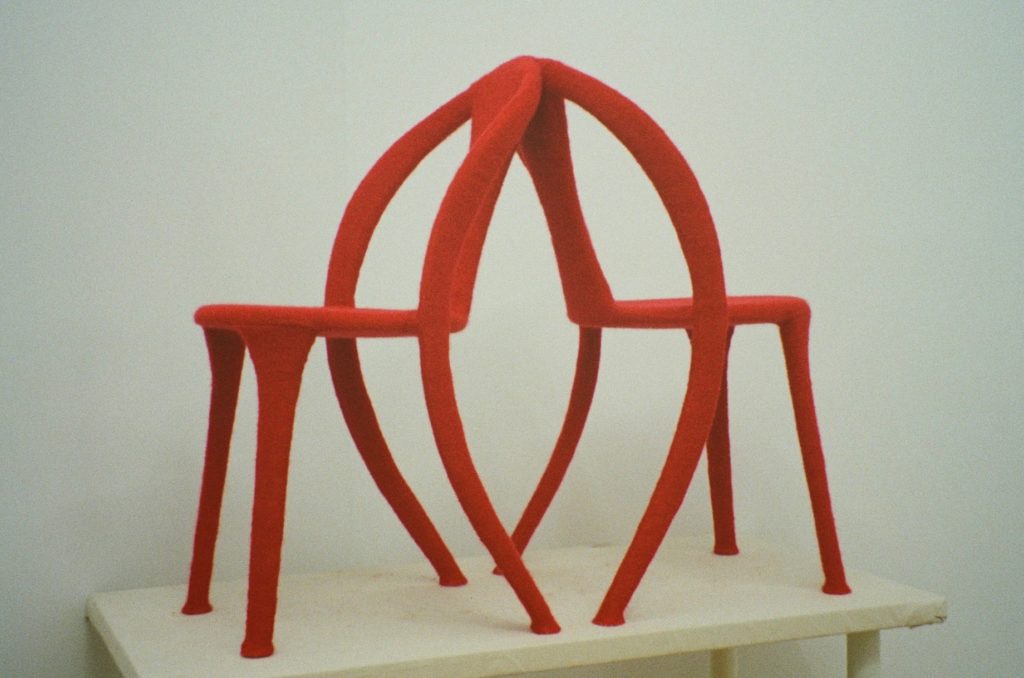
R: Yeah, but back to back there is almost a sense of anonymity, which potentially demands more vulnerability. Confession comes to mind. You are side to side but locked off. In that anonymity, you're meant to speak truthfully and openly.
It harkens back to a garment I made years ago that connected two people. Up until then I had been making garments for myself. Later, it became all about the object—stuffed animals, my collection of buttons. This is a similar exploration, but instead of the wearer, it is the object first. It's an invitation for people to be connected by the object.
G: I’m excited to see how people will interact not only with the chair but with each other.
R: I’m really excited too. No one has sat in the chair except for me trying it out. I have such an emotional attachment to these chairs now. Even transporting them was a nightmare because I was so worried about them. Ultimately, I’m interested in how people will wear down what I make, in a way that is motivated by love—like the way a child loves a doll until it’s falling apart, or a baby blanket until it’s barely more than a string.
Riley Grossman is a multidisciplinary artist based in Queens, NY. During their time at The Fashion Institute of Technology and Central Saint Martins, Riley studied fashion design with a specialization in knitwear. Riley’s work centers around exploring the form of both body and object, in an effort to better understand the way fiber interacts with the subject. This is demonstrated in structures that cocoon the body, physically connect people, or distort proportions through stuffing. Beyond garment making, Riley utilizes objects to achieve their signature bulbous silhouettes through mediums of wire, collage, or stuffed animals. Their work presents the viewer with unfamiliar usage of familiar materials, challenging the way in which the viewer is able to interact with and understand structure. Through exploring the infinite shapes a form can take, Riley presents the peculiar as the intimate.
Cover image credit: Riley working during Textile Arts Center Open Studios, Brooklyn, NY. Photo by Geovanni Barrios.