

Geo Barrios, Artist Programs Intern at TAC, spent time with March WIP resident Maris Van Vlack:
G: One of the things that captured my attention and the attention of everyone else [at TAC] is how prolific you are on the loom. You've already grinded out two pieces, and are well into the third. Obviously, that comes from spending a great deal of time working on the loom, but where did you build up the practice? How did you get started on the loom?
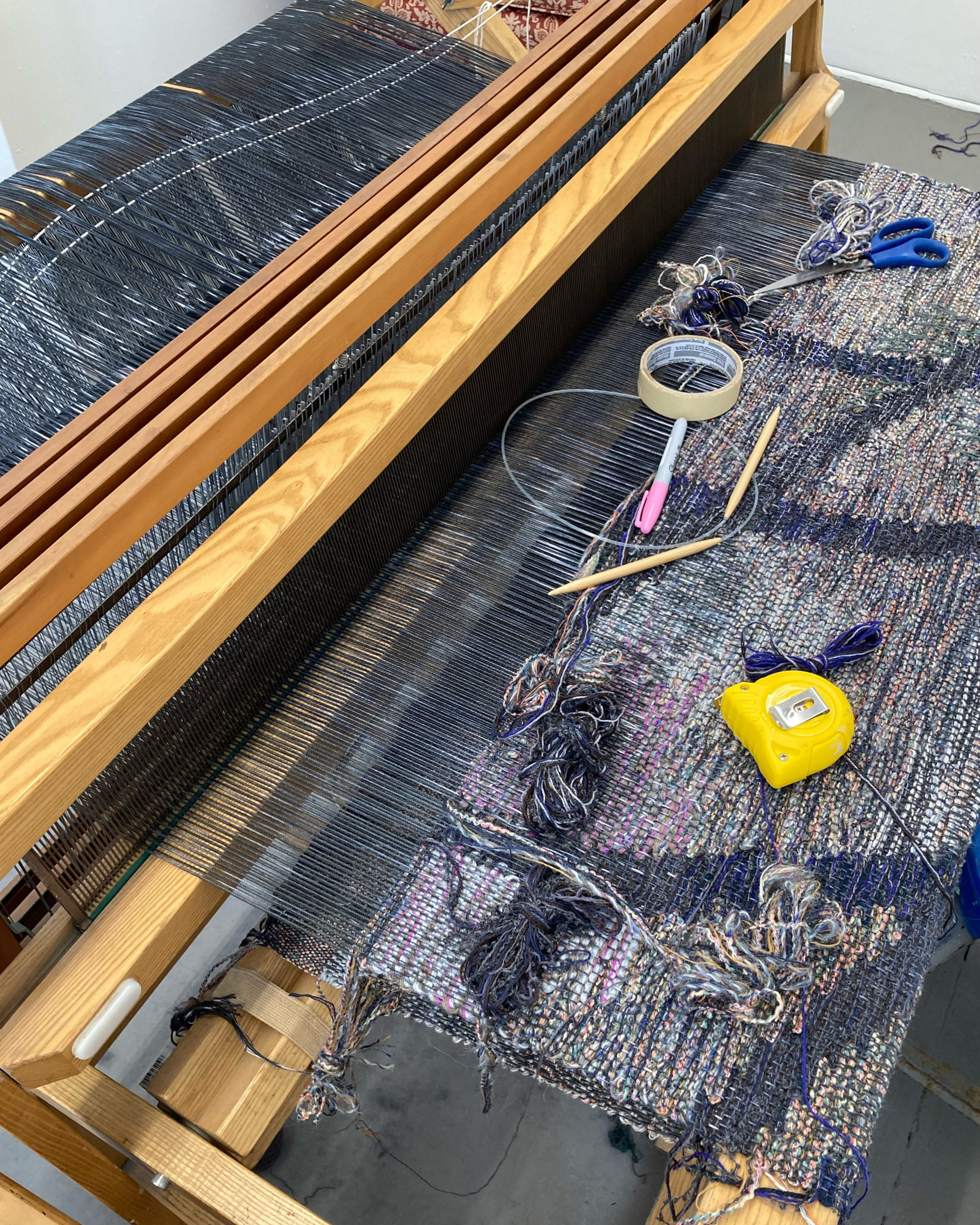
M: Yeah, I've always been interested in working with fibers, but I really started weaving in undergrad at the Rhode Island School of Design. I wanted to find ways to combine textiles with everything else that I’m interested in like painting and drawing, so I've come up with this way of working that really works well for me.
I'll often start with a painting or a drawing and turn that into a diagram, which I use to weave with. Then the time that I am weaving is intense. I try to get through it really quickly, because there's a lot to do and I work on a very large scale. After weaving, I slow down a little bit, and just spend a lot of time looking and thinking. Then [the piece] actually changes a lot after it comes off the loom. I'm collaging things onto it, cutting things away and layering up material, with fiber and paint and other things.
G: I feel similar in that I approach my work as projects. Do you find that you work best in phases? Three months of just grinding out this thing that you've thought about for a while, and then three months of living life? How do you think your process on the loom informs those phases?
M: Yeah, I kind of divide up my time by project. There's really just one piece that I'm thinking about at a time. Sometimes I'll do small experiments or swatches on a digital machine that I'll put away for months or maybe even years, and then I'll come back to them later and collage them into bigger pieces. But there's definitely one main thing I’m working on in the studio at one time. I go through these stages of a few weeks of weaving every day, and then a few weeks where I'm doing a lot of stitching or painting on top of the weaving instead.
G: If your process is making a painting or drawing—an underdrawing of sorts. Why not present those as works? What is it about the process of the loom that you feel gives the life force behind your work?
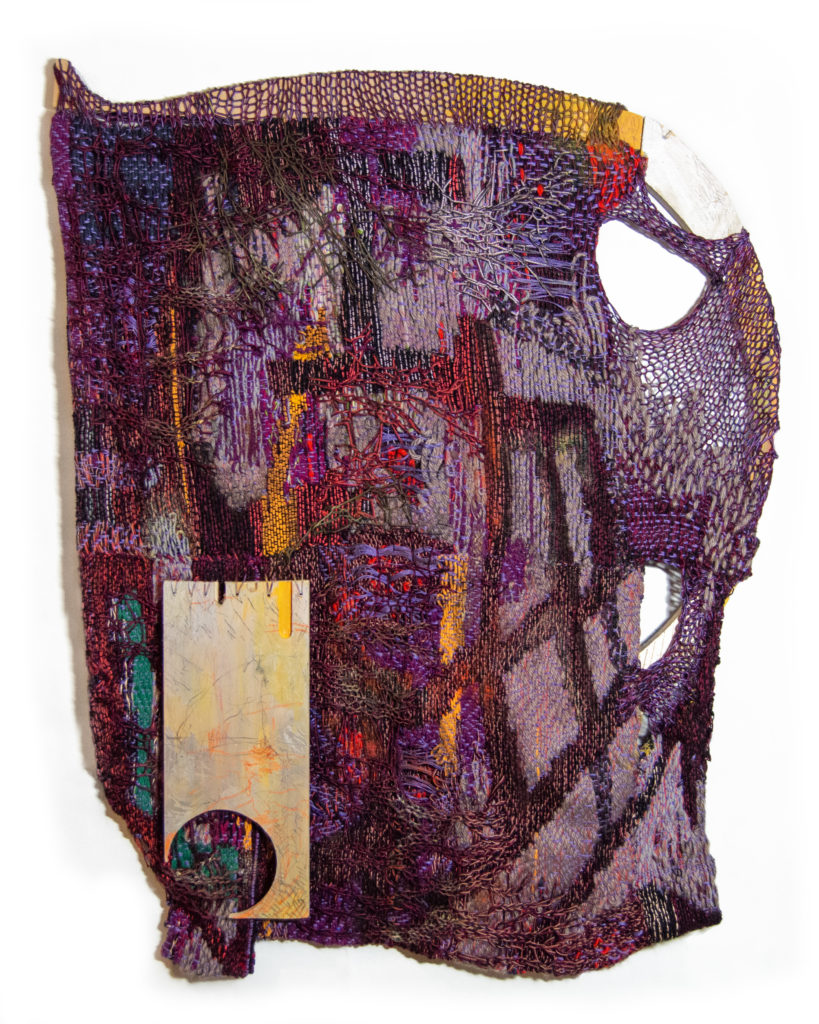
M: For me, weaving is very closely linked to my architectural subject matter. I’m interested in how the weaving process is linear and you're building up this surface in a very slow methodical way from bottom to top. Then you have this surface that can be cut apart, torn away, or collaged together. That process feels similar to the architecture that I'm looking at, which was once built up, but then has deteriorated and become something else. So I use weaving as a metaphor for that cycle. And then I think weaving and painting each brings something different that the other one can't really achieve. So by combining painting and weaving, I’m getting into something visually that's very exciting for me. It’s very tactile, but also it feels like a landscape, like a deep, atmospheric space.
G: If I were an audience member going into an exhibit and I was looking at your work, what is something that you think most people would look past but is something you want them to consider? Every so often, the buildings in my neighborhood get a new layer of paint. When the painters work, a paint chip will come off and it's eight or nine layers of exterior paint that has accumulated over time. Is there something comparable to that in your weavings that people look over?
M: Yes, I use different textile techniques and different scales of material to create these very subtle shifts in the work. Sometimes I'll have an area of knitting that I've integrated into a piece of hand weaving. I don't want it to be a visible patch, but more a slight textural shift you're not really consciously thinking about. I realized recently that a lot of old buildings—if you're looking at a brick surface—you'll notice areas that were constructed later on are made of a slightly different material or different size brick, and that gives you an idea of the building’s history. Or the events that it went through to get to its final state. I love all those little connections and things you notice after looking at something for a while.
G: Could you describe the buildings that you've referenced in your previous work? What building are you referencing in this work that you’re producing at TAC?
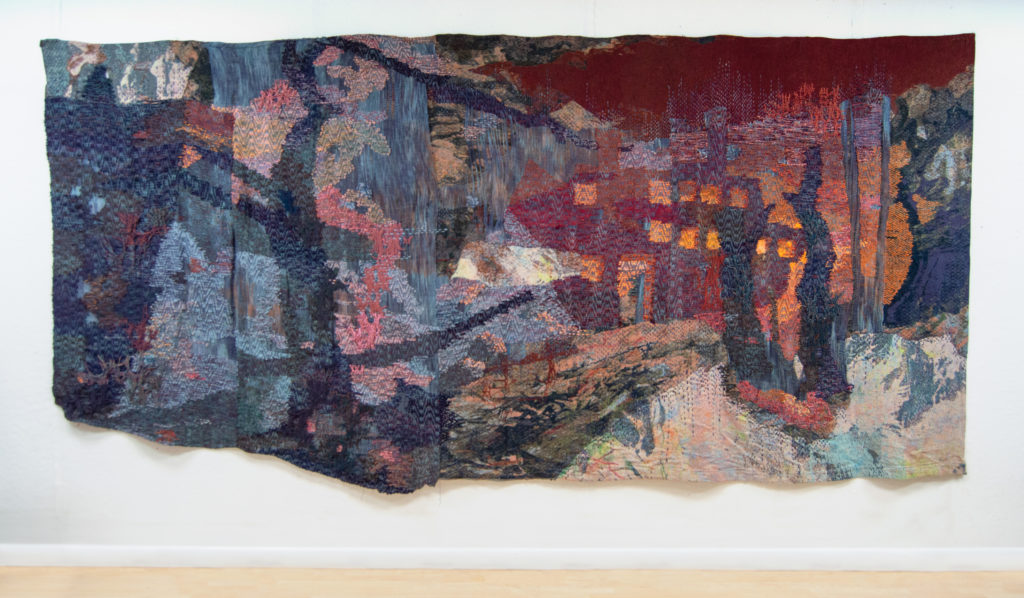
M: I'm looking at a lot of historic New England buildings. That's where I'm from. A lot of them have ties to the textile industry. And the way that they're built and they're deteriorating is really interesting to me. Growing up, I saw remnants of stone walls or foundations and buildings everywhere that were being taken over by plants or were sandwiched in between newer buildings. So, I'm very interested in the history of that and how all these materials carry the impression of a long period of time.
The work I'm doing now is a bigger piece that's part of a series where I'm kind of exploring the intricacies of my process. So before I came [to TAC], I did some printed works where I used the texture of the weaving to do ink prints on paper, and I'm taking aspects that I liked from when I was printing, and am using them as the base of the composition for this new woven piece.
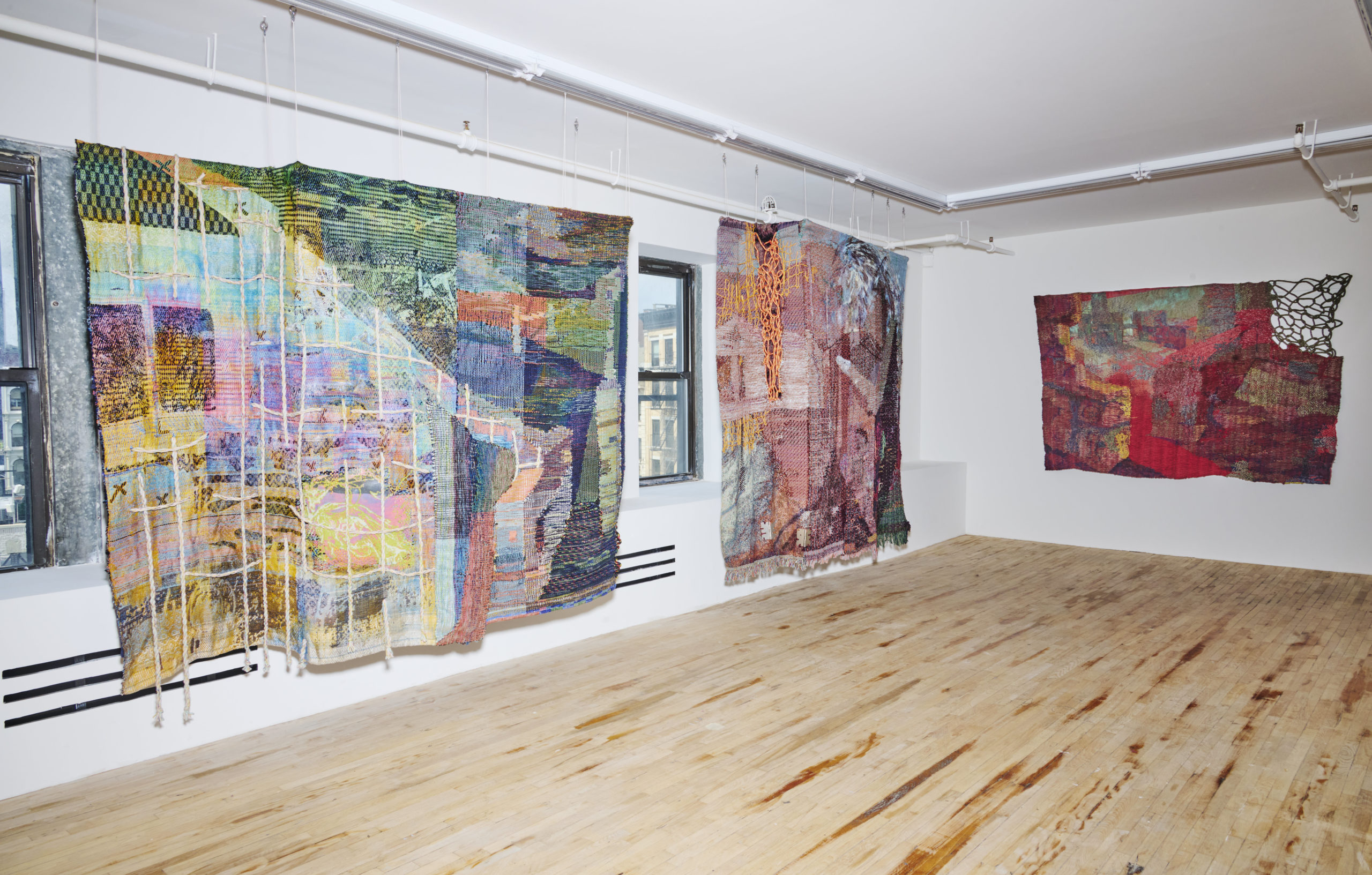
G: From the work that I've seen of yours before, the weavings are presenting your perspective, not necessarily that they take up architectural forms themselves. They do in some capacity, but it's not as if you are replicating the building. Do you see yourself moving towards architectural forms in your next projects?
M: I'm interested in using architecture as a starting point to find some interesting forms. Whether it's the way something interacts with light or the way it was pieced together. That's where I start with a piece. Then I'm interested in how I can combine different pieces and create this imagined landscape with them. The resulting piece is a collage of different things that can end up feeling very surreal. There's still a lot within architecture that I'm interested in exploring.
G: We talked about your process in terms of creating the image or the subject matter of your work, but how do you set yourself up for sitting at the loom for [an extended period of time]?
M: I don't have many rituals, but when it's a day that I've set aside for weaving, that's all I'm doing and I’m trying to get as much done as possible. Sometimes I'll say, like, I have to weave two feet today before I can go home. But then when I'm not actively at the loom, it's a calmer process. There's a lot of looking and thinking and not so much active work. So I alternate between those two different phases of work.
G: For me, it's almost an obsessive compulsion when I make with textiles. Do you also get totally lost, and lose track of time? Destructive is a choice word, but there is a sort of irony in neglecting the self while trying to be incredibly productive on the loom. It seems you’re willing to accept the sort of the trade-off of that?
M: Something that can get in my head is—I need to make this section of the weaving perfect. And I can't move on until I've done that. And because weaving is very linear, you can't go backwards and fix something at the beginning. What gets me through that is how weaving is just the very first stage of my process, and I can cover something up or completely change it later on when I'm in the collage stage, so it doesn't have to be perfect. When I’m at the loom, I just try to get the piece done.
G: Your work really reminds me of those period rooms at the Met or these bigger museums where they have paintings that act as false landscapes for these staged rooms that we’re standing in. I'm looking forward to seeing your next show. Do you want to plug your next exhibition?
M: My next group show is Labor and Adornment: Radical Craft in America, and it is at Superhouse in Manhattan opening on March 19th through April 25th. I’d love to see you there.
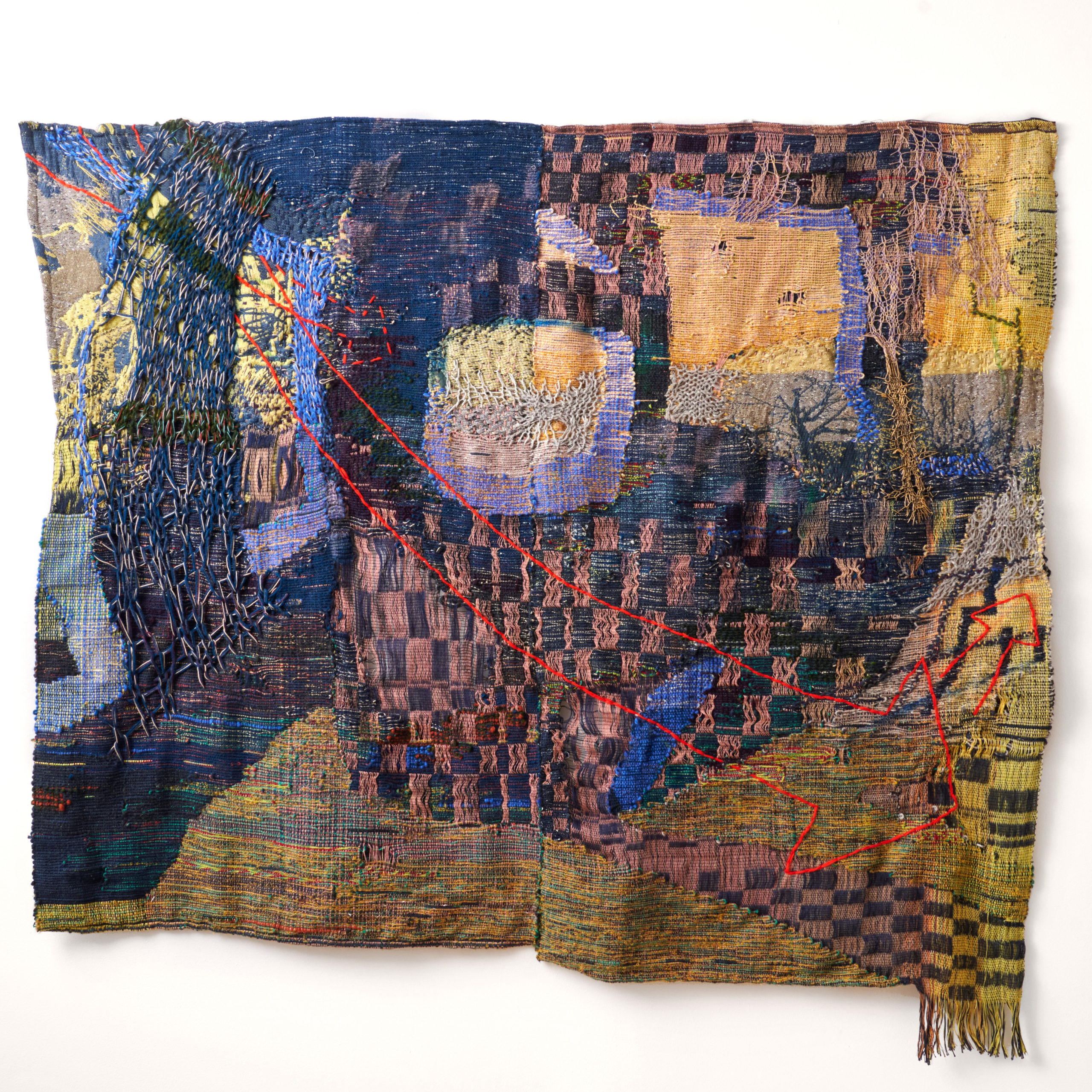
Maris Van Vlack is an interdisciplinary artist from Massachusetts who combines digital and traditional weaving practices with painting to build tapestries that explore memory and history. Growing up in New England surrounded by remnants of stone textile mills inspired her to explore the connections between architecture and textiles, and how the ruins of a building tell a story about a landscape. Studying Textiles and Drawing at the Rhode Island School of Design taught her to think of a thread as a drawing material that can be used to create pictorial spaces. She has exhibited in the USA and Europe, including shows at the U. S. Capitol Building (Washington, DC), NADA New York (New York, NY), the RISD Museum (Providence, RI), the Icelandic Textile Center (Blönduós, Iceland), and FOG Art Fair (San Francisco, CA). She is a recipient of the Kennedy Center’s 2024 VSA Emerging Artist Award, the St. Botolph Club Foundation Emerging Artist Award, and the RISD Textile Department Award for Innovation in the Textiles Field. Her work has been published by the Boston Globe, Interior Design Magazine, Google Arts & Culture, Dwell Magazine, Miami Living Weekly, and Warp + Weft Magazine.
Cover image credit: Maris working on her loom in her studio at the Textile Arts Center, Brooklyn, NY. Photo by Geovanni Barrios.