

Geovanni Barrios, Artist Programs Intern at TAC, spent time with current AIR 17 resident Mateo Gutiérrez:
G: Has your time up here in the Northeast changed your perspective or approach to the subject matter you’re engaging with now?
M: I feel a little like a fish out of water, you know? When I'm in Texas or, you know, I'm also from Los Angeles, Southern California and I have a lot of family in New Mexico. When I'm in those southern and southwest regions, I feel a very deep connection to the subject matter, because it's at the border and there are very different gun laws, and it's just culturally so different. And so I do feel a little bit like a fish out of the water sometimes. And I completely understand what Diego Rivera said. Eventually, an artist has to establish their roots. That's where real work comes from.
G: I am relieved to hear you speak so firmly about settling down. My parents came to Miami from Guatemala to start a new life, but there are obviously things they held onto. My mother taught me how to knit when I was young, and I eventually learned to embroider. It was all just something I picked up from her. Did embroidery become part of your practice from your family, or was it something that you fell upon? How does that influence your approach to materials?
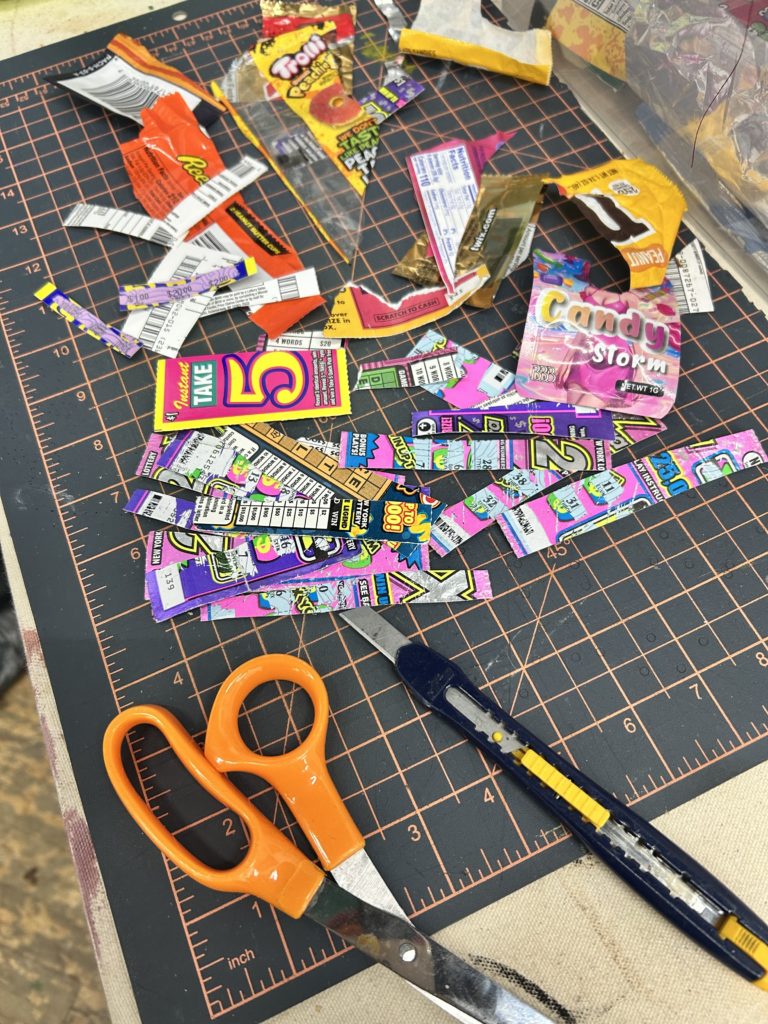
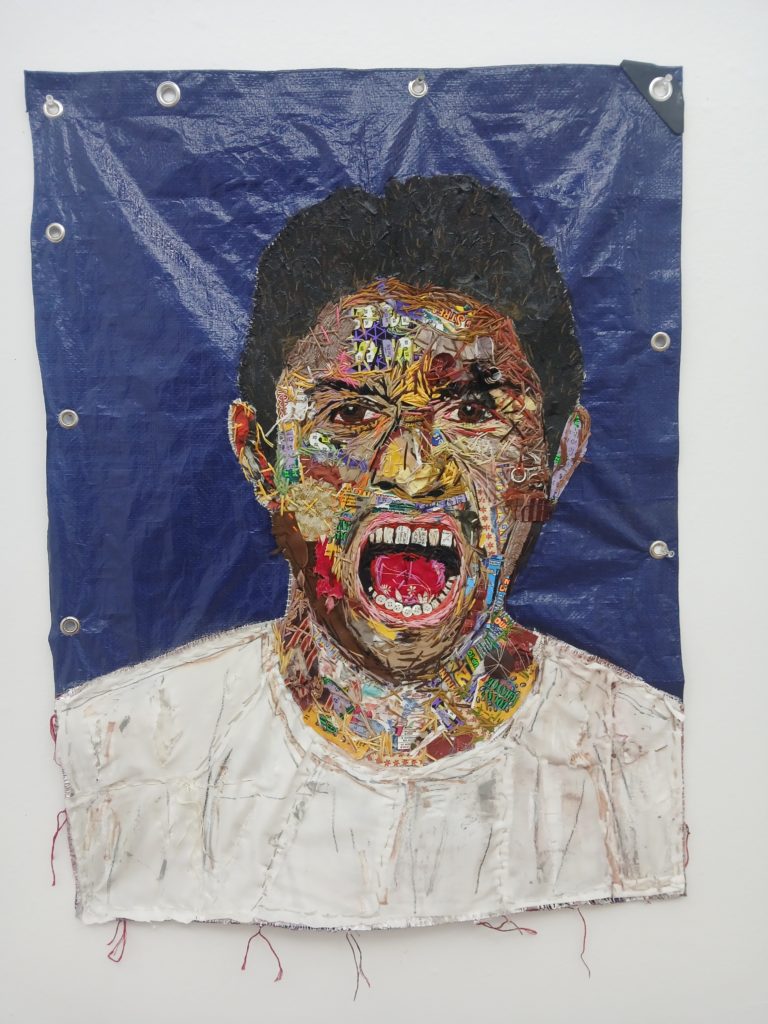
M: There are some pieces in there that are similar to my story. So my father’s family is from Guatemala, and they self exiled. My mother’s family is from Puerto Rico. So I have Latino immigrants on both sides and all that entails; hope and dreams and fear and anxiety and poverty and racism. My mother is from Puerto Rico and there is a lot of light colored skin in our family, so they really whitewashed us as best they could. They did not allow us to speak Spanish in their house, but they did retain all these things that as I've gotten older, I realized were them holding onto their past. My mom was always sewing and always repairing clothes and always making, which was just passed through her family. And so I was always in that room with her when I was young. I loved it. I just loved being in there and listening to the sound of the sewing machine and her sewing. And she was in her best mood, you know. My dad was very macho and so she was very withdrawn when he was around. But then in her sewing room, she was this whole other person. I would go in there and spend time with her. And so I was always sewing and doing buttons and making things and she was always talking to me about it and embroidering things. It was just always around sewing and needles and pins and threads and fabric was just always around, you know. So I tend to use a lot of found materials. I like found fabrics and I don't buy high quality materials—probably to my own demise in terms of archival qualities—but I try to be aware of that as well. I really like to use those kinds of materials as a direct deconstruction of hierarchy, of the patriarchy, of the elitism of art. I like everyday materials. I use tear-away stabilizer, which is the backing. So it's like the story behind the story. I don't want the beautiful fabric and frock. I use relatively cheap embroidery floss. I don't go buy high-end, super high-quality embroidery floss, you know, so my materials are very pedestrian on purpose. I used lottery tickets that I find on the ground, I use materials like garbage candy wrappers, anything I can find, and I incorporate it in my work.
G: Has that sewing-room lifestyle been true in your home with your children too?
M: Yeah. I was a kid when I had a kid. My eldest was in my studio with me all the time growing up, but I was only painting then. Then my middle child was the one who was not in my studio so much. I had a studio away from my house. With my youngest one, he has been in my studio with me since he was an infant. And he has been around when I’ve been doing more of the textile work.
G: When did you transition from painting to textile? What sparked the change?
M: In 2018. I’ve been making work for 30 years. So it is quite recent for me. I had a very vivid dream of embroidering hip-hop lyrics with thread, with paint on them, and then dripping all over the canvas. And I’ve always been into music and have kept up with hip-hop from the very beginning. Those lyrics from the 90s were so powerful and political—about the failed state of our society in such a perfectly honest way. There was a lot of violent gangster rap too, and I felt like in the 2010s there was this really interesting transition that I just—some of the lyrics that were coming out were just so powerful. I had a dream about embroidering those lyrics with blood—paint on the thread—but it looked like drops of blood when you punctured the canvas. That was when this idea of embroidery being in my work came to me. I have to do something with that. I didn't know what to do, so I just started.
G: What you're talking about—incorporating lyrics and words of violence into your preexisting painting practice—is closely aligned to your weekly Saturday embroidery circle, which is proactively about violence inflicted on children. Could just say a bit more about that and the impetus to start that programming?
M: I would say that the transition into embroidery was what focused me onto violence in our culture. I remember when I was in grad school—I think I might have mentioned this in one of the classes we were in together—I had a studio visit with a professor who was a very successful artist. And I said, “Can you just give me some advice?” Just give me some fucking advice. I was struggling, you know, I didn't know what to make or who I was.
And he said, “What do you think about every day? Just make work about that.” It took me 10 years to understand what that meant. I always think about American violence. I think about why this culture is so violent. Why they did what they did to Latin America? Why are they doing what they are doing today? Why do we do what we do to each other? Why does every film end with violence? Why are we such a violent society? And then we had mass shootings. We obviously had Columbine, and there was Sandy Hook, which was right in 2022. And I remember Sandy Hook, I was like, okay, Obama's president. It must get better. This is the end, right? This is it. Guns are gonna go away. Even the people who love guns are gonna go, okay. Nothing happened, and it's gotten worse. And it was around 2018 that I felt like I was losing my mind a little bit with that. And that hasn't changed.
G: From your figurative work, thinking still of embroidery as painting, you’re not depicting that kind of violence, you're depicting more of a domestic or familial scene. Where do you draw the line between the work that is explicitly referencing violence and the work that depicts the families affected by violence?
M: I made a very conscious decision not to focus on the act of violence, but to focus on the ramifications of violence. The ramifications of violence are universal, which is what I found so interesting. I used two sets of images in my work in this very singular body of work that I've been working on since 2019—the larger piece in my studio being a part of that. The migrant experience coming to the United States is a response to American violence. It is itself an act of extreme danger, which is violent against the body, soul and psyche. It's physically difficult, as they say, poverty is a crime. So all of those are very violent experiences. And obviously a mass shooting is a violent experience. And what I started to notice is that we were seeing these images of people going through these transitions into the United States, and they were responding in the same physical gestures that people after mass shootings were responding. It's the reaction to violence.
I am interested in the response to violence. I believe that seeing those images is also an act of violence on our soul, because there's nothing we can do about it. Day in and day out. I mean, what are you going to do? You've tried. We've tried. You know, it's thoughts and prayers. And bring yourself up by the bootstraps and ain't America great. That's why everybody wants to come here. And so I'm approaching it from that angle versus showing violence itself. We see enough of that.
G: You said earlier that you're working now on a continuation of a body of work that you started in 2019. What are you working on here in the studio? What does your day-to-day look like at TAC?
M: I'm continuing that series but I’m limiting the size of my work in the studios. I’m focused on a series of six portraits that I want to install in the exhibition in September. I found that each one takes about a month if I have a good amount of studio time. I work with a friend who is a sociologist at the University of Toronto, and she is a specialist in state violence in Central and South America. She works with Indigenous groups in Latin America. She is very much interested in my work around violence and how an artist can be doing the same thing that a sociologist is doing in these two different modalities. We became friends online and we recently went to Mexico City to meet a group that she's been working with for eight years now—a group of indigenous people who live on the outskirts of Mexico City. They live in difficult conditions, homes of cement cinder blocks, wires coming in for the electricity, no running water, and they continue to fight for their rights on their land, their indigenous land. And so they come to Mexico City, they live there, and they petition. And are consequently disappeared in unbelievable numbers. These are state executions, right? For disappearance. So I went to meet them—It's a very difficult situation to navigate. It was a big honor to be trusted in that way. I had the privilege of meeting them and agreed to make six portraits of six people who had been disappeared. And so I'm making those six portraits now.
This series I have been concerned about because I know that this group FNLS is on many watch lists. If I travel to Mexico as Jasmine is now, I will probably be detained at the airport. I know I'm on lists and it's a little concerning to show this work, but not nearly as concerning as what they go through, not even close. Fear of life. And if you look at the things that are being done to them, you know, it's just unspeakably disgusting. So I kind of go, well, if I can't have a little courage with my privilege… who am I? You know? I have the privilege of the distance from it.
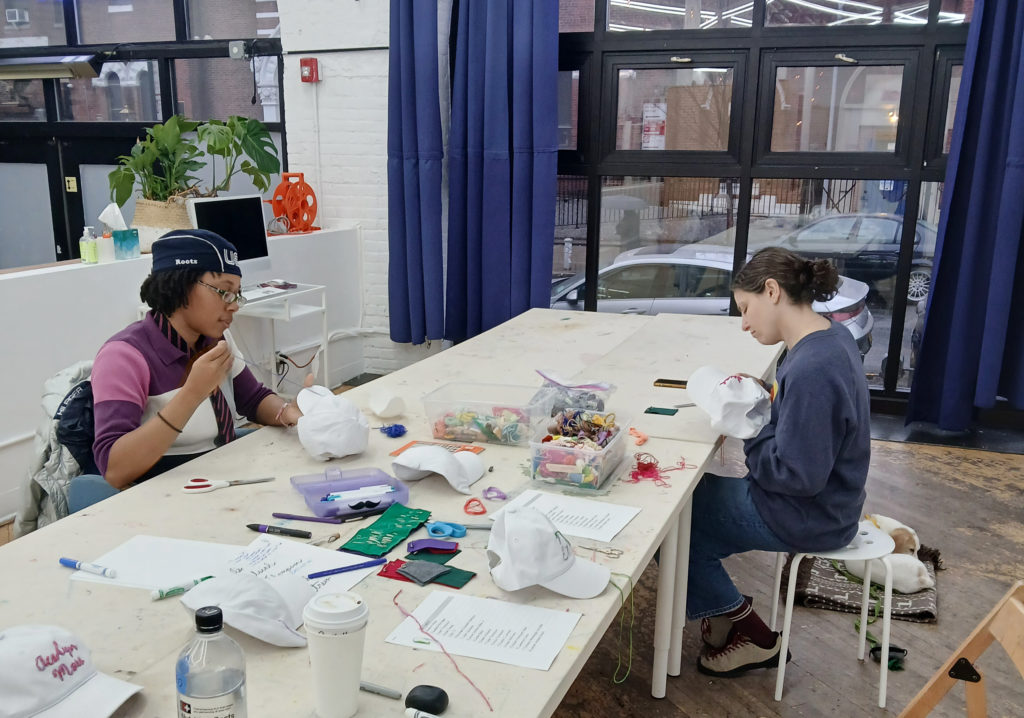
G: That isn't so far from this project that you're doing with embroidering the names of children on hats. Trying to render that violence in an understandable way for audiences so removed from that terror. I know a lot of artists who are fathers and they talk about how their practice changes so much in raising their children.
M: I can’t look back and say, “Oh, yeah, I remember being 34 and having my first son, and everything changed.” I was barely 20. I was just a baby. So, yeah, I think kids just change everything in hindsight, because I feel responsible for the world they’re in. Love and empathy are a very powerful tool against the voyeurism of violence.
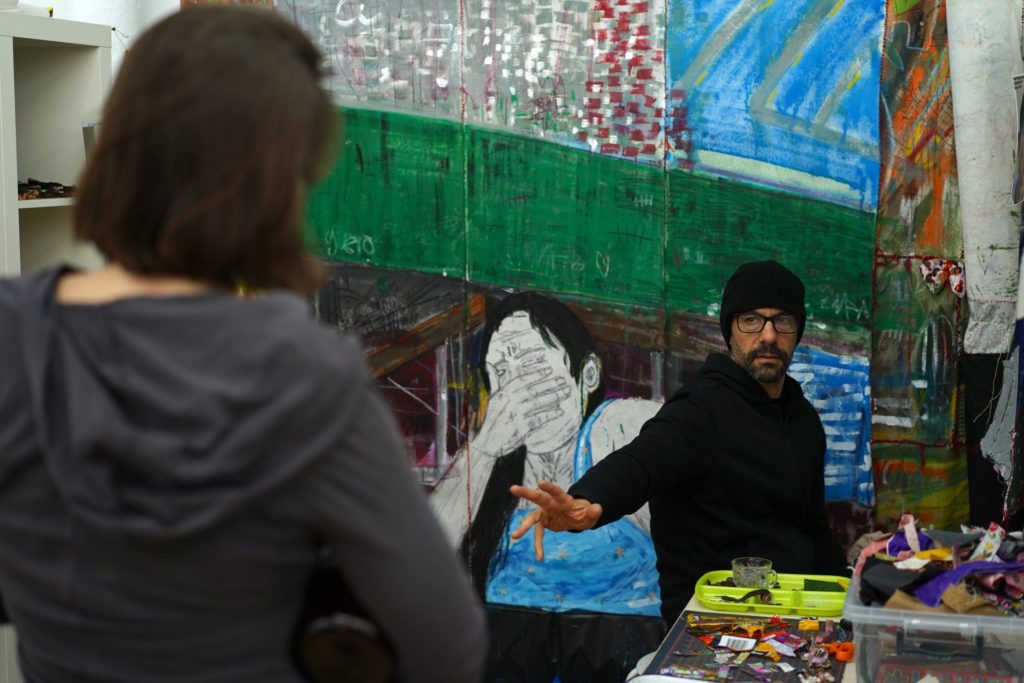
Mateo Gutiérrez is a contemporary artist who makes hand-embroidered artworks that bring into question the underlying culture of violence endemic to American life both personally, politically and historically. Mateo moved to the U.S. at the age of sixteen, and has struggled with his conflicted relationship to the U.S. ever since. He presents both a sociopolitical and a deeply personal reflection on what it means to be American. He challenges the viewer with both a haunting and empathetic view of the traumatic effects of the so-called "American way of life" and also what it means to be an outsider as both foreign born and Latino. He cites his complex experience with the United States as central to his understanding of American cultural practices that are defined by racial and socioeconomic hierarchies engendering violence and xenophobia. Mateo has exhibited nationally in galleries in Los Angeles, New York and across Texas, including multiple museum exhibitions and prestigious art residencies. Mateo was a featured artists in the 2024-2025 Texas Biennial, the longest running state biennial in the US. Mateo has been featured in New American Painters, Hyperallergic, the Austin American Statesman, Glasstire and other notable art journals. Mateo has a BA in Philosophy from the University of California at Berkeley and his MFA in studio painting from the University of Texas at Austin. He divides his time between Brooklyn NY and Austin TX.
About the AIR program:
TAC AIR combines studio access with a rigorous interdisciplinary curriculum, and regular critical dialogue, providing residents an opportunity to learn and explore the textile medium, and an alternative to traditional higher education programs. The residency culminates in a group exhibition produced and hosted by TAC. Since 2010, TAC AIR has graduated over 100 artists and designers whose work continues to further textile art within the fashion, fine arts, design and art education fields.
Cover image credit: And I Feel Fine / Y Me Siento Bien VII, 2025-2026, hand-embroidered thread, acrylic paint, oil pastel, colored pencil, marker on mixed materials (tear-away stabilizer, burlap bag & lottery tickets), 72 × 120 in. Installation view at Textile Arts Center Open Studios, Brooklyn, NY. Photo by Geovanni Barrios.