

On view: Museum at FIT, 227 West 27th Street, New York City 10001-5992
Gallery hours: Wednesday – Friday : Noon - 8 pm & Saturday – Sunday : 10 am - 5 pm
Closes January 3, 2027
When I walk through the flower district on a crisp Fall day, I see it to my left on Seventh Avenue and 27th Street. To the right of me, the subway stop I have just departed; it waits patiently until I return, but when the time comes to leave, I am always reluctant. Many New York natives who don't work in fashion or are unaware of the art of fashion, might regard it as a hidden gem, but for anyone who has been in the fashion industry, it is a well-known treasure trove. The Museum at FIT or MFIT, as students call it, does not have its own building, but at 227 West 27th Street, it houses itself within the campus of the fashion capital that is the Fashion Institute of Technology.
The Special Exhibitions Gallery showcases the Doll Dressing exhibition from September 16, 2026, to January 3, 2027. It’s an exhibition whose sole purpose is to answer a question that may seem frivolous and silly: what influence have dolls had on fashion? The exhibition was curated by Dr. Colleen Hill, senior curator of costume at MFIT. The curation was a culmination of years of research and the result was the coming together of 170+ objects. This collection included: fashion dolls, full-size pieces of clothes, fashion accessories, videos, and pieces of artwork. At the heart of the exhibit is the phrase ‘doll dressing’. Hill coined this term which refers to the adoption of doll clothes, accessories, hairstyles, makeup, and even gestures. It is traced back to the 14th century, where mini models of fashions were sent all over Europe. This exhibit is comprised of seven sections. The first section defines the fashion doll. The other six sections have titles such as Fashion Doll Foundations and Broken Dolls. This collection of dolls was created to put forth one main argument: dolls have been muses, canvases, and prototypes.
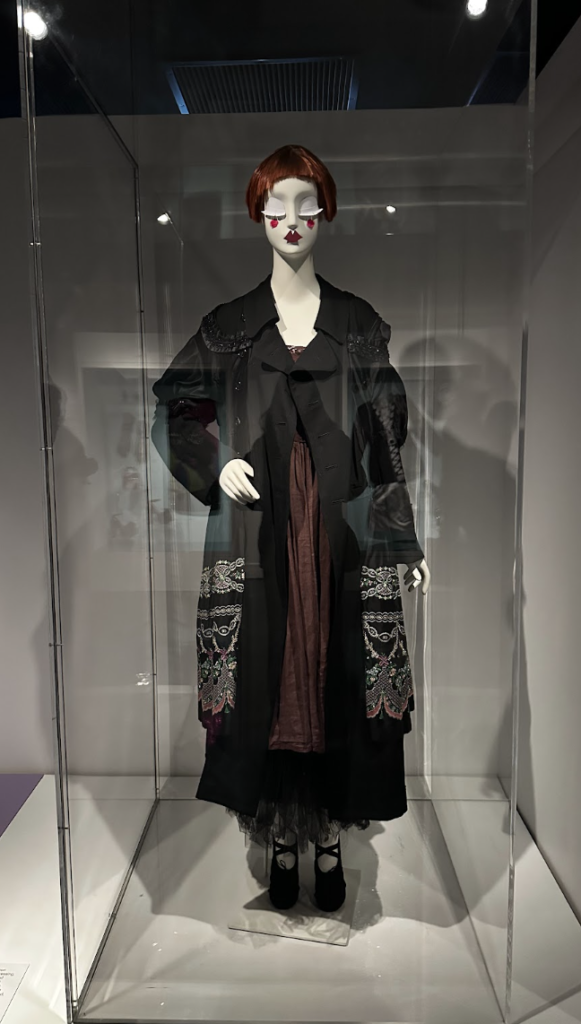
In the first section of the exhibition the show asks the question“What is a Doll?” The first part, “Dolls Love Fashion,” features one of the most archaic dolls in the exhibition – the Egyptian Paddle Doll, made from wood, beads, and textiles – along with dolls from 2040-1750 B.C. An important distinction to note is the difference between dressing up a doll versus a fashion doll. Most modern dolls are considered fashion dolls, where the doll can be undressed and changed into new attire – think how Barbie has sets that sell only clothes to be interchanged with her current attire – versus the standard doll whose purpose is not made to have a constantly changing wardrobe. Every fashion doll is a doll but not every doll is a fashion doll, a square and rectangle situation if you will. Following this section, the definition of a doll and its importance broadens to include everyone in “We Can All Be Dolls.” The museum text proposes the rhetorical question: if so many women find it insulting to be referred to as “dolls,” why do they dress like them? The text on the wall is an eye-opening account of why girls play with dolls and boys are disallowed to do the same: the light skin, big eyes, rosy cheeks, and small noses and mouths of dolls became beauty standards in Europe and America around the 19th century, therefore enforcing the idealization of physical and maternal attributes in girls. Next to the text on the wall, a photograph of fashion journalist Lynn Yaeger stands in Comme des Garçons. She says, “My red bob, the circles of rouge on my cheeks, my dark Cupid’s bow lips—they’re all part of a peculiar obsession I’ve harbored throughout my life: to dress up as a doll.” At the other end of the wall, an image of the “Protect the Dolls” T-shirt designed by Conner Ives for his Fall 2025 collection is featured. The graphic on the shirt was made to empower women in trans culture who use “doll” as a term of endearment to refer to other women they see as a celebration of femininity and confidence. According to the text accompanying this section, the T-shirt proceeds were donated to Trans Lifeline and made an impressive $70,000 in presales alone.
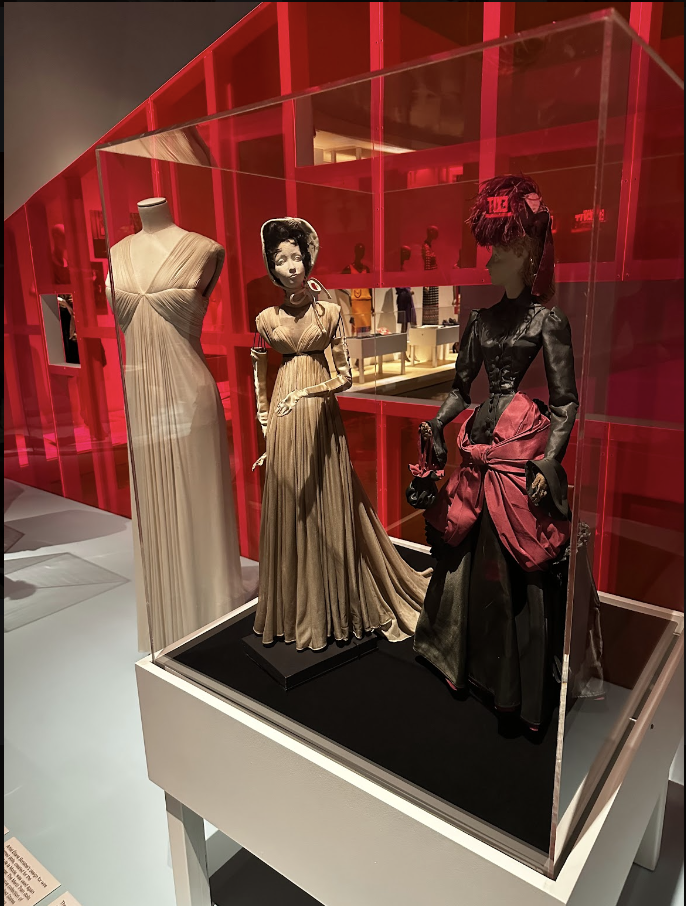
Following into the next area of the exhibit, behind the double doors, the whole exhibit transforms into a dollhouse. In the first room, you will find a handful of ensembles accompanied by the very dolls modeled after them (or the other way around). The actual toy dolls are also on view and they carry the history of this exhibit in their bodies. “Fashion Doll Foundations” takes us all the way back to the dolls that archaeologists recovered from the tombs of Roman young girls, over five hundred of them, made of ivory or bone, with the adult bodies and articulated limbs we associate with Barbie. The wall text here explains how these dolls’ clothing have long since turned to dust, but the dolls wear gold jewelry and carved shoes, proving that they taught these little girls how to look. As well as showcasing the dolls women traded between the courts of Italy, England, and France in the sixteenth century, and the tactile manuals they used to show dressmakers how to make full-size garments.
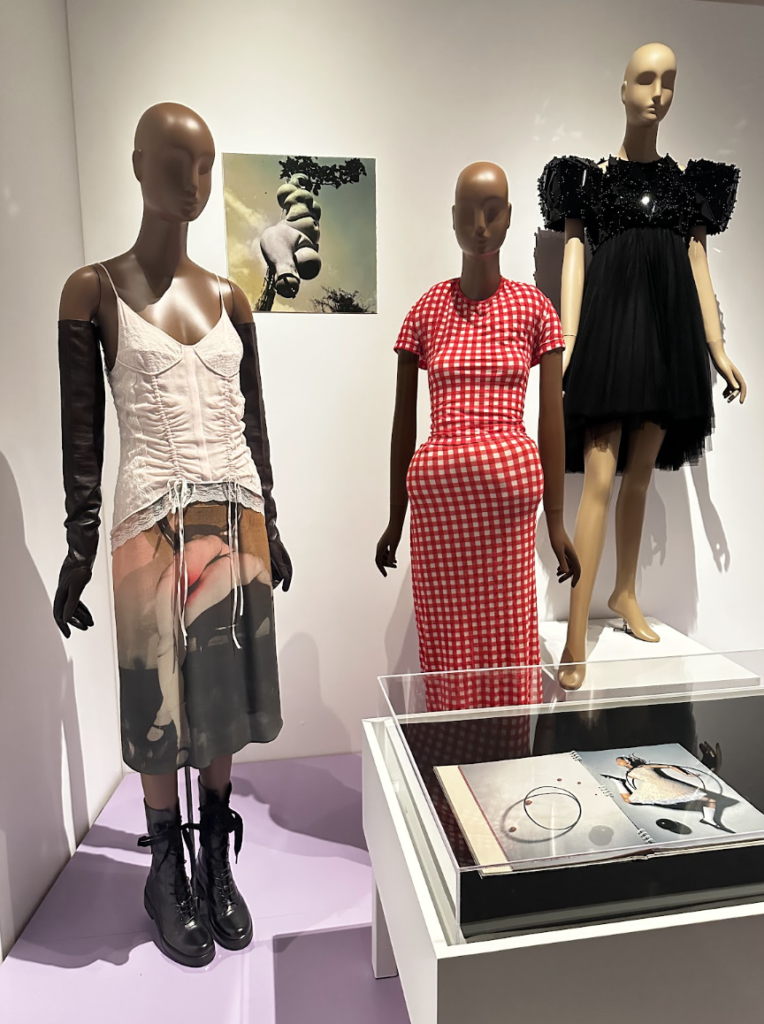
The exhibition turns down a different road as one enters a corner and is faced with the darker, violent meaning a doll can have. What I appreciated about this section of the show was the wall text accompanying the Hans Bellmer art. Bringing light to how the images are violent, misogynistic, and pedophiliac. Naming the exploitative nature of the art and the terms of how the doll is used in an explicit context, was a welcomed surprise for me. Other designers, Rei Kawakubo and Mert Alas and Marcus Piggott, showcases ways to embody the distorted forms and poses of the fractured Bellmer doll through padded and swelled gingham cloth for Body Meets Dress, Dress Meets Body and binding a contortionist’s joints until she appears ball-jointed. The idea of the violated female form is expanded upon the Kinderwhore section staged next to Bellmer’s area. Kat Bjelland and Courtney Love, along with others, embraced the fragile, damaged doll. The wall text explains the aesthetic of what it means to be a kinderwhore including the tattered vintage dresses, bleached hair, and smudged makeup. The record covers of these music artists were filled with dilapidated dolls. This room of the exhibit views the doll as both an instrument of violence towards the female body and as a weapon for women to use against this violence.
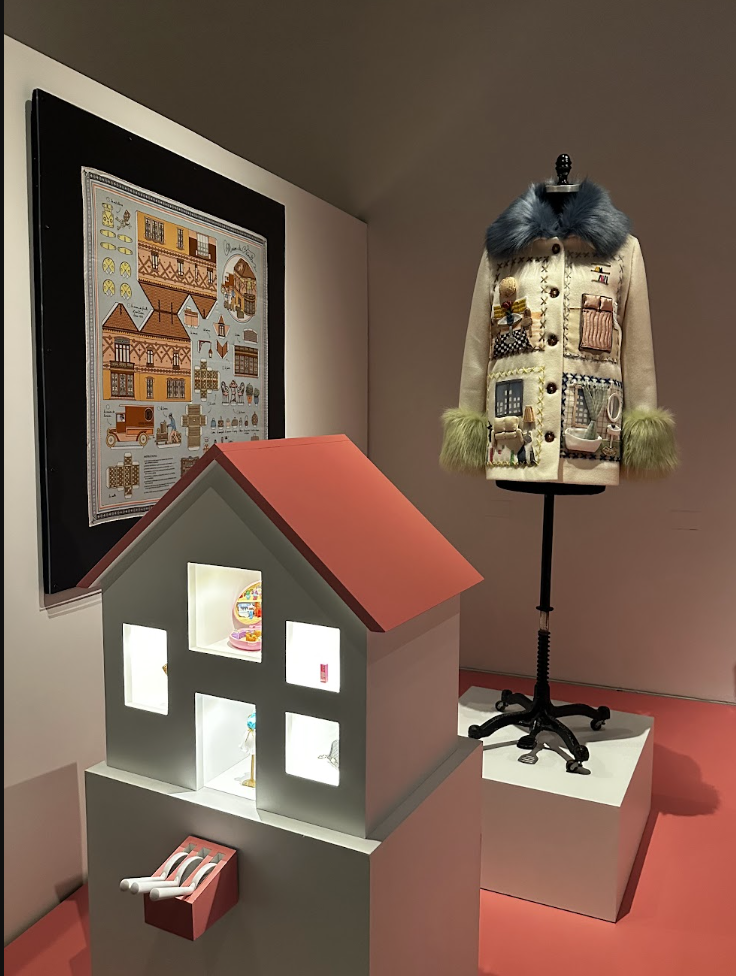
Other objects have fashion designers' more literal approach to dolls, and their designs are included in the exhibition as well. Maison Martin Margiela, fall 1994 collection gives a taste of doll life to a world of humans, Margiela blew up a doll’s clothing 5.2 times and put his models in them. Oversized stitches show the doll clothing’s clumsy construction and fit that no body could fill. Lirika Matoshi and the Apartment Coat, the coat has a bookshelf, a dining room table with a vase of tulips on a checkered rug, a bed made up in pink. These are just some of the tiny rooms appliquéd to a gorgeous cream wool coat. Whoever wears this coat carries her dollhouse with her, on her back. And, of course, what would a doll exhibition be without the most famous doll of them all? Entering Barbie’s section, the walls are not straight like in the previous sections. They rise to a peak to create a roofline. The floor is covered in a soft mint green. In the back, an oversized, white wardrobe trunk is open like the carrying cases children would use to transport Barbie’s clothes. Human-sized replicas of her outfits are hanging on the rails.
With my brief overview of this exhibition, I hope to leave a desire to go see the show in its full capacity, as there are even more aspects of the doll that the show explores. The “Doll Dressing” exhibition showcases the deeper levels of what doll means and how it exist as a term for multiple things at once: from being the canvas of self-invention for the trans woman, Lolita fashion of an overseas subculture, the kinderwhore, to the idea of the impossible fantasized “ideal” body for all women through the societal gaze.
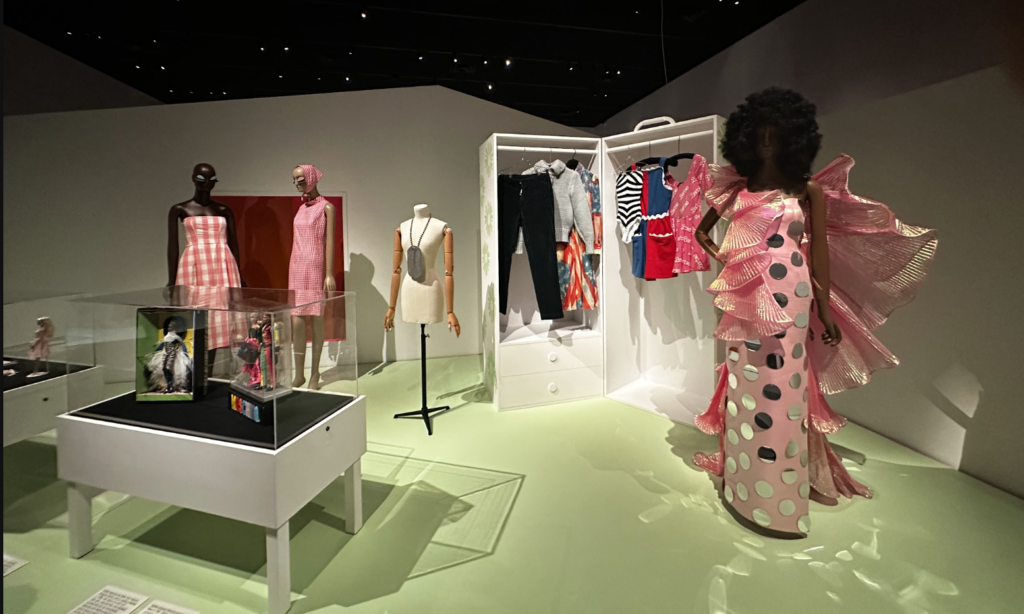
Cover image credit: Opening row of Fashion Dolls portion of the exhibition. Photo by Vivian Yip.