

Ikat Enchantment: Contemporary Tie-Dyed Textiles from India
On view: Textile Arts Center, 505 Carroll St, NY 11215
Gallery hours: Saturday through Thursday, 11am - 9pm (closed on Fridays)
Saturday March 7 - Wednesday March 18, 2026
Opening: Saturday March 7, 6:30pm - 9:00pm
It is a tremendous privilege to feast one’s eyes not only on the obvious beauty of textiles, but also on the effort and mastery of their makers. In the latest exhibition at TAC, visitors are guaranteed not only the euphoria of saturated colors and vibrant patterns, but also a sense of 'enchantment' at the sight of such skill, patience, and dedication. Close observation of the warps and wefts of these contemporary Indian patolas is sure to impress: the painterly qualities inherent in the ikat process reveal an unmatched sensibility for pattern, color, and texture. Particularly for young people who have grown up surrounded by technology, this exhibition is not one to miss.
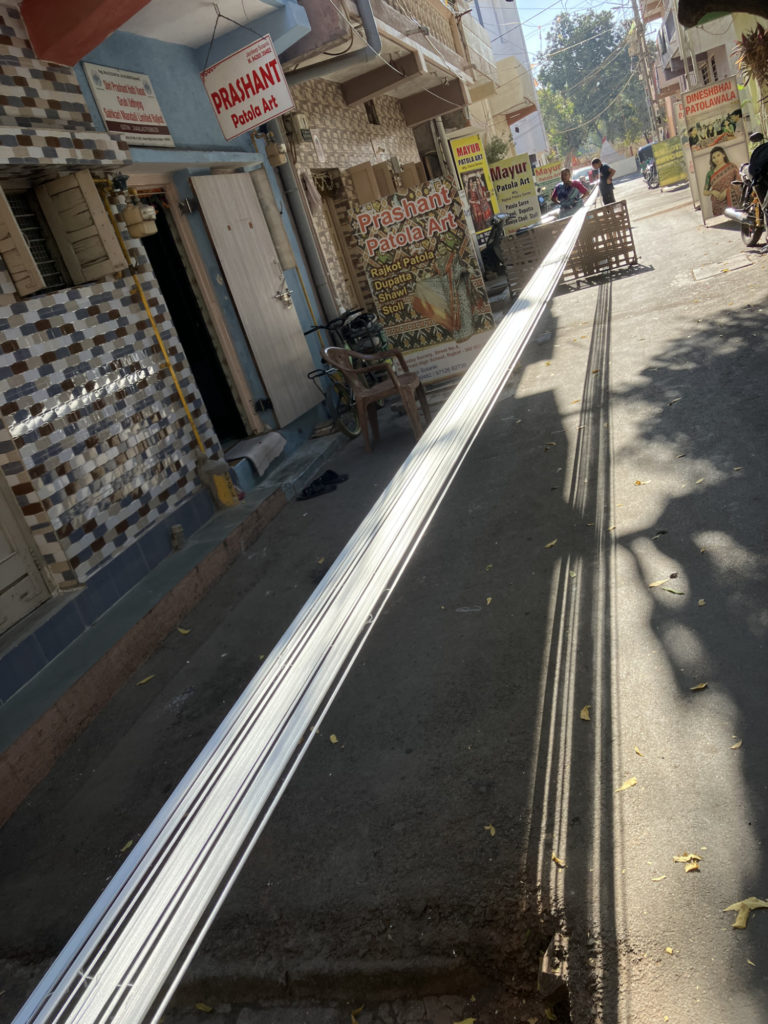
An exchange between Dr. Urmila Mohan, co-curator of the upcoming exhibition at the Textile Arts Center, Ikat Enchantment: Contemporary Tie-Dyed Textiles from India, and Geo Barrios, Artist Programs Intern.
G: What draws you to textiles as a means to understand human social behavior?
U: My childhood home in Chennai, Tamil Nadu, during the 1980s, was next to a large field owned by a government textile cooperative where weaving exhibits were held throughout the year. These coincided with the Indian religious and national calendar and, since new sarees and clothing are donned on festive days, there was a lot of textile-related activity from the building of pavilions to the crowds thronging the stalls. I would watch this from my balcony and maybe somewhere it entered my subconscious.
G: I imagine you grew up at home with lots of textiles around you. What is your general relationship to making and craft?
My mother and grandmother were very talented makers, and I have seen samples of their work since childhood, ranging from homemade clothes to hand-painted curtains. And then, I was exposed to a range of artisanal textile forms when I studied at the National Institute of Design in Ahmedabad, India as well as prevailing discourse that connected design to craft and nationalism. Following that I was in an MFA studio art program, ostensibly in ceramics, but in which I found myself pivoting to textiles! My research has been influenced by all of this and it is difficult to think of art, craft, and design as separate from each other or from living and livelihood. I think that is the social and cultural complexity of places where artisanal work is still done as a family-based practice. Such phenomena demand a social and cultural exploration in conjunction with methods from art and aesthetics.
G: I am familiar with Indonesian ikat, and considering Indonesia is not particularly close to Gujarat, do you get a sense that the Gujarati patola developed out of that historical trade and Gujarat's position as a critical junction between East Africa and West Asia? Or Gujarat's position in the greater trade markets globally?
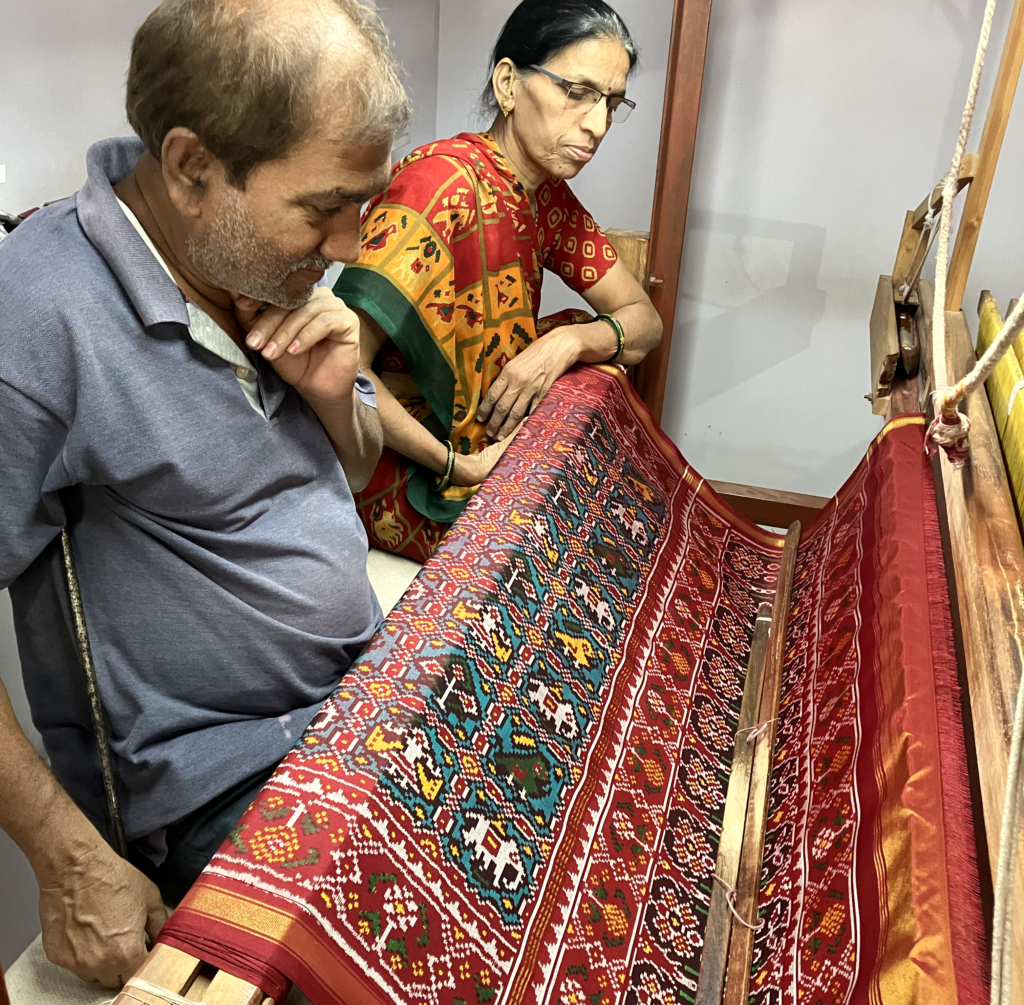
U: From the ethnologist Alfred Bühler’s work on Indonesian ikat and on Gujarati patola, we know that the types of cloths made for Indonesia were generally different from those made for local clientele in India. Within that broad format there were some crossovers, and shifts in pattern or color preferences may have been part of that back-and-forth dynamic, converging at some points in time and diverging at others. This is why what we recognize as patola in the 20th century may be different from what was traded, say, in the 16th century although the general format may have stayed the same. The location of Gujarat on the western coast of India and its seafaring, mercantile, and entrepreneurial communities are often cited as the reason for such vigorous and continuous textile production, creativity, and trade. This is much like how ikat influences are going in all directions today, for instance, between Central Asia and India or Central Asia and Indonesia, and even within India there is so much mobility. I think, in textile studies, traditional artisanal forms are viewed as static or so localized that they don’t change–how ‘influences’ are incorporated, rejected, or ignored at the ground level is not so explored. However, that is changing and this is all for the better.
G: With all of that movement, what formal artistic elements can we look for to distinguish a patola as distinctly Gujarati or Rajkoti in nature?
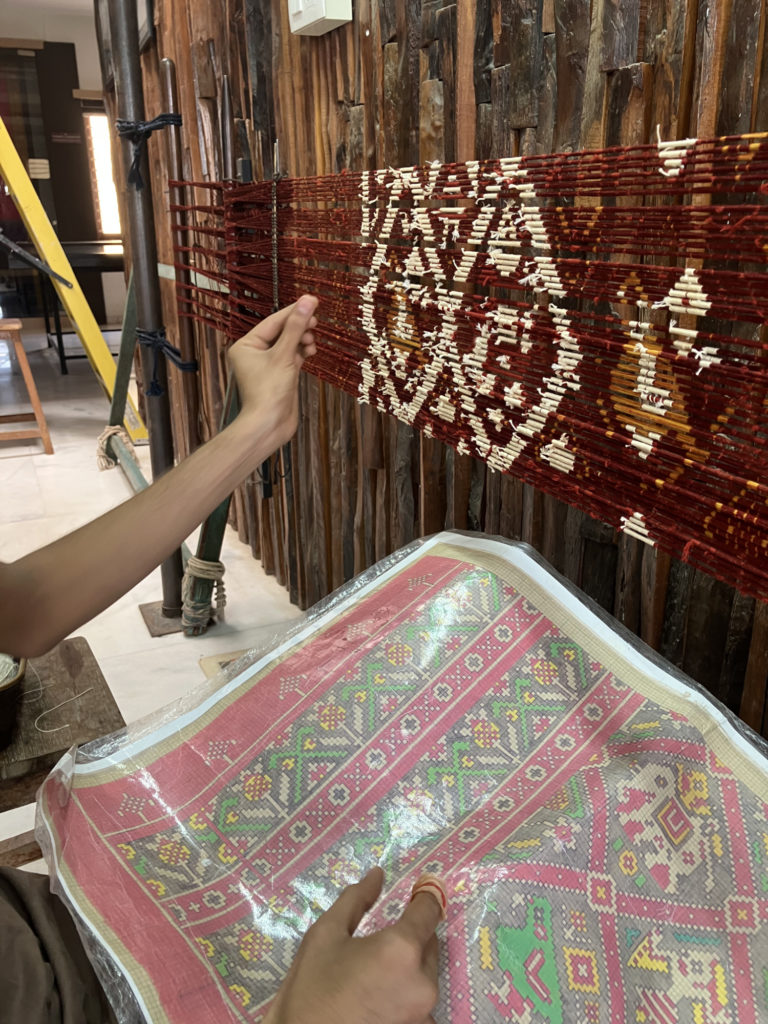
U: Rajkot patola is quite distinctive in many ways although its early history was based on ‘copying’ patterns from Patan patola. Very quickly those patterns were altered for a range of markets and commercialized. But the meaning of commercialization is also contextual and doesn't simply mean that quality deteriorates or that something is unsustainable. In balancing labor with costs, motifs were sometimes simplified, and for a consumption-oriented Indian middle class of the 2000s onward, display value was added through ‘gold’ thread borders, double shade weaves, ‘fusion’ patterns, etc. Probably the biggest innovation is that weavers figured out how to make double ikat fabric on a floor loom and they have a strong market patronized by the rising middle-class and elite. All of this is illustrated by textiles on display in my exhibit [at the Textile Arts Center], and during my talk on March 9th I will share changes in loom technology as well as some kinds of pattern diversification.
G: Considering these different workshops have always tried to stand out amongst their competitors, can you speak to the emergence of schools of patola in the 1950s and 60s?
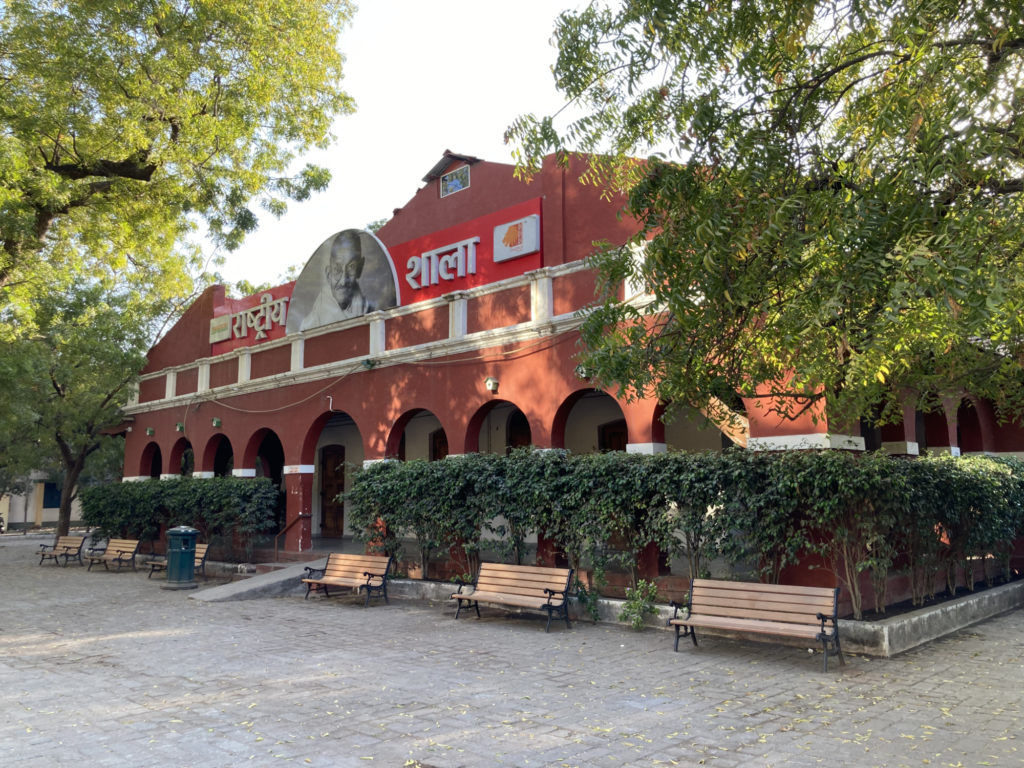
Artisanal textile communities are adjacent to the fact that agriculture is still the occupation of a majority of Indians. Modern India has had extended governmental support for textiles since its Independence from the British in 1947 and one example is the Gandhian school called Rashtriya Shala in Rajkot where traditional Patan patola-making was taught over two sessions,in the 1950s and 1970s. Moreover, it was part of a movement and belief that hitherto caste-limited knowledge could be shared and ‘democratized’ as part of a livelihood and poverty alleviation scheme. That workshop was subsequently closed and now Rajkot patola-making happens through family-based entrepreneurs, with most of the artisans actually in Surendranagar but also spread over other parts of Gujarat.
G: And in the transition from British colonial rule, through partition, and Indian independence and sovereignty, does patola emerge as a distinct textile in the development of a sort-of national identity?
U: In terms of nationalism and sovereignty as identity, yes, artisanal textiles, especially ones like Patan’s patola which were made earlier for specific elite communities and aristocracy have also become democratized. It has happened through a heritage industry and touristic route which gives it a certain kind of cultural capital. I try to stay agnostic myself about the aesthetic merits of Patan and Rajkot patola, and so I term it an issue of taste which in turn, becomes an agentive social force. You can see something similar happening when UNESCO certified monuments and World Heritage Cities become sites for the tourist and heritage economy. Since neo-liberalization in the 1990s, Indian artisanal textiles have both been revived for middle-class and elite consumption and it’s interesting how, depending on the ‘quality’ of the handmade work, one craft form might be seen as more spiritually-crafted, refined, and elevated, and other is seen as more hastily-made, soul-less, and commercial. These value distinctions and contestations emerge as different agents stake out positions in the heritage textile economy and certainly, a lot of creative forces have been unleashed.
G: [Focusing] on the contemporary textile artisans and practices in Gujarat, what are some ways the Gujarati textile industry might show up in someone's life across the Atlantic?
U: Indian Rajkot Patola weavers come to New Jersey and the tri-state area with sarees in their suitcases and sell in person to the Gujarati Hindu and Jain diaspora. Conversely, the diaspora visits India to buy directly from well-known weavers. Also, block-printed and embroidered fabrics, beadings, appliques, etc. from Gujarat may bear similar patterns, and certain motifs (dancing woman, elephant, flowers, pot) are auspicious elements that can be commonly found. You may see these motifs used in a sari or lehenga-choli (blouse-skirt) at a Gujarati wedding or garba dance event, for example. Patan’s patola used to be made for the Gujarati Bohra Muslim community as well and so it is possible that their descendants, if in the U.S., have these as family heirlooms. Older patola pieces, especially double ikat Patan patola, can be found in New York estate sales, antique shops, and museums.
G: Considering the use of water in textile dyeing, how does ecology emerge in the patterns and colors of the textiles?
U: Patan patola weavers do use natural dyes in some of their textiles when they have special commissions but these cost in the thousands of USD and would require a specific market. The spiritual ecology shows up in the color, brightness, and sheen of textiles and the vitalizing power they transfer to things in the vicinity. Certain patterns like leheriya could be interpreted as wave- or water-like while a more indirect connection can be made between patterns on historic stepwells like Rani-ki-Vav in Patan and the motifs on patola. As mentioned earlier certain flora and fauna also appear such as auspicious motifs of flowers, certain animals, and ceremonial figures, and these could be considered part of a cultural ecology.
G: We are all incredibly excited to see some of these examples in the exhibition opening soon. What would you like audiences to take away from the exhibition? Would someone's ‘enchantment’ towards ikat and maybe an attempt to produce with the technique be a marker of success for you?
U: Thanks for emphasizing the term ‘enchantment’ as it points to both the exhibit title as well as a curatorial goal. As an anthropologist with a background in art and design, my educational approach is one of making as relationality. So, my goal for the exhibit, as a real-life place of education, would be to hope that people are indeed enchanted by something in the exhibit, and that it engages them to create whether in the form of an idea, a conversation, writing, drawing, or trying to reproduce a technique.
Ikat Enchantment: Contemporary Tie-Dyed Textiles from India, curated by Dr. Urmila Mohan and Romina Chuls opens on Saturday, March 7th, 2026 at the Textile Arts Center.
Dr. Urmila Mohan is a leading public-facing anthropologist, editor, and publisher whose work examines how sociocultural values are circulated through cloth, bodily practices, and belief systems. She holds a Ph.D. in Anthropology from University College London, and has a background in art and design. Her ethnographic research is based in India, Indonesia, and the U.S. and her most recent work on Gujarati patola was funded by a Fulbright-Nehru Academic and Research Excellence Fellowship. She is part of global working groups and supports innovation through her platform, The Jugaad Project (www.thejugaadproject.pub).
Dr. Mohan’s research has been supported by the Fulbright Program; Asian Cultural Council, New York; Nehru Trust for the Indian Collections, Victoria & Albert Museum, London; and The Rotary Foundation International. Her research includes an ethnography of Hindu devotees who make garments for their deities (Clothing as Devotion in Contemporary Hinduism), a curatorial study of Balinese ritual textiles at the American Museum of Natural History (Fabricating Power with Balinese Textiles), and an exploration of how designers sewed masks to protect fellow citizens (Masking in Pandemic U.S.). She theorizes the materiality of practices in her edited volume, The Efficacy of Intimacy and Belief in Worldmaking Practices.