

TAC Youth Educators Exhibition: Threading the Needle
Exhibited October 18th-26th, 2025 at the Textile Arts Center, 505 Carroll Street, Brooklyn, NY 11215
Threading the Needle features works by past and present Youth Educators of Textile Arts Center.
"Threading the Needle uplifts the craft of teaching and the creativity of the Youth Educators of Textile Arts Center. Together we examine the intergenerational artistry that exists at the intersection of care and play in the context of craft, and the reciprocity that unfolds uniquely at TAC.
Care in TAC Youth Programming comes in many shapes and forms. It looks like empowering a Young Maker to thread a needle and tie their first knot. It looks like generating a lesson plan that guides us along multiple learning pathways, exploring global textile history, material culture, and world building. It looks like meeting the students where they are; after a long school-day or early morning at camp. It's fostering an environment to explore textiles; valuing the experience of the young maker.
The spirit of play goes hand in hand with care. The act of playing is a remedial vehicle that drives meaningful and joyful conversations. The freedom of play emerges from respecting ourselves, others, and the shared studio. As educators, we maintain a space where knowledge is decentralized; students and teachers are collaborators. When we all agree on a shared mission, right here, right now, imaginations can safely run wild.
Weaving structures transform into inflatable sculptures, fairies become living beings immortalized through a quilt. Our imaginary buddies come alive in printed fabrics, and rhinestoned garments grow larger-than-life. Patchworks emerge from scrap bin gems. Remnants of others’ inventions are launching pads for vibrant responses to textile waste. Left over inks and dye pots are reclaimed for new projects. We are teaching, learning, and inspiring one another as the rhythm of care and play continues.
We, as teaching artists, thrive from this rhythm. We debrief, share constructive feedback, and ideate within our shared values.
How do we meet ourselves where we are at the end of a long day?
How do we put ourselves in the role of student?
How do we embody our artist selves?
How do we thread the metaphorical needle when we feel like it is impossible?"
Curated by Milo K. Godfrey, Faviola Lopez-Romani, & Kelly Valletta
Exhibiting Artists:
April Behnke, Camila Ruiz, Itala Aguilera, Flo Low, Oscar A. Chavez, Julia Scheiber,Caitlyn McLaughlin, Luisa Walther, Cedar Heffelfinger, Howard Ptaszek, Ingri Yi-Chen Lu, So Ye Oh, Luisa Walther, ben galaday, Annika Wahlsten, Susie Oh, 2ndnatsanfrat, Amanda Morales, Kathleen Quaintance, Al Dettmann, Erina Pearl, Ben Schneier, Karin Persan, Lucy Beizer, Milo K.Godfrey, Kelly Valletta
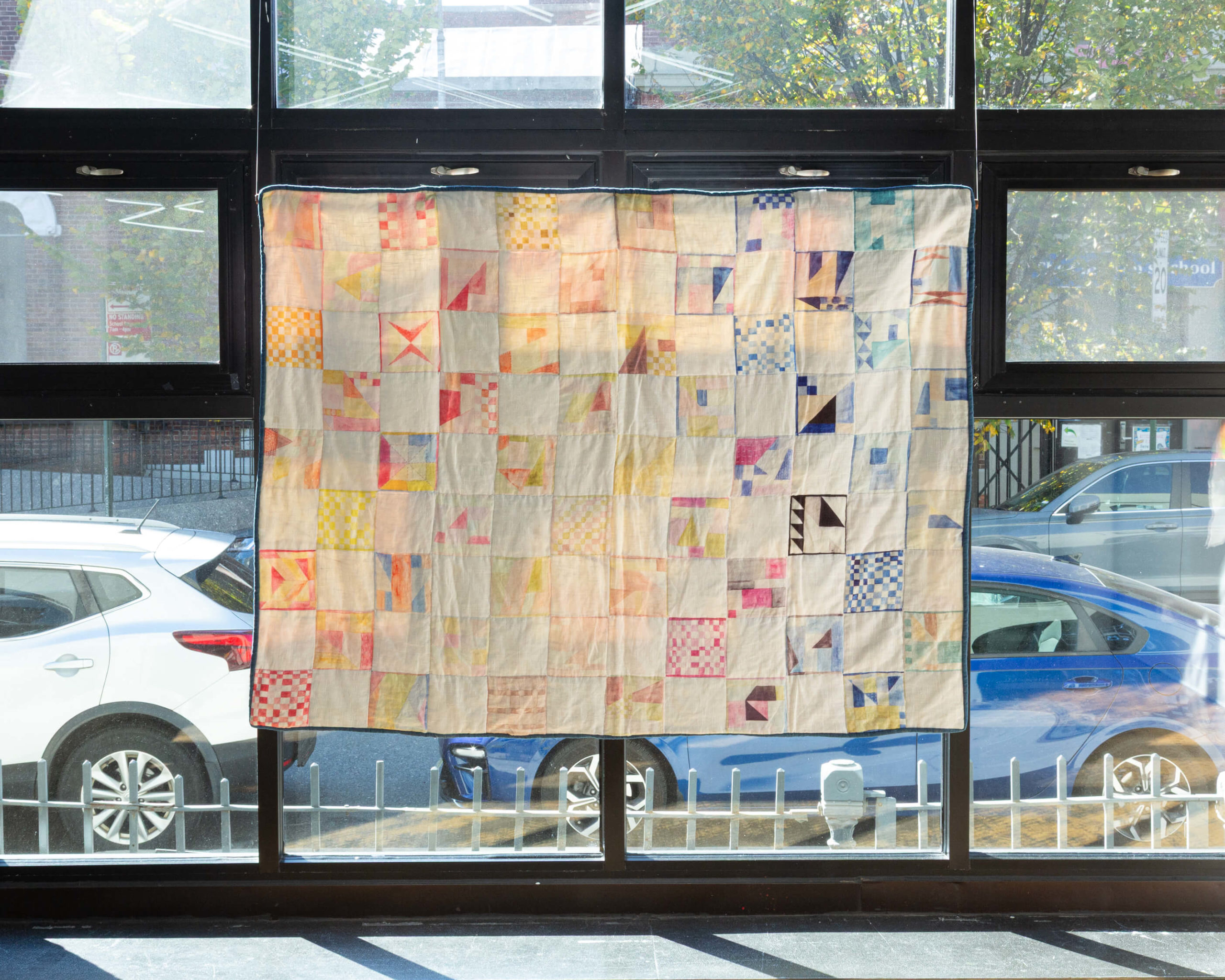
Al Dettmann
Dettmann Designs
Youth Education Assistant
Picnic in the Park Quilt
Reactive Dye on Linen, Quilting, Embroidery, Patchwork
62” L x 46” W
2023
The “Picnic In The Park Quilt” translates my Daily Practice watercolor patchwork paintings into a reversible quilt. Hand-stitched elements, embroidery, quilting, and dyed fabric are added to create a tactile textile experience that patches all of my experiences from the past five months together. The Picnic In The Park Quilt” tells the narrative of bleeding fruit in the summertime, dancing under the moonlight at midnight, and experiences of growing up queer in a community that lacked representation. Similar to the fading of color in watercolor surfaces, we all hold these imperfect bruises that remain as a reminder of our beautiful stories.
A queer fibers artist focusing on mixed-media and fine art practices, Al Dettmann's work explores worlds of color, hand-painted textures, and patchwork surfaces. In the absence of verbal language, textiles serve as their tongue. Where gender and sexuality are too hard to explain, Al turns to fragments of fibers to speak on behalf of their lived experiences. Grown from seeds of curiosity that reflect our fragmented identities, they aim to uplift queer voices through art and design. Their greatest passion is to constantly create wonders that inspire all of us to live our messy lives beautifully, boldly, and authentically.
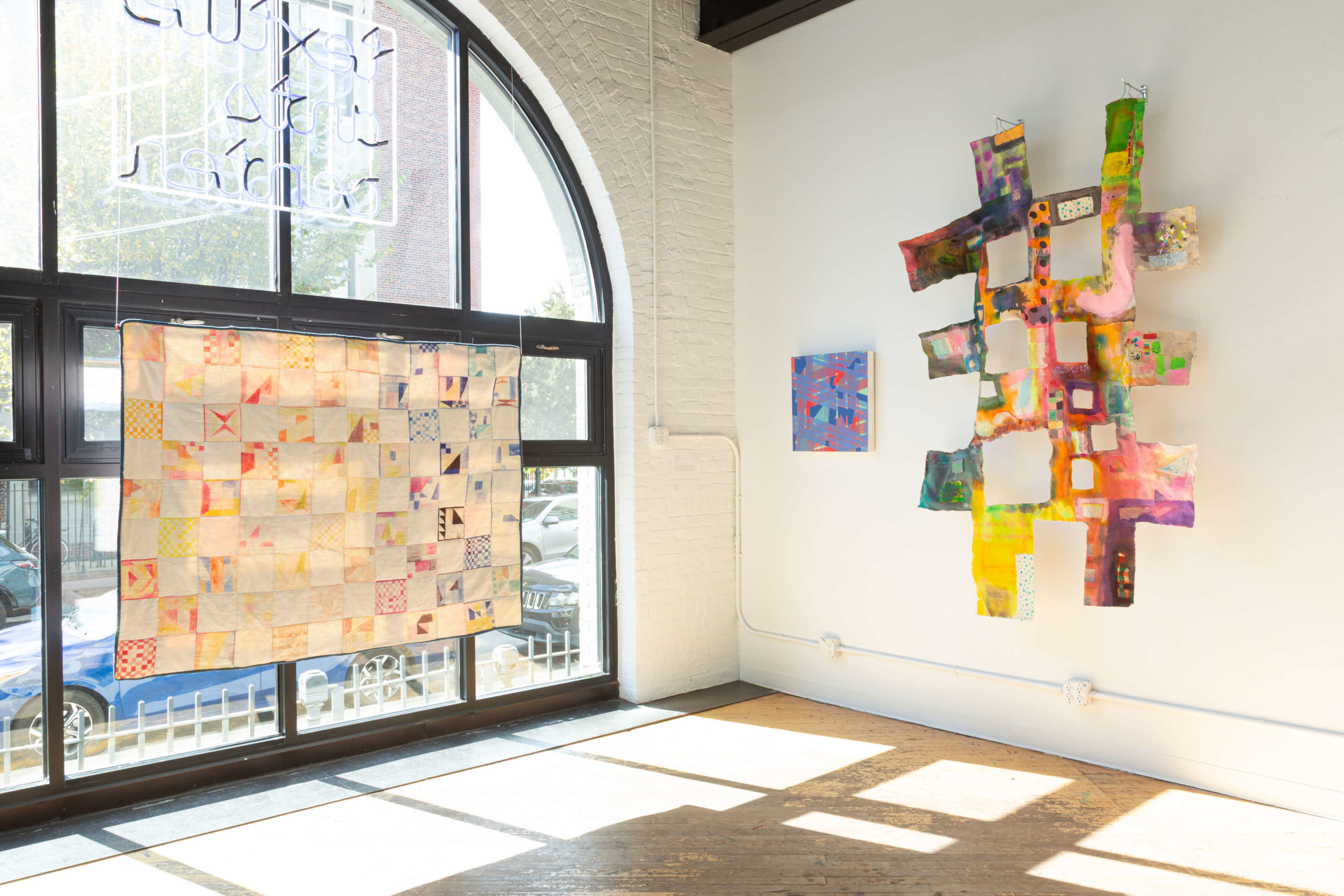
Al Dettmann
Picnic in the Park Quilt
April Behnke
Primary Play
Ingrid Yi-Chen Lu
Abstraction 101
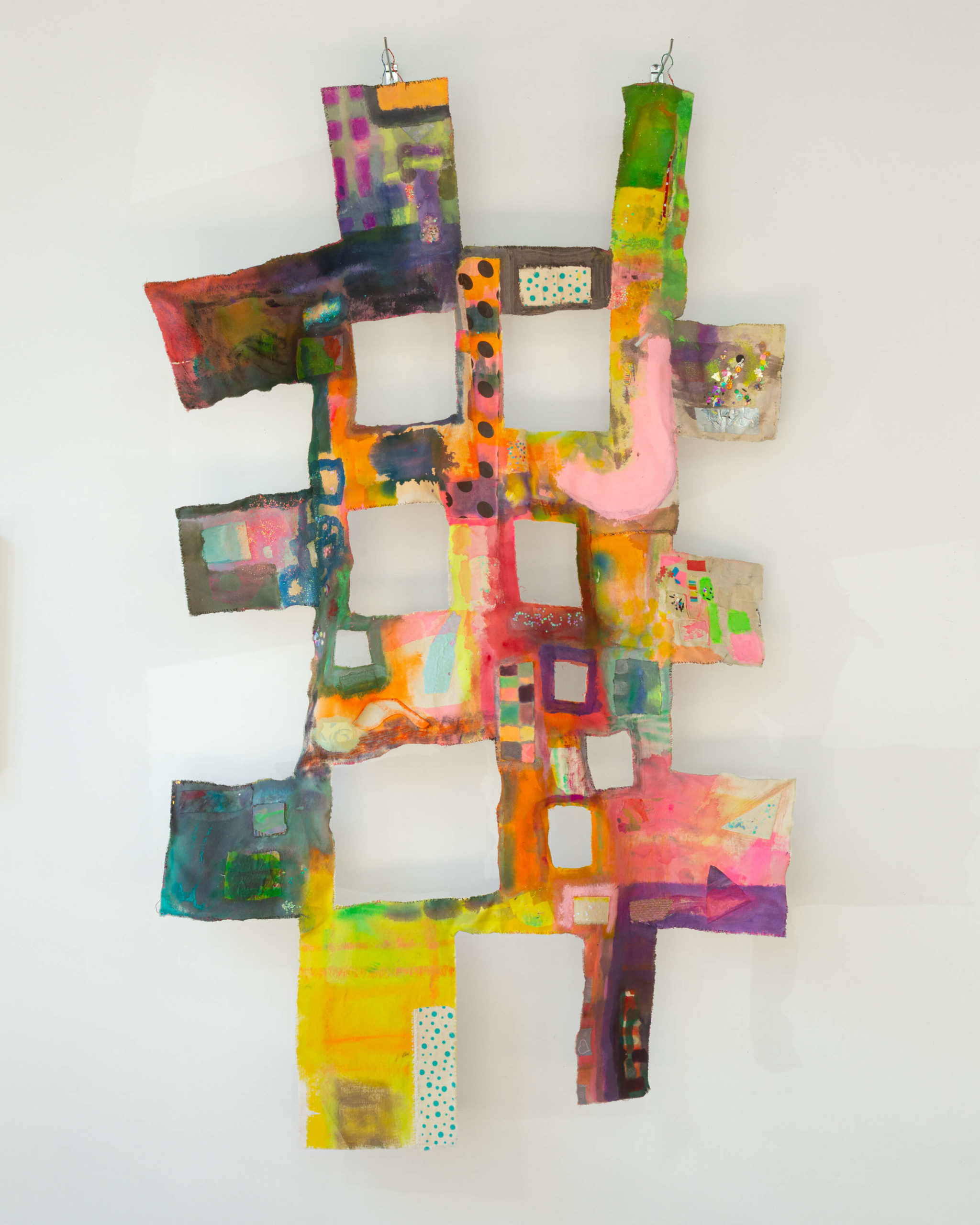
Ingrid Yi-Chen Lu
Fall 2024 Youth Intern and Youth Instructor
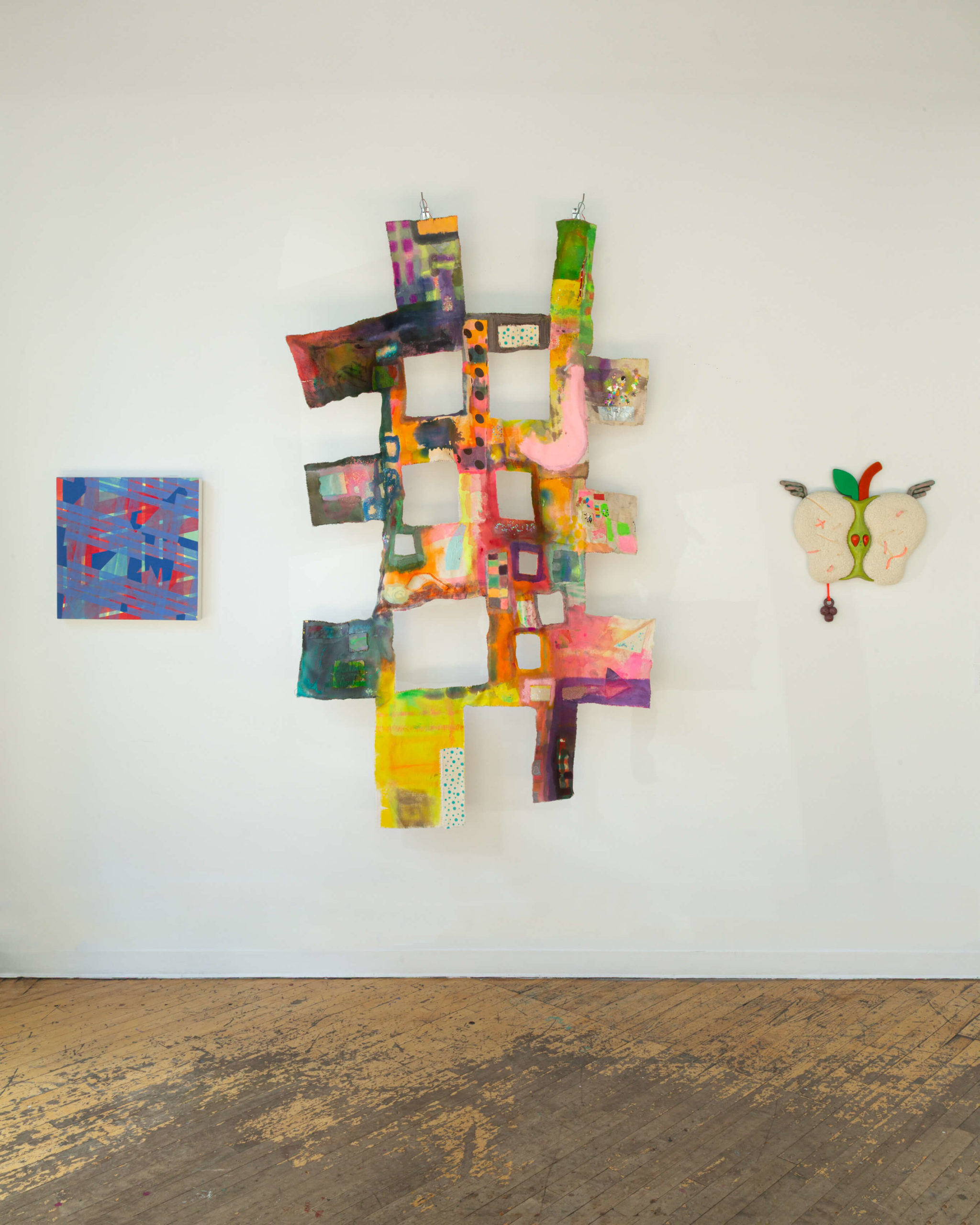
Abstraction 101
Acrylic paint, fabric paint, gesso, glitter, sequins, cardboard, fabric, wrapping paper, canvas, wire, threads, and retail display hooks
(2024)
80h x 50w x 7d in
A dyed, grid-like canvas embellished with fabric scraps, glitter, and paint splashes, hand-sewn with wire, Abstraction 101 bridges painting, costume, and a dollar store trinket. The work originated from my first lesson plan in TAC’s Youth Program, where students made patchwork tote bags. Using beginner-friendly methods like painting, glueing, cutting, sewing, the work captures the playful atmosphere of a youth learning space, where mistakes and experimentation are embraced. At the same time, the work engages with traditions of minimalist abstraction, breaking the rigidity of the grid, a recurring motif in my practice inspired by menus, store displays, and city layouts.
Ingrid Yi-Chen Lu (b. 2000, Taipei, Taiwan) lives and works in Brooklyn, NY. Her painting practice explores material processes, diary writing, and collecting habits. Drawing inspiration from childhood, mass-produced goods, and city life, she embraces DIY approaches that combine oil and acrylic with textiles, clay, and found objects. Her work has been exhibited at White Columns (New York, NY), Adams and Ollman (Portland, OR), Morgan Lehman (New York, NY), National Arts Club (New York, NY), Romance (Pittsburgh, PA), Iowa (Brooklyn, NY), Melrose Botanical Garden (Los Angeles, CA), and recently at Art-o-rama (Marseille, France). Lu holds an MFA in Painting and Drawing from Pratt Institute and a BFA in Fine Arts from Parsons School of Design.
My painting practice revolves around materiality, collecting, and systems. I explore the juxtaposition of materials: from minimal shapes to thickly layered oil paintings, fabric-wrapped surfaces, and sculptural objects. Approaching painting from an experimental lens, I shift between formal restraint, abstraction, and play. The logic of each painting begins with a material and evolves from its manipulation. I treat the making process as an event in itself: cutting, scribbling, staining, gluing, sprinkling, wrapping, and decorating.
This sensibility is shaped by my life in cities, especially growing up in Taiwan, where I spent time in stationary stores, ribbon markets, and birthday parties. I find these environments in New York, where similar spaces are filled with mass-produced goods laid out in orderly grids. Strolling through these spaces has cultivated my practice of dérive or in English, "drifting," a technique introduced by Guy Debord. I collect ribbons, ornaments, fabrics, and sequins to blend them with oil and acrylic on raw or recycled surfaces like canvas, tablecloth, cardboard, or wood. There are no hierarchies between materials, each element holds significance.
Through this process, I construct systems in which materials become paintings, paintings become objects, and objects shape space. I build shelves and arrange paintings into assorted compositions, allowing each piece to encounter its own visual challenges and find solutions alongside my developing sense of self.
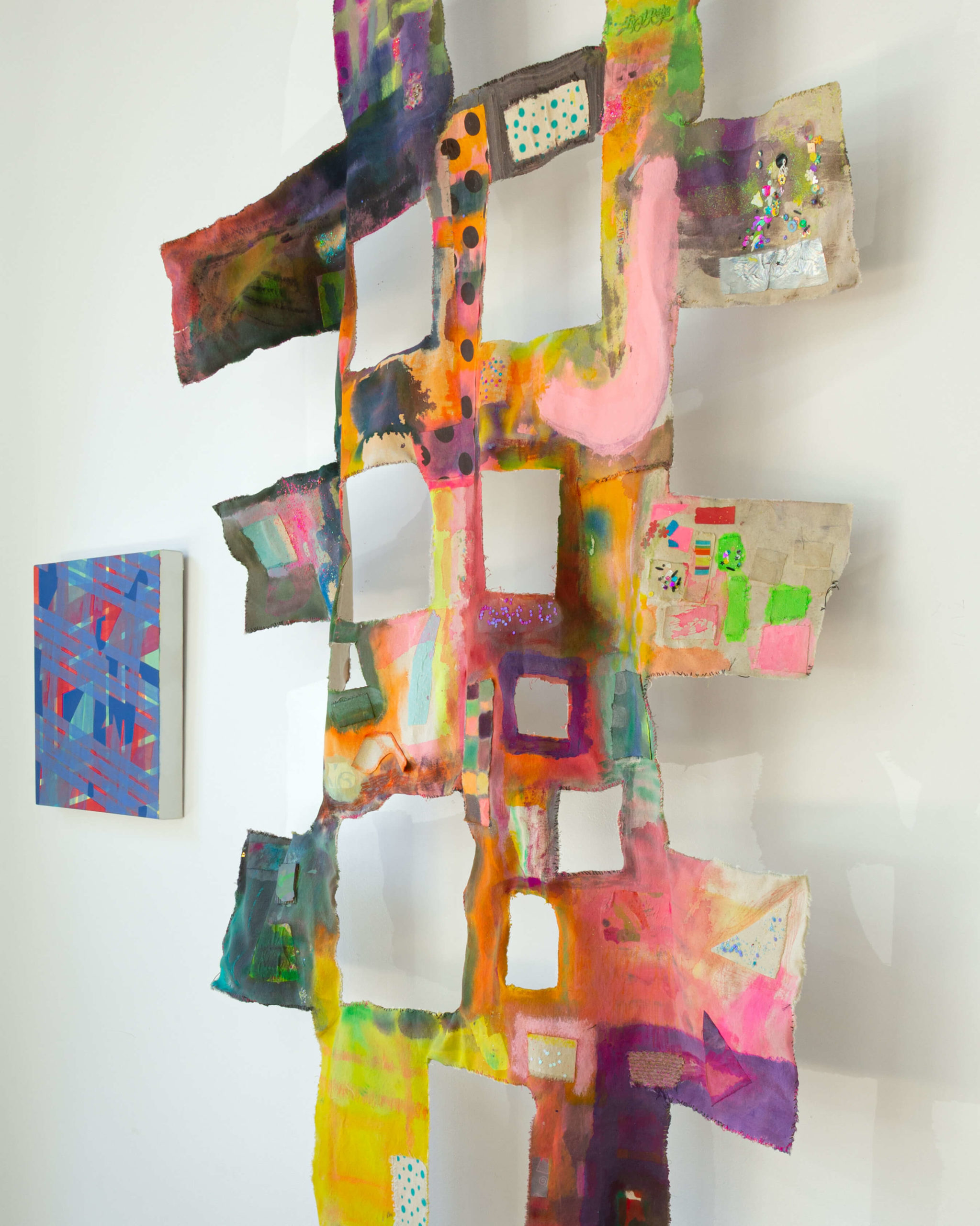
Ingrid Yi-Chen Lu
Abstraction 101
April Behnke
Primary Play
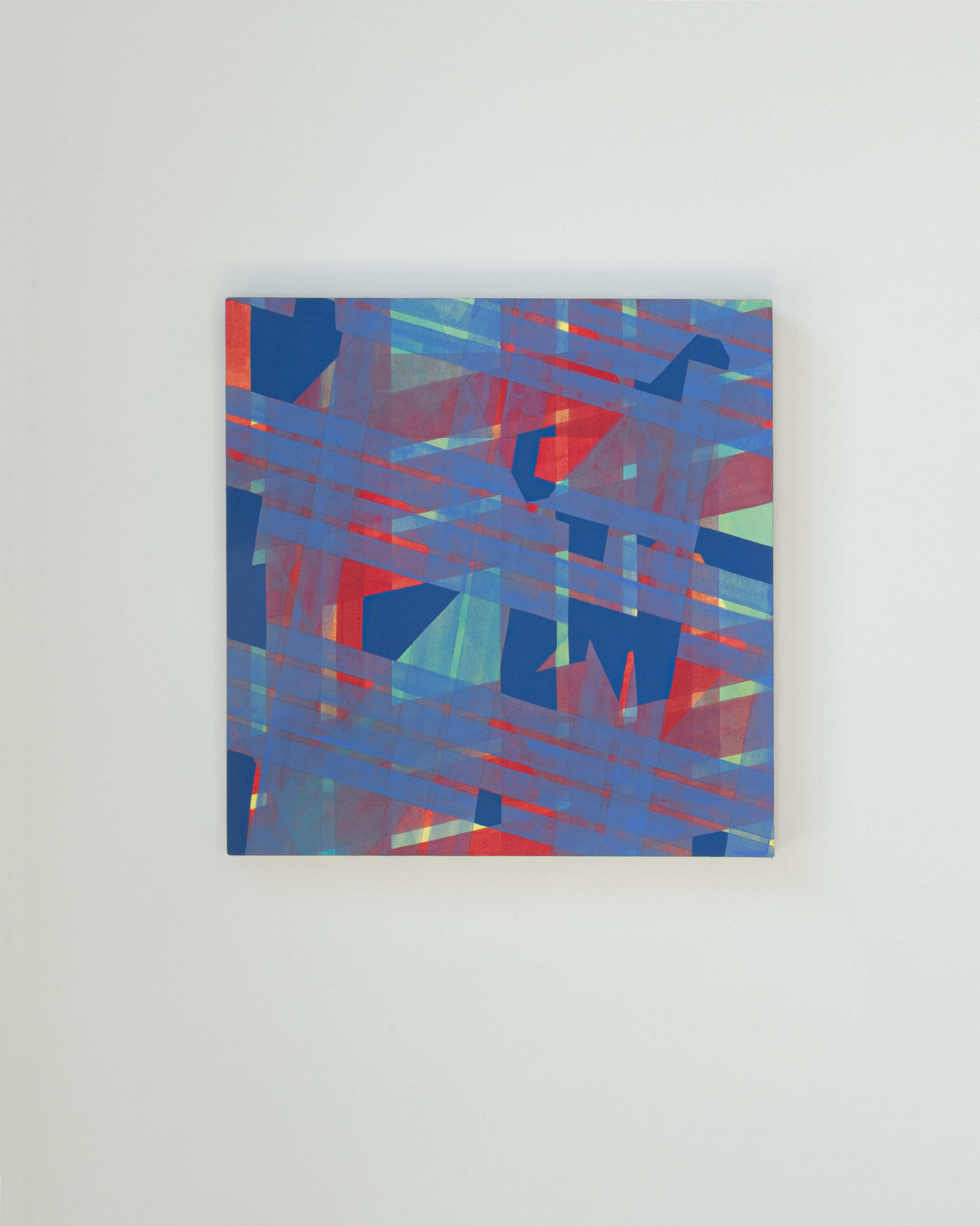
April Behnke
Primary Play
Flashe on Canvas, 20" x 20" (2024)
My work explores how patterns influence perception and how their disruption can produce visual instability. By layering shapes that break apart underlying structures and using color to blur the distinction between foreground and background, I invite the viewer to question their search for order and balance.
Color plays a central role in this process. I use it strategically to destabilize structure, allowing hues to vibrate against one another or shift between advancing and receding. This manipulation of space and tension creates an active viewing experience where the eye is invited to move, wander, and question what it perceives.
My paintings are built in layers, beginning with structured patterns that provide a sense of order. As the creative process unfolds, I improvise with both color and form, responding to how each element interacts with the others. This balance of planning and spontaneity allows the work to remain fresh and unpredictable while grounded in logic.
Ultimately, my goal is to create works that engage viewers in a playful exchange with perception itself, forming images that are both familiar and unstable, prompting reflection on how we make sense of what we see.
Award-winning artist April Behnke received her MFA in Painting and Drawing from the School of the Art Institute of Chicago in 2011 and has completed residencies at the Bemis Center for Contemporary Arts in Omaha and the Slak Foundation in the Netherlands. She has exhibited nationally and internationally, including in Mexico City, Seoul, New York City, Berlin, Chicago, London, and Basel. Her work is included in Georgetown University's art collection and has been featured in Chicago Gallery News, the Washington Post, Time Out Chicago, and on CBS News, among other media outlets.
Behnke is represented by Kim Storage Gallery in Milwaukee, WI and is based in Chicago, IL.
April Behnke
Primary Play
Ben Galaday
Soft Fantasy
Ingrid Yi-Chen Lu
Abstraction 101
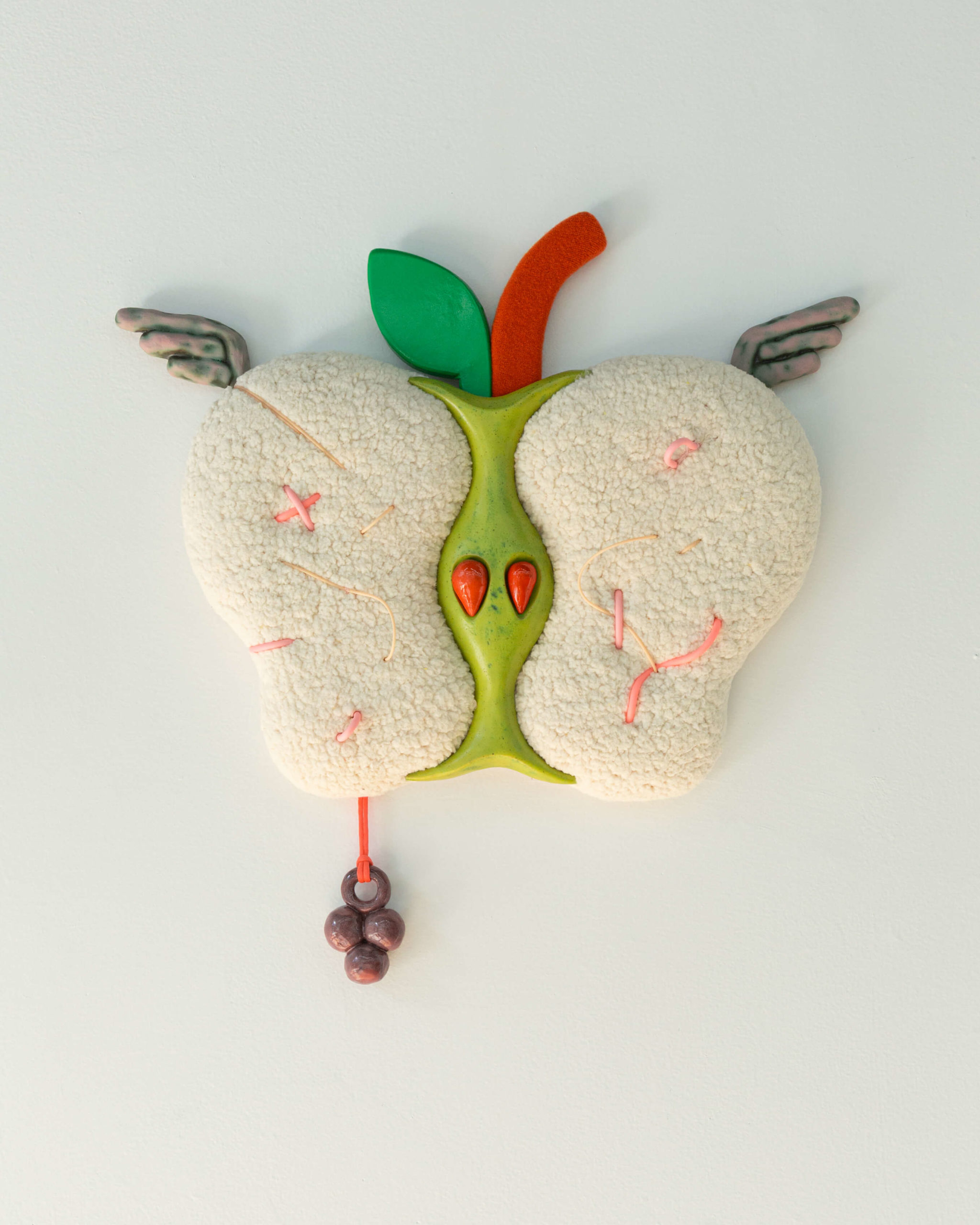
Ben Galaday
2019 Summer Camp Instructor
Soft Fantasy
Plywood, foam, fabric, ceramic, silicone tubing
23” x 23” x 3”
2023
Living in a dog-lick-frog world, Ben Galaday
handcrafts bespoke Twiddle Muffs and other therapeutic objects in the Dreamcore aesthetic for adults living with undiagnosed dementia in NYC.
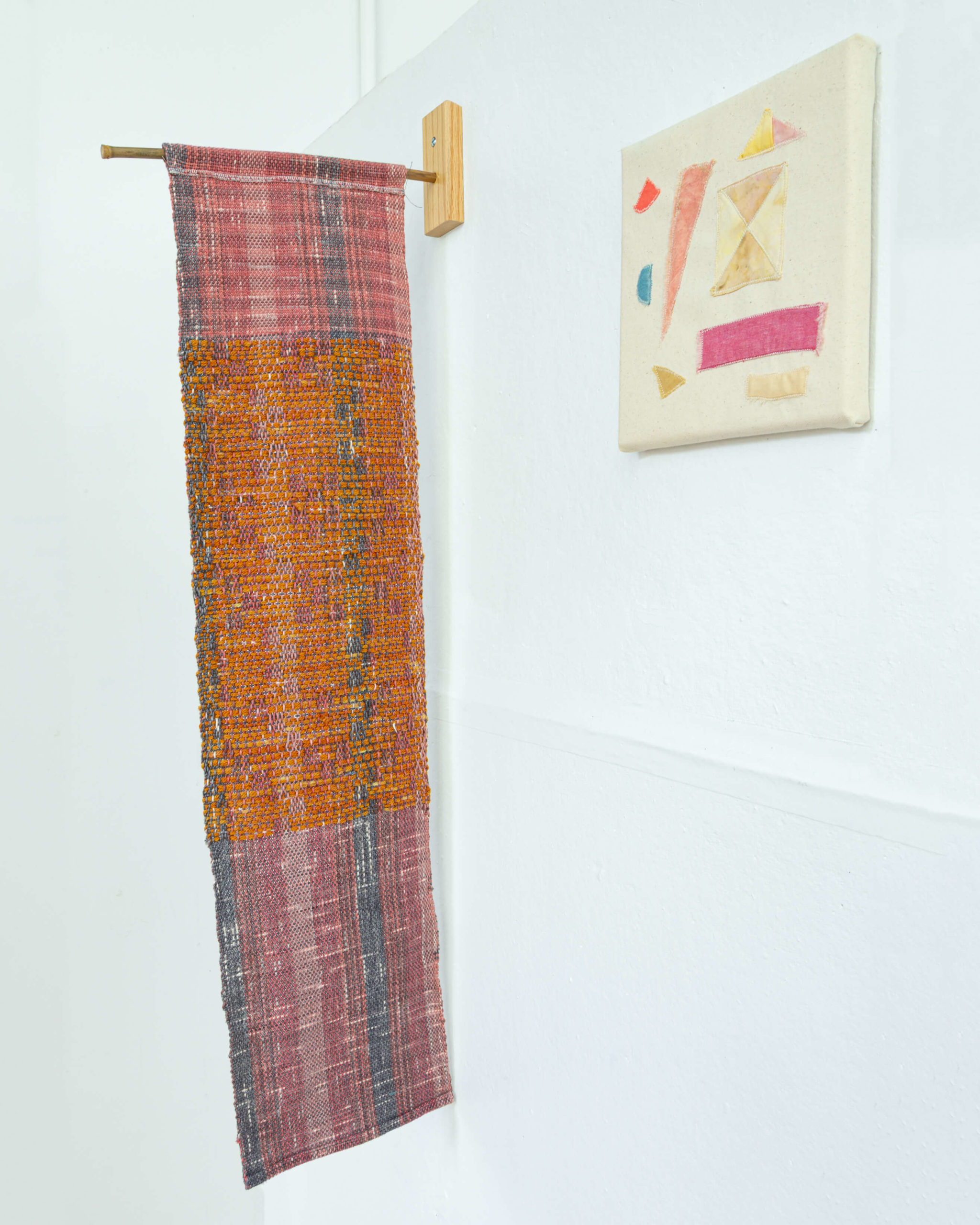
Kathleen Quaintance
2023 Summer Camp Instructor
Summer and Winter in Natural Dyes
Cotton dyed with marigold, osage, logwood, iron, citric acid, cochineal and madder
34", 8.75"
2025
I make objects to teach with. As an art historian, I often find that my students connect more with history when it is tactile: when they can touch fibers and smell dyes, the past comes to life.Words can only do so much when it comes to teaching and learning, and I find it necessary to supplement them with physical objects. I make these objects not necessarily in order to fulfill a need for artistic expression, rather, they are made in service of knowledge. Materials are chosen to illuminate the possibilities of natural dyes, the range of shades attainable through dyers' chemistry, and the distinctive elements of woven structures. They transcend temporalities, demonstrating how modern making can interact with age-old techniques.
Kathleen Quaintance is an educator and PhD candidate in the department of History of art at Yale University. She teaches a range of courses on modern art and craft, researches textiles in the 20th century, and maintains a practice of weaving, dyeing, and stitching in order to bring hands-on experience to students of all backgrounds.
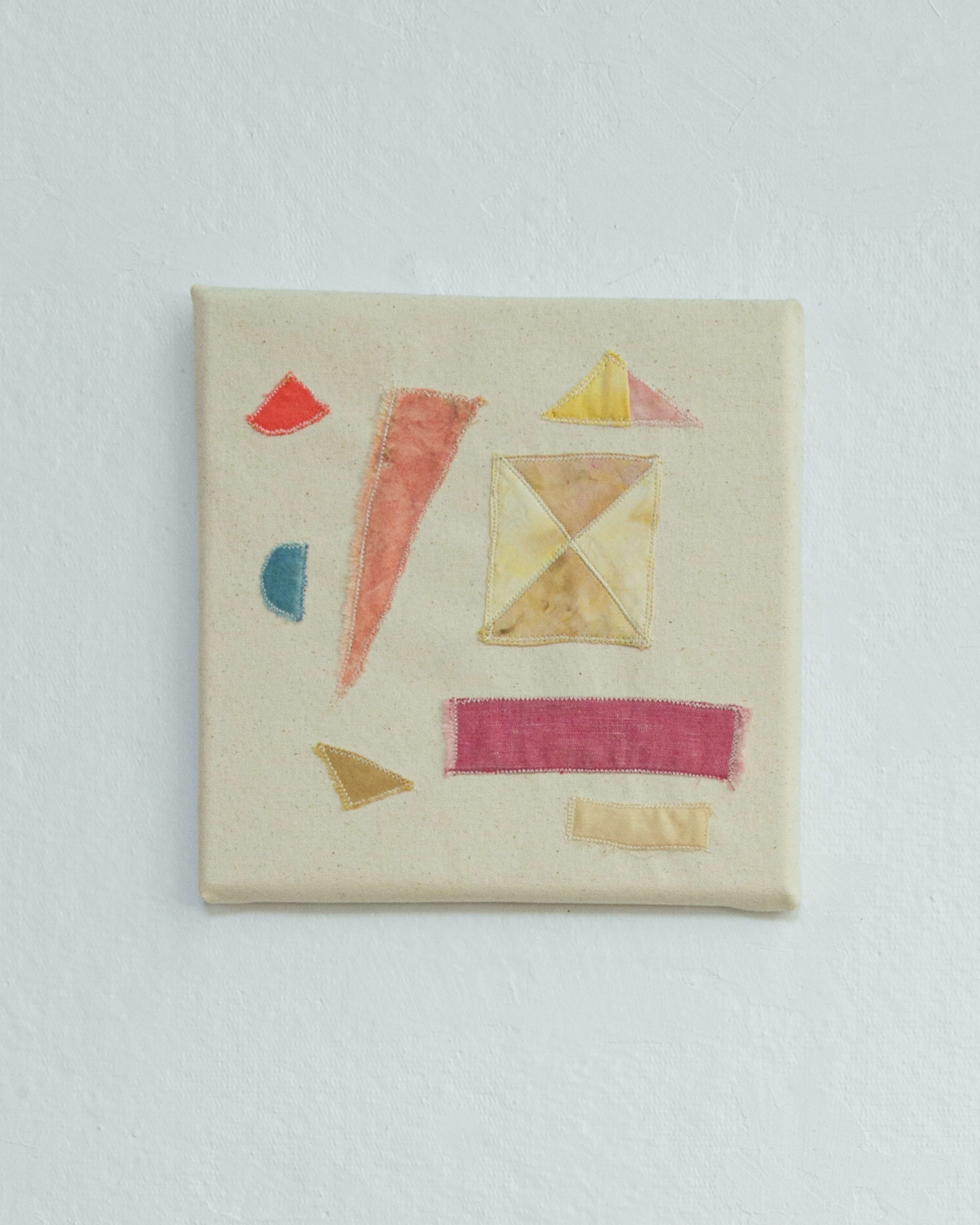
Amanda Morales
Youth & Adult Educator, Summer Camp Visiting Artist
Fantasy Playground,
Fabric on canvas, 8" x 8"
As an artist I am interested in the intuitive and unexpected, and creating beauty from the natural world and re-arranging existing materials. Working with textiles connects me to the caregiver within me, and I want to create things that feel nurturing and engaging for the viewer.
Amanda Morales is an artist and educator living in Brooklyn, NY. She is inspired by nature, transformation, her studies in philosophy, spirituality, and fine art.
Amanda holds a degree in Philosophy and Art & Art History from the College of William and Mary, with continuing study at SVA, Hunter College, and Art Students League.
She currently teaches sewing, quilting, and natural dye to children and adults at the Textile Arts Center and The Level Up Project.
In addition to her art practice, Amanda has held numerous leadership positions in arts orgs and nonprofits, and still works with select organizations such as Frieze and The Cooper Union.
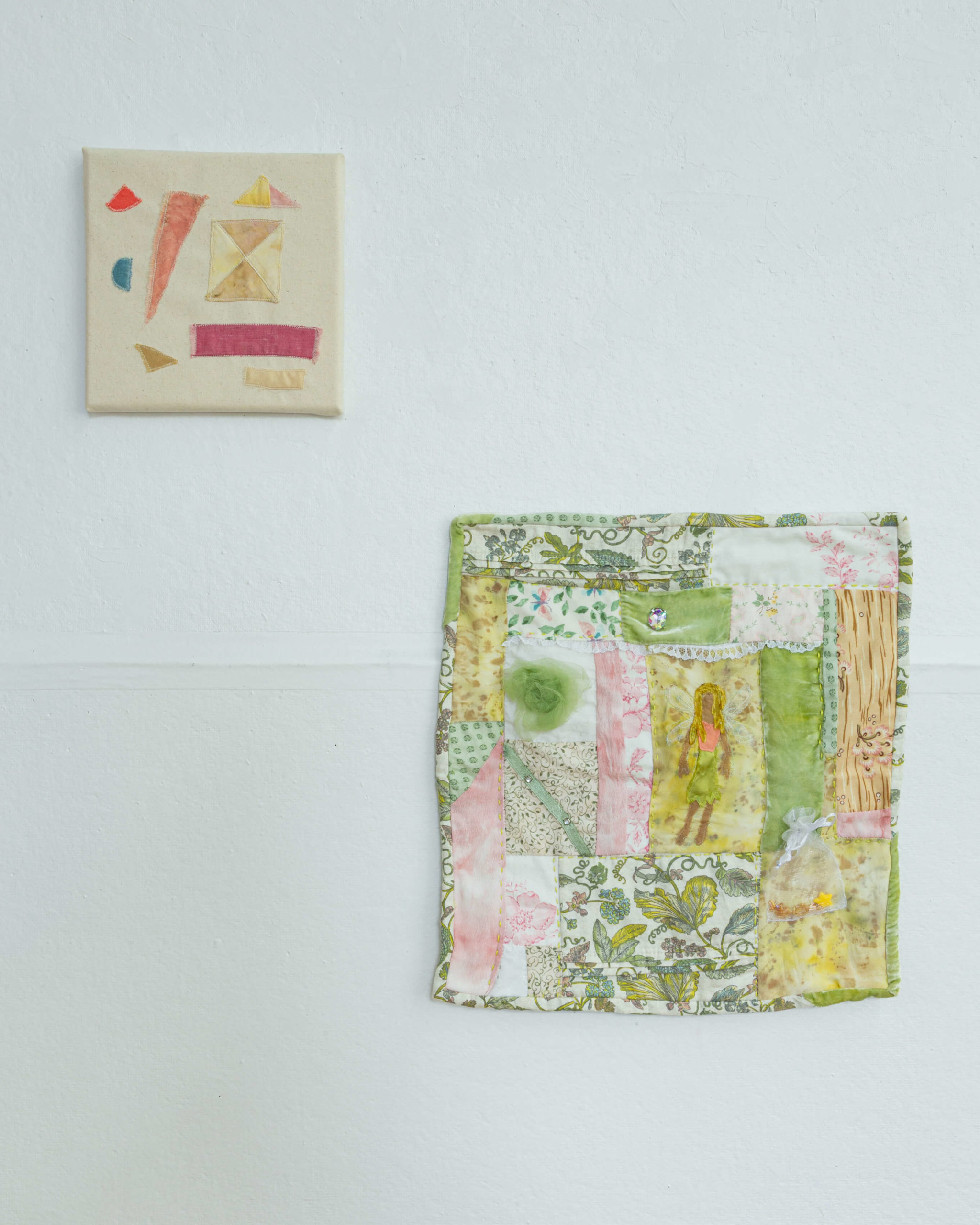
Amanda Morales
Fantasy Playground
Lucy Beizer
Fairies are Real
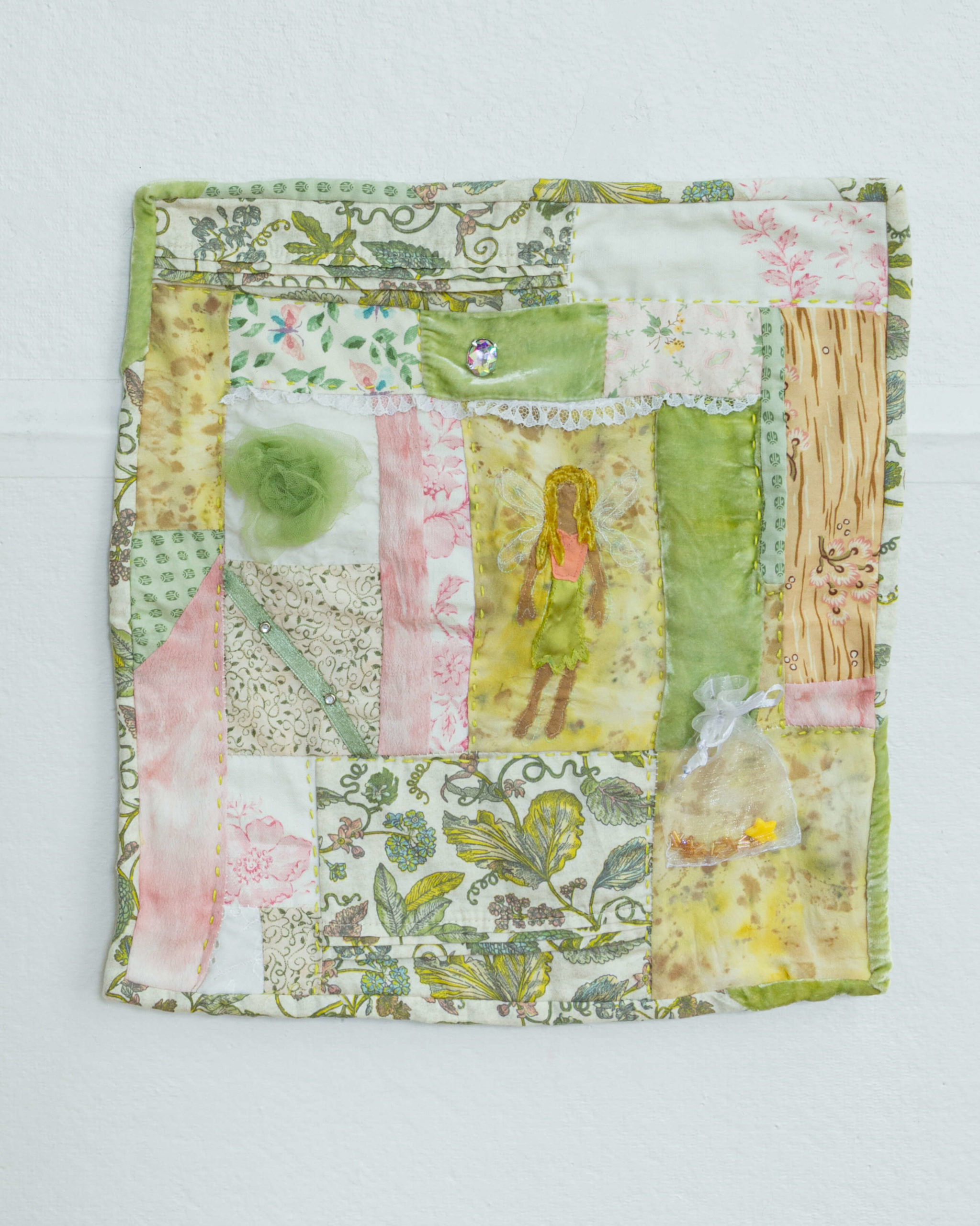
Lucy Beizer
Youth Instructor
Fairies are Real
Small pink green and yellow quilt made of scrap fabrics and natural dyes featuring a fairy and bag of fairy dust, 14"x16"
These works are an exploration of materials, techniques, and ideas. By combining traditional quilt block patterns and techniques with different fabric manipulation methods, found objects, and scrap fabrics, I am exploring the traditional medium of quilt making through a new lens. The celebration of invented new characters and everyday objects allows me to expand on what is real, what is important and what is possible.
Lucy Beizer is a Brooklyn based fiber artist who engages in creative record keeping through soft sculpture using a variety of textile techniques. Her work, inspired by nature, nostalgia and conservation, focuses on the ever changing state of memory and dreams. She often incorporates found and reused objects into her pieces, as well as natural dyes, scrap yarns, original illustrations and recycled fabrics. Lucy’s work has deep roots in interpersonal connection, mysticism and story-telling.
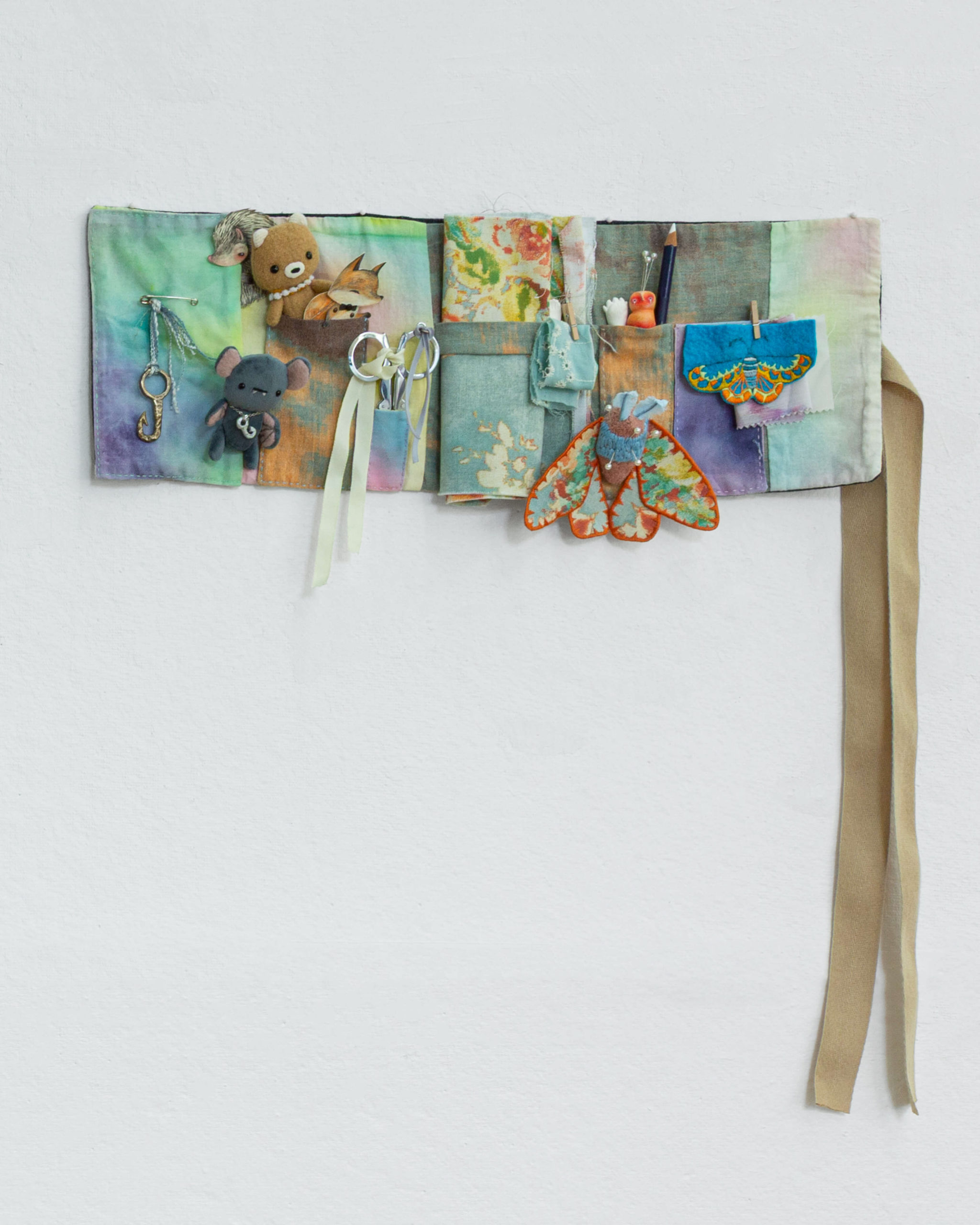
Susie Oh
Visiting artist for Soft Sculpture week at TAC's Summer Camp.
20"x7"
sewing, lost-wax casting, clay): Sewn from scraps of friends' and family members' clothes, this personal sewing kit is a patchwork of experiments in characters, materials, and collected inspirations.
I divide my creative practice between writing and illustrating books for children and exploring conservationist and natural history themes in my personal work. A mixture of collage and drawing, my book art features emotive characters that teach problem solving and empathy to early readers. My personal art bridges two identities: drawing from my Korean heritage with folk art motifs and sewing techniques, I explore themes of wildlife conservation and ecological history -- with a focus on entomological and avian lives -- local to New York where I've lived most of my life.
Susie Oh is a Korean American children's book illustrator and artist who studied illustration at Pratt Institute. Her debut picture book, "Soomi's Sweater", was a silver medal winner of the 2020 Key Colors Illustrators Competition, and she subsequently wrote and illustrated "Odd Duck Out" and "A Book for Pio". In her personal work, she explores ecological themes using a variety of media and techniques from painting to Korean sewing to lost-wax casting. Susie studied animal drawing and urban ecology at the American Museum of Natural History and the New York Botanical Garden and was the 2024 Artist in Residence of the NYC Bird Alliance.
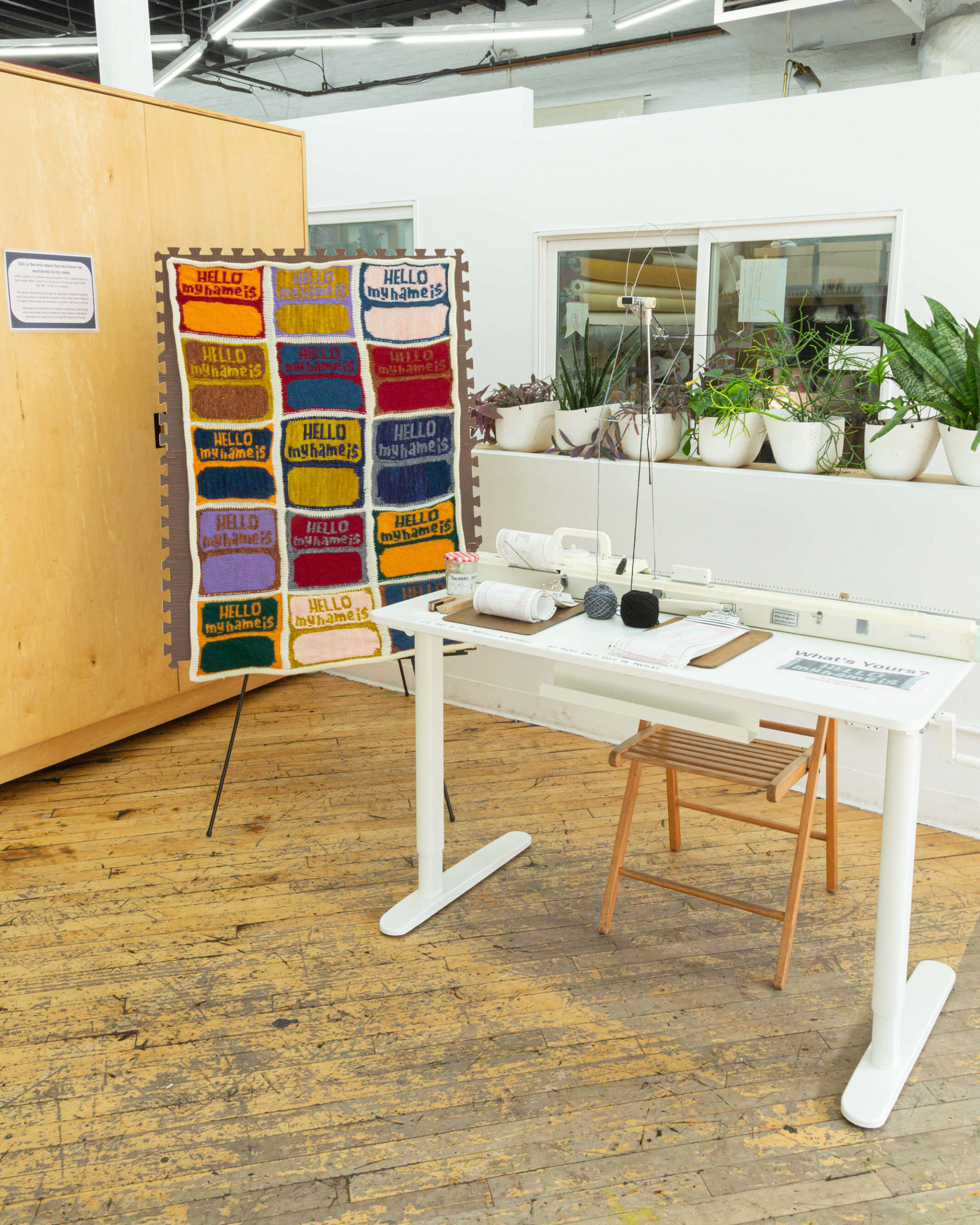
Milo K. Godfrey
Youth Education Director
Machine Knit, wool tapestry
2025
Nametags are equalizers in any space. A small way to make a space more accessible, and an invitation for every person to self-identify.
The classic sticky-back name tag is an opportunity- Everyone is wearing one! I have a way to remember everyone’s name! I don’t have to freak out if I forget! Other people can know who I am even if I don’t say it out loud! AND these nametags aren’t permanent!
When I applied as a summer camp counselor in 2022 I was at the beginning of my social transition and I applied under my dead name. When I came in person for the interview, I introduced myself with my Name- Milo.
Milo K. Godfrey (they/them) is a multi-disciplinary artist and arts educator.
Their art practice focuses on gathering and synthesizing information from their transgender life. They collect, sew and weave their HRT packaging to create artifacts which aim to connect their queer communities and those who are curious about them.
They knit by hand and machine as an embodiment practice, and an attempt to focus their hyperactive mind.
Milo's roots as a performer inspires the social-emotional approach that they offer in all learning spaces. Milo is committed to chipping away at accessibility barriers to art making, and facilitating arenas where folks feel empowered to learn cooperatively.
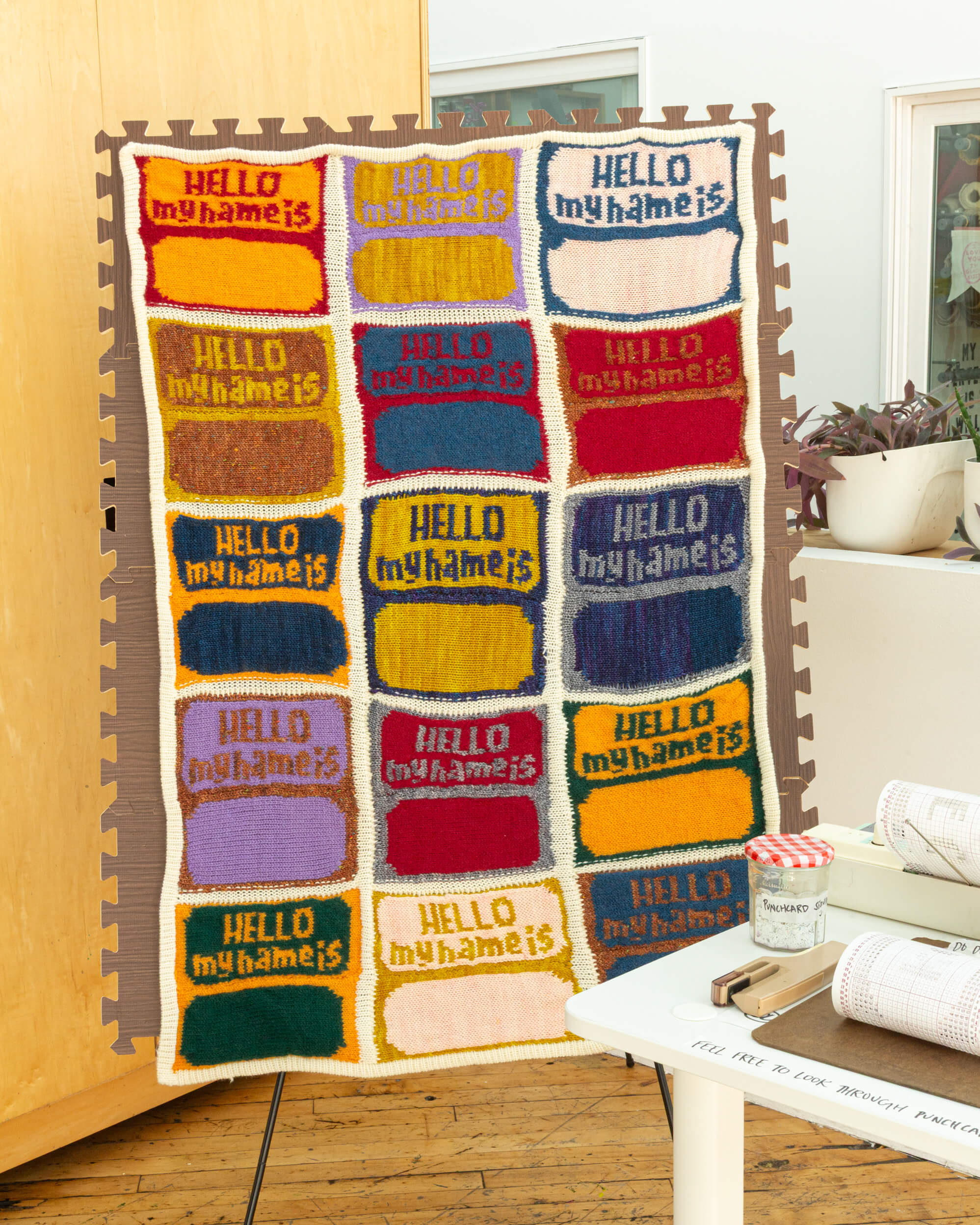
Milo K. Godfrey
Youth Education Director
Machine Knit, wool tapestry
2025
Nametags are equalizers in any space. A small way to make a space more accessible, and an invitation for every person to self-identify.
The classic sticky-back name tag is an opportunity- Everyone is wearing one! I have a way to remember everyone’s name! I don’t have to freak out if I forget! Other people can know who I am even if I don’t say it out loud! AND these nametags aren’t permanent!
When I applied as a summer camp counselor in 2022 I was at the beginning of my social transition and I applied under my dead name. When I came in person for the interview, I introduced myself with my Name- Milo.
Milo K. Godfrey (they/them) is a multi-disciplinary artist and arts educator.
Their art practice focuses on gathering and synthesizing information from their transgender life. They collect, sew and weave their HRT packaging to create artifacts which aim to connect their queer communities and those who are curious about them.
They knit by hand and machine as an embodiment practice, and an attempt to focus their hyperactive mind.
Milo's roots as a performer inspires the social-emotional approach that they offer in all learning spaces. Milo is committed to chipping away at accessibility barriers to art making, and facilitating arenas where folks feel empowered to learn cooperatively.
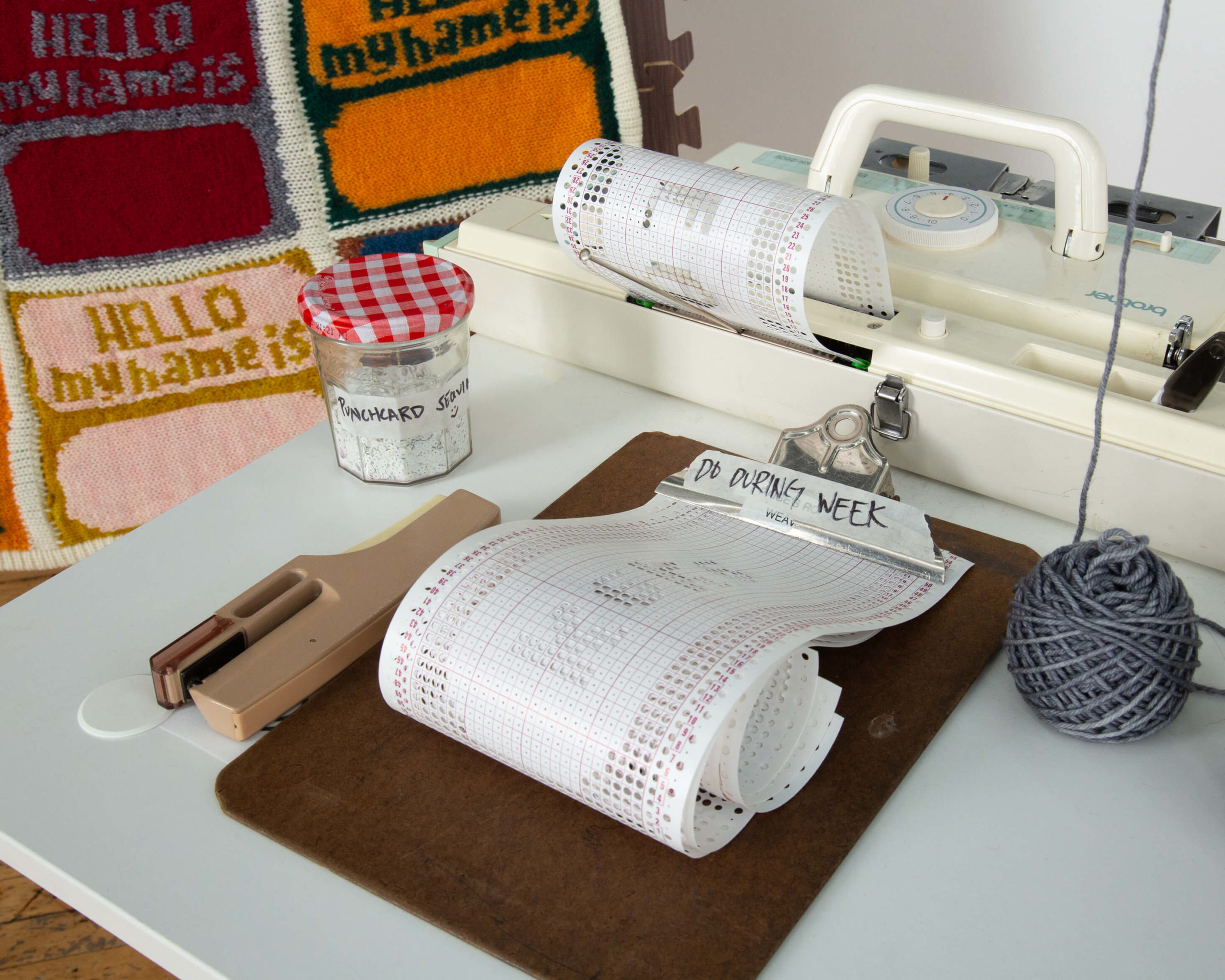
Milo K. Godfrey
Youth Education Director
Machine Knit, wool tapestry
2025
Nametags are equalizers in any space. A small way to make a space more accessible, and an invitation for every person to self-identify.
The classic sticky-back name tag is an opportunity- Everyone is wearing one! I have a way to remember everyone’s name! I don’t have to freak out if I forget! Other people can know who I am even if I don’t say it out loud! AND these nametags aren’t permanent!
When I applied as a summer camp counselor in 2022 I was at the beginning of my social transition and I applied under my dead name. When I came in person for the interview, I introduced myself with my Name- Milo.
Milo K. Godfrey (they/them) is a multi-disciplinary artist and arts educator.
Their art practice focuses on gathering and synthesizing information from their transgender life. They collect, sew and weave their HRT packaging to create artifacts which aim to connect their queer communities and those who are curious about them.
They knit by hand and machine as an embodiment practice, and an attempt to focus their hyperactive mind.
Milo's roots as a performer inspires the social-emotional approach that they offer in all learning spaces. Milo is committed to chipping away at accessibility barriers to art making, and facilitating arenas where folks feel empowered to learn cooperatively.
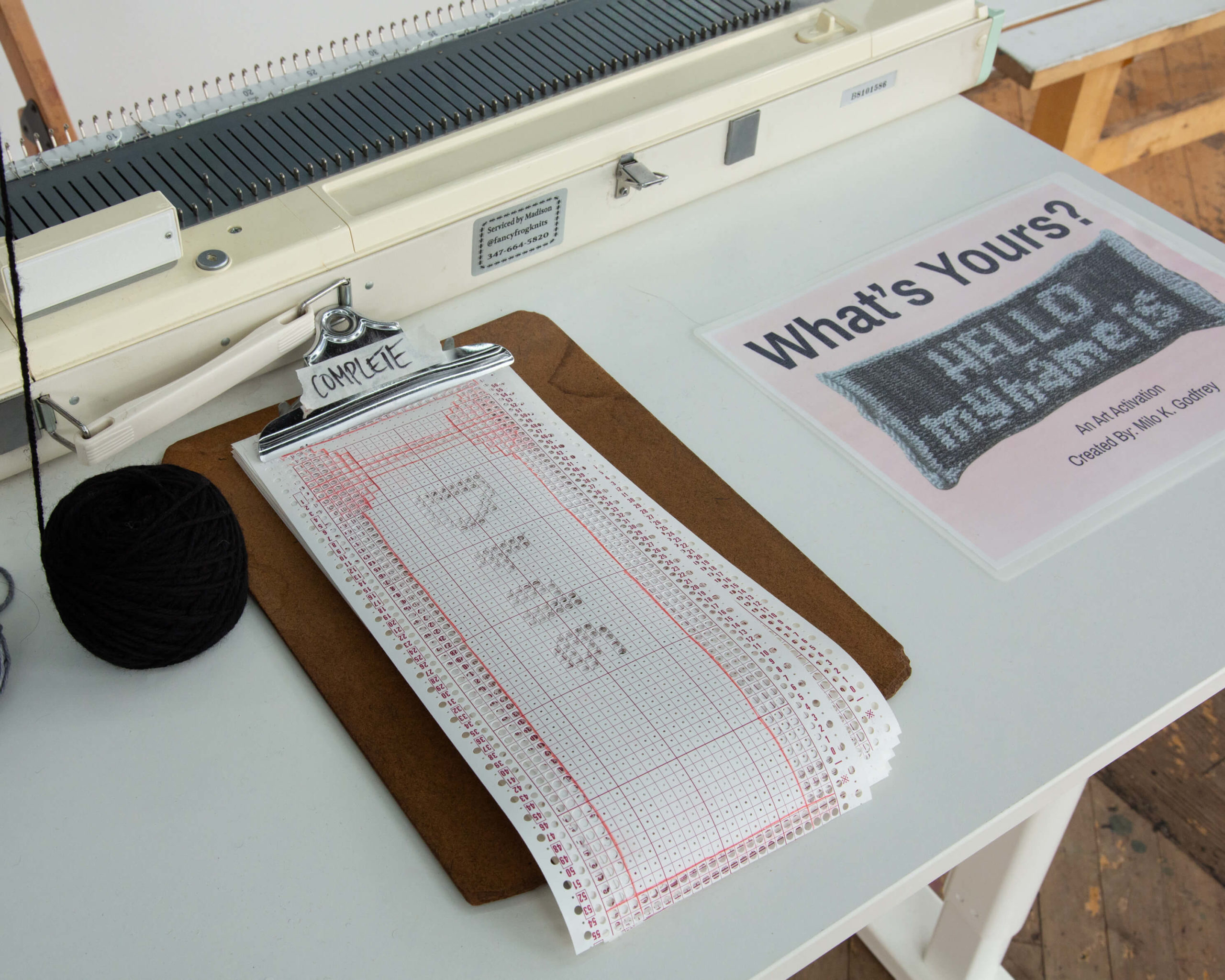
Milo K. Godfrey
Youth Education Director
Machine Knit, wool tapestry
2025
Nametags are equalizers in any space. A small way to make a space more accessible, and an invitation for every person to self-identify.
The classic sticky-back name tag is an opportunity- Everyone is wearing one! I have a way to remember everyone’s name! I don’t have to freak out if I forget! Other people can know who I am even if I don’t say it out loud! AND these nametags aren’t permanent!
When I applied as a summer camp counselor in 2022 I was at the beginning of my social transition and I applied under my dead name. When I came in person for the interview, I introduced myself with my Name- Milo.
Milo K. Godfrey (they/them) is a multi-disciplinary artist and arts educator.
Their art practice focuses on gathering and synthesizing information from their transgender life. They collect, sew and weave their HRT packaging to create artifacts which aim to connect their queer communities and those who are curious about them.
They knit by hand and machine as an embodiment practice, and an attempt to focus their hyperactive mind.
Milo's roots as a performer inspires the social-emotional approach that they offer in all learning spaces. Milo is committed to chipping away at accessibility barriers to art making, and facilitating arenas where folks feel empowered to learn cooperatively.
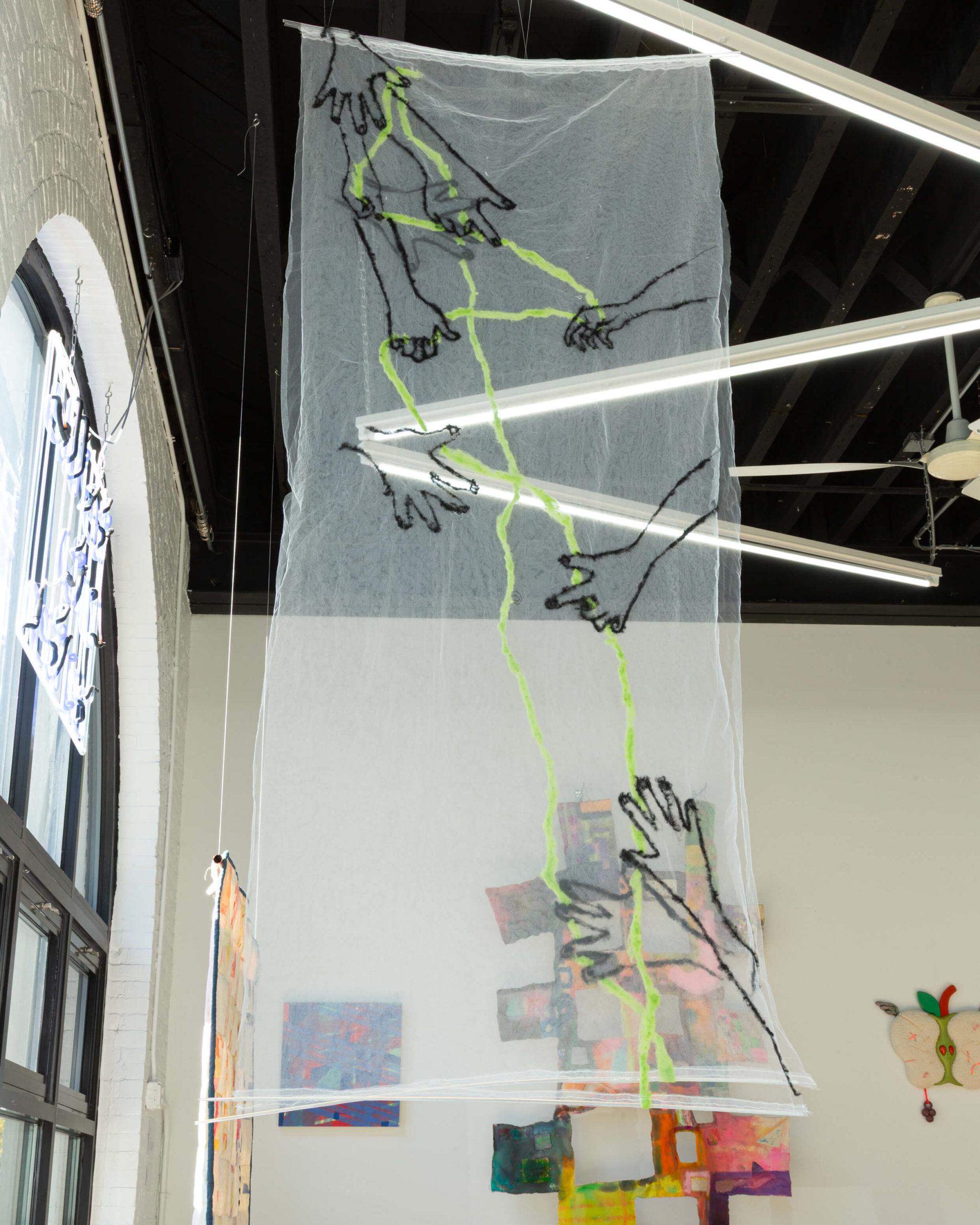
Luisa Walther
2024 Summer Camp Instructor
Threading Connections
This installation is inspired by a welcome game at the Textile Arts Center, where children and educators tossed a ball of yarn to each other, creating a symbolic web. It makes the invisible connections within the creative learning process visible: many hands (felted onto two overlapping layers of transparent tulle) are linked by a continuous thread, representing collective learning, shared knowledge, and the social power of textile art.
The work highlights relationships, co-creation, and playful exchange — across generations and different lived experiences. It embraces textile art as an inclusive medium that weaves together education, care, and creativity — in line with the mission of the Textile Arts Center and my own experience with participatory art projects.
In the summer of 2024, I worked as a Youth Summer Camp Counselor at the Textile Arts Center, where I served as an art educator for the 7–8 age group. In this role, I guided children through creative textile projects and helped them explore artistic expression in a playful and supportive environment. In addition to my work with the youth program, I also took part in several courses and used the studio space to deepen my interest in textile art. I am very grateful for my time at the Textile Arts Center, as it allowed me to grow both artistically and pedagogically, expanding my practice at the intersection of art and social engagement.
Luisa Walther lives and works in Berlin. She is a visual artist with a focus on textile art. She deepened her knowledge during her studies through a semester abroad in fashion design at the Accademia di Belle Arti in Bologna, as well as through her work at the Textile Arts Center in New York.
Her artistic practice combines painting, textile art, and video documentation to create interdisciplinary works that highlight social, cultural, and feminist issues. Luisa Walther sees art as a medium for dialogue — a tool to connect people across cultural boundaries.
Even during her studies, she led various socially engaged art projects and workshops focused on textile art, where she encouraged people with disabilities and children to express themselves artistically — from plant dyeing and creating individual outfits to professional presentations in photoshoots. Another key project was an upcycling workshop, where second-hand clothing was transformed into unique, wearable artworks. These works were presented performatively in a fashion show and visually through photography, creating a new, inclusive interpretation of fashion that consciously questioned and expanded existing norms.
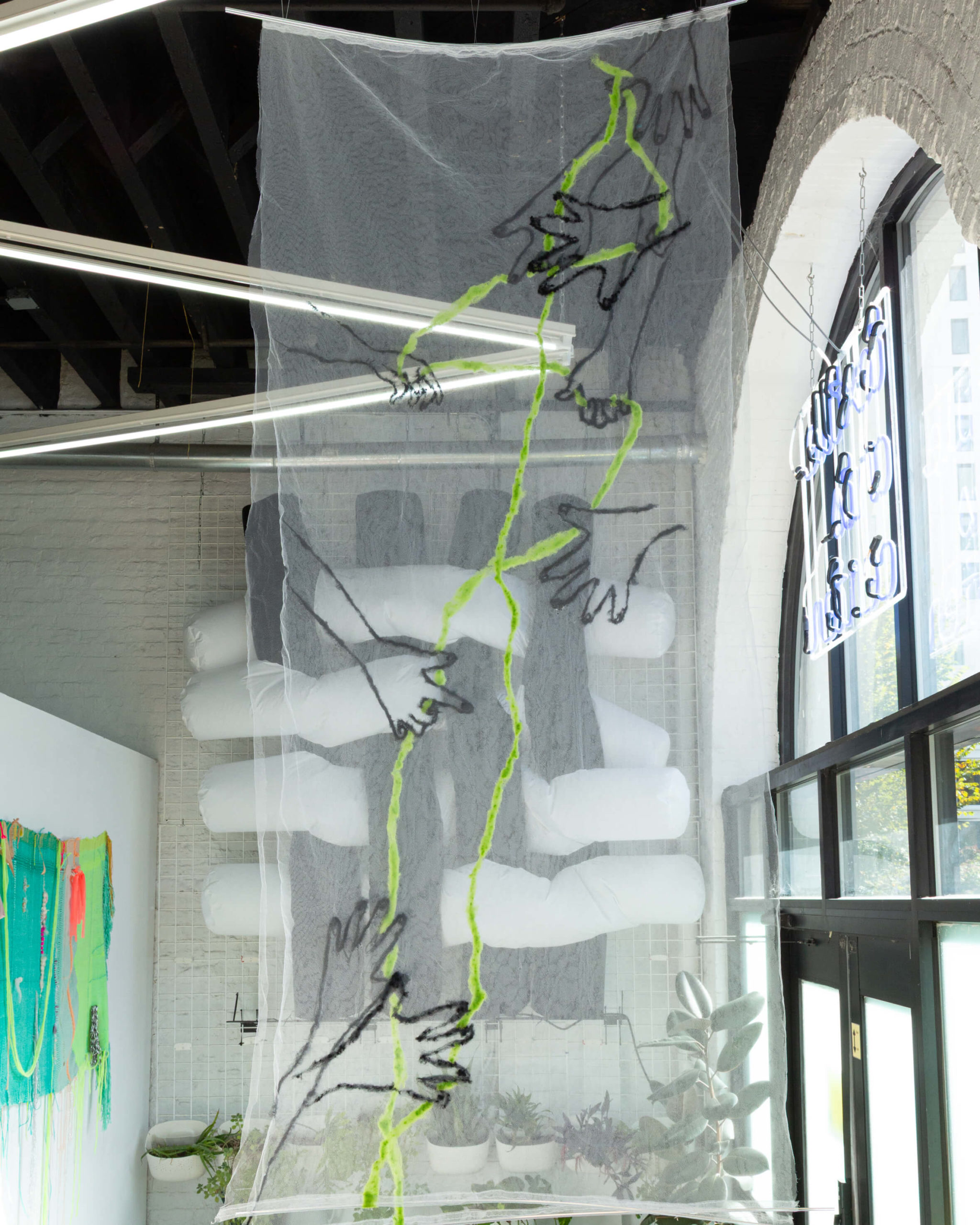
Luisa Walther
Threading Connections
Nathalie San Fratello
Color Test
TWILL !
Howard Ptaszek
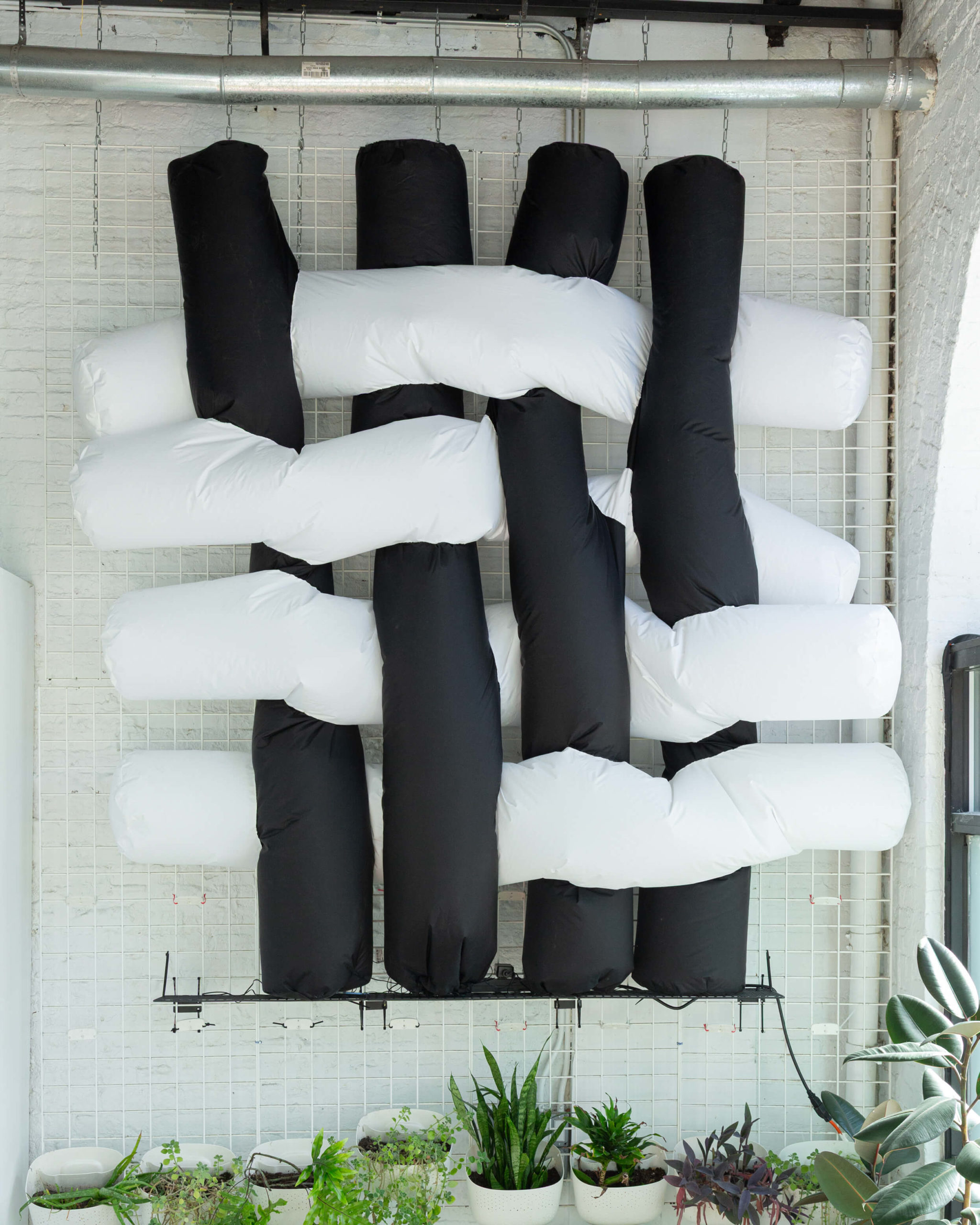
Howard Ptaszek
Past Core Staff member
TWILL !
96"x96"x18", An inflatable woven piece
Howard Ptaszek is an experimental Fiber artist living in Brooklyn, NY. His artwork is informed by his love of learning, analysis and synthesis. He has degrees in Physics, Mathematics and Industrial Design. His work reflects his interests in formal properties of materials and processes. He has been weaving since 2009.
Howard is interested in extending the scope of the possibilities of the floor loom, often using new techniques for dressing the loom, adding to the loom itself, or by adding a step (or more) beyond the traditional loom to create his works.
His artwork has been shown in several invitational and juried shows across the US.
If there’s nothing to learn, it isn’t worth doing.
All my artwork stems from my inquisitive mind. How can I do something new or unexpected? Can I add to the craft of hand weaving? How can I overcome limitations of the floor loom? What other weaving forms can I elevate?
Through variations of the setup of the floor loom, and physical manipulations of the materials and of the loom itself, I make artwork that is unique to the processes that I develop. Each piece is the result of the process, or processes, created solely for that piece. This culminates in work that has intellectual as well as aesthetic aspects to each piece.
I yearn to offer a glimpse of the stories that I hold. Through my art, I offer a peek into my thinking and, hence, my life.
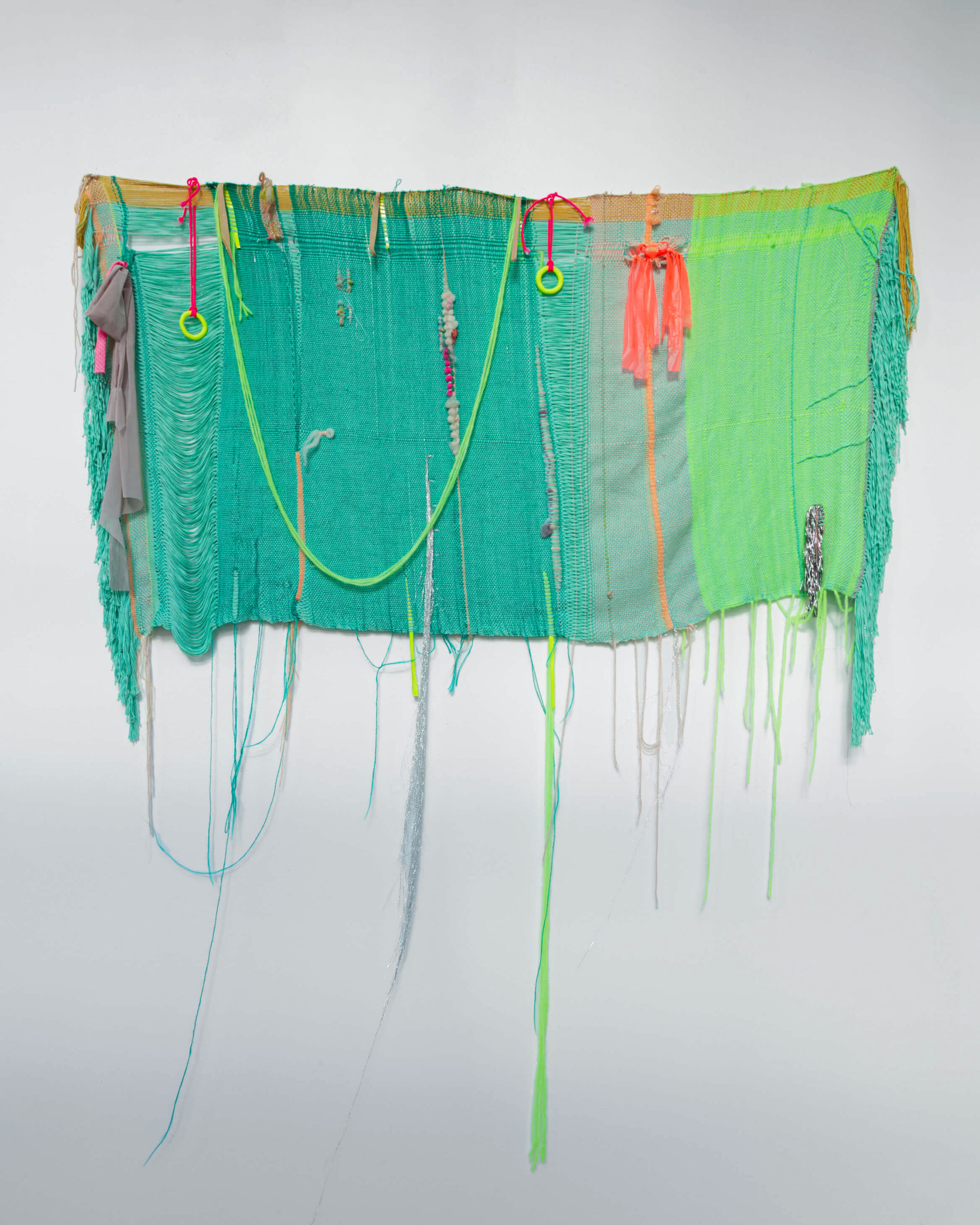
Nathalie San Fratello
2025 Summer Camp Instructor
Color Test
Mesh, paracord, wool roving, clay, silver tinsel, various colored yarns
80" by 38"
Color Test: A journal on self care and making from November 2024 and September 2025 to pair with August’s weaving.
I used to work only with fabric and the scraps it became. This time I worked with strings, fluff, wires, plastics, leather, strips, and thread. Always an experiment more intuitive than intentional. Something shifted in me, an interest in becoming even more delicate. In this weaving I experimented with thin fragile yarns. Gently pulling strings out from the spool across the width of the weaving before me. I laid frail slender traces of silver that fell through my fingers. This is not about just me or just you, it's about how we touch every single thing we pass.
Sewing and touching peoples clothes:
I never know when someone will ask me for a repair and it always feels personal, adorable and insider. Never will I turn down sewing up a hole. It just feels good. Usually I say no you don't have to pay me it will take five minutes but then people insist. I’ll take the money; it is my time and my cute pink string that's saving your life. Have a look into your most personal of personal lives, see how time and wear have distressed your clothing item. I always start sentences with the same words and it feels weird. I start sewing with something familiar and it never feels weird. Makes my hands feel at home. I like to return to something charming like repairing something for someone when I feel lost. Two weeks will pass and I will get to your awesome hole, admire the loss, praise the open space, the possibility, and cover it up real nice. This is an ad for my patching services. I will embellish your hole, address its emptiness with a loving of colors and a scrap from someone else's scrap.
Color and texture, specifically, assist me in expressing radical love and resistance. In the act of touching and looking, qualities of an object can evoke a distinguishable emotion and experience. Enjoying the feeling of being too bright:
The color orange takes care of me. I feel more visible when I cover exposed parts with muted neon oranges or something too bright. The kind where anyone who sees it has a headache. A me headache. You know I am there. I don't have to speak for you to hear what I have to say. I think color is magic like that. Touching becomes less literally tactile and more realistically ephemeral. It can do work for you, and tell stories that words can’t. Something about me is attracted to knowing I don’t have to do the work of speaking, I can just move around as orange and eat yogurt and be myself. Lots of great things are orange!
Do you like traffic cones? Can you describe one to me? Do you own one? Have you ever stolen one and not know what to do with it? Did you keep orange forever in your own way? I did.
I craft, write and make as a contemplation of bodily experience, sensitivity, play, and intimacy. My work with fibers emphasizes the sensory act of touch as a meditative repetitive process. Making is my call to a calm transformation as I am slow building lines, horizontal taking care, and tying easy knots. As I move materials through my hands I can investigate curiously through the act of touch. Touch brings me closeness with myself, as I pursue haptic meditation, journaling and documentation.
A note: I am inspired by artists and thinkers that create dialogues which make up the intersectional fields of disability studies and feminist theory. A few readings to reference: Accessibility in the Arts by Carolyn Lazard, the Right to Maim by Jasbir Puar, and Care Work: Dreaming Disability Justice by Leah Samarasinha, some thinkers who heavily inform my thinking. These works all offer social critiques on the structures we live under that normalize, demand, and commit violence against human bodies placing value in labor and capital over health and needs. To create slowly, without a means for production, purely out of the need for touch and play, is to resist structures which perpetually debilitate us in various ways.
I believe fiber mediums can expand a contemporary definition of the body, of time and what is of value. Fiber arts honor spaces which rely on community, interdependence, and symbiotic notions of care. I place attention into my weavings simply because it feels good and relaxes me. Building my practice of weaving has also brought me to many friends and beautiful moments. Handwork is an imperative part of my self-care, and in turn I hope to share it with you all as you share with me!
Nathalie San Fratello is a weaver, clothing designer, and interdisciplinary thinker. In May they graduated from Colorado College with a BA in Art, and a self guided concentration in Weaving and Textiles. Nathalie enjoys organizing events dedicated to communal spaces for play, fashion and joy. She has led various fashion shows in Chicago and Colorado Springs featuring her colorful collections of upcycled pieces. Beyond fiber arts, they have engaged with metals, stained glass, performance art and curation. This summer, after a move to New York, Nathalie instructed at Textile Arts Summer Camp, crafting the summer away with 9 and 10 year olds. Currently their practice consists of weaving with found materials as they expand their skills on the floor loom.
b. 2002, Chicago, Illinois
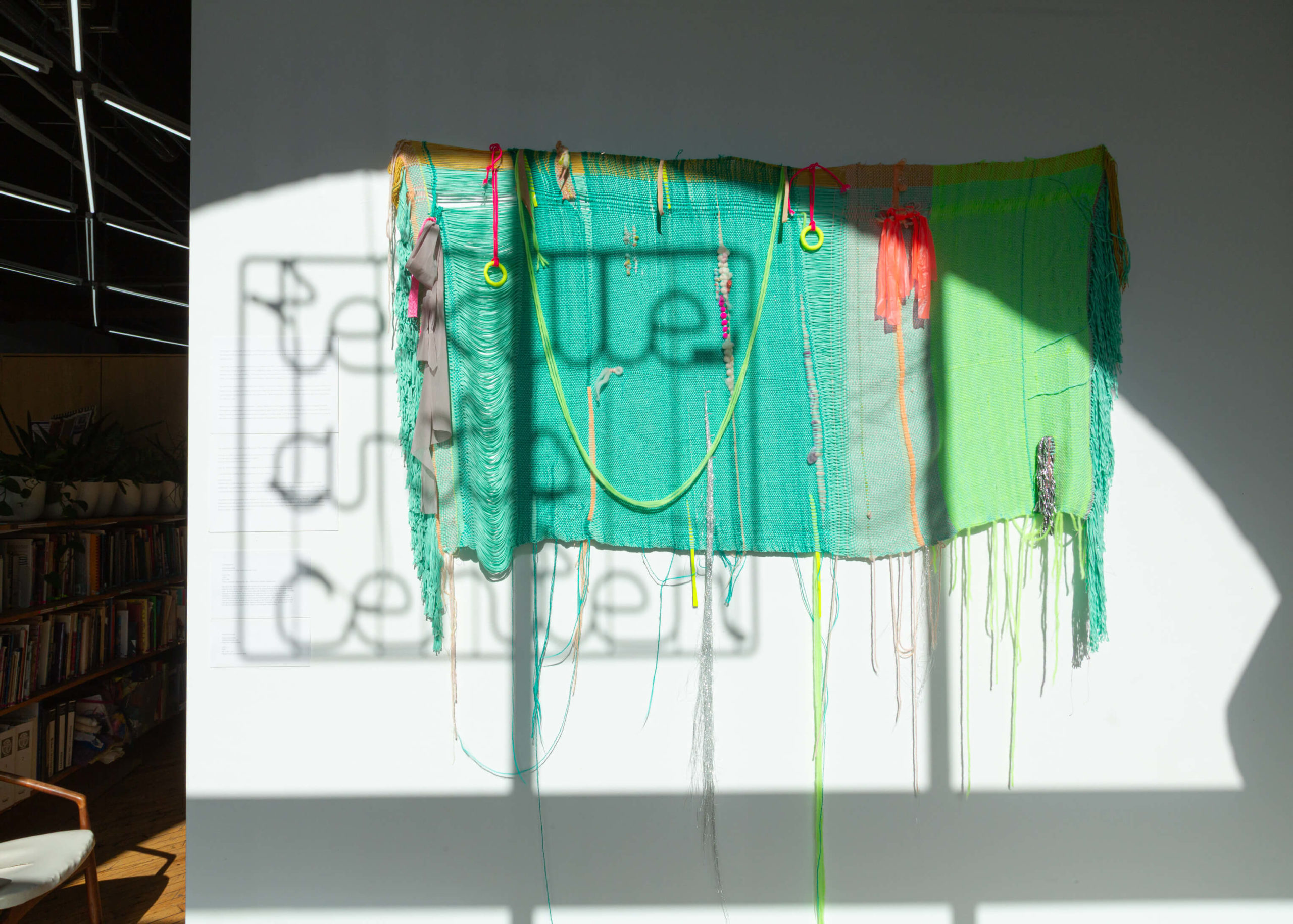
Nathalie San Fratello
2025 Youth Summer Camp Instructor
Color Test
Mesh, paracord, wool roving, clay, silver tinsel, various colored yarns
80" by 38"
Color Test: A journal on self care and making from November 2024 and September 2025 to pair with August’s weaving.
I used to work only with fabric and the scraps it became. This time I worked with strings, fluff, wires, plastics, leather, strips, and thread. Always an experiment more intuitive than intentional. Something shifted in me, an interest in becoming even more delicate. In this weaving I experimented with thin fragile yarns. Gently pulling strings out from the spool across the width of the weaving before me. I laid frail slender traces of silver that fell through my fingers. This is not about just me or just you, it's about how we touch every single thing we pass.
Sewing and touching peoples clothes:
I never know when someone will ask me for a repair and it always feels personal, adorable and insider. Never will I turn down sewing up a hole. It just feels good. Usually I say no you don't have to pay me it will take five minutes but then people insist. I’ll take the money; it is my time and my cute pink string that's saving your life. Have a look into your most personal of personal lives, see how time and wear have distressed your clothing item. I always start sentences with the same words and it feels weird. I start sewing with something familiar and it never feels weird. Makes my hands feel at home. I like to return to something charming like repairing something for someone when I feel lost. Two weeks will pass and I will get to your awesome hole, admire the loss, praise the open space, the possibility, and cover it up real nice. This is an ad for my patching services. I will embellish your hole, address its emptiness with a loving of colors and a scrap from someone else's scrap.
Color and texture, specifically, assist me in expressing radical love and resistance. In the act of touching and looking, qualities of an object can evoke a distinguishable emotion and experience. Enjoying the feeling of being too bright:
The color orange takes care of me. I feel more visible when I cover exposed parts with muted neon oranges or something too bright. The kind where anyone who sees it has a headache. A me headache. You know I am there. I don't have to speak for you to hear what I have to say. I think color is magic like that. Touching becomes less literally tactile and more realistically ephemeral. It can do work for you, and tell stories that words can’t. Something about me is attracted to knowing I don’t have to do the work of speaking, I can just move around as orange and eat yogurt and be myself. Lots of great things are orange!
Do you like traffic cones? Can you describe one to me? Do you own one? Have you ever stolen one and not know what to do with it? Did you keep orange forever in your own way? I did.
I craft, write and make as a contemplation of bodily experience, sensitivity, play, and intimacy. My work with fibers emphasizes the sensory act of touch as a meditative repetitive process. Making is my call to a calm transformation as I am slow building lines, horizontal taking care, and tying easy knots. As I move materials through my hands I can investigate curiously through the act of touch. Touch brings me closeness with myself, as I pursue haptic meditation, journaling and documentation.
A note: I am inspired by artists and thinkers that create dialogues which make up the intersectional fields of disability studies and feminist theory. A few readings to reference: Accessibility in the Arts by Carolyn Lazard, the Right to Maim by Jasbir Puar, and Care Work: Dreaming Disability Justice by Leah Samarasinha, some thinkers who heavily inform my thinking. These works all offer social critiques on the structures we live under that normalize, demand, and commit violence against human bodies placing value in labor and capital over health and needs. To create slowly, without a means for production, purely out of the need for touch and play, is to resist structures which perpetually debilitate us in various ways.
I believe fiber mediums can expand a contemporary definition of the body, of time and what is of value. Fiber arts honor spaces which rely on community, interdependence, and symbiotic notions of care. I place attention into my weavings simply because it feels good and relaxes me. Building my practice of weaving has also brought me to many friends and beautiful moments. Handwork is an imperative part of my self-care, and in turn I hope to share it with you all as you share with me!
Nathalie San Fratello is a weaver, clothing designer, and interdisciplinary thinker. In May they graduated from Colorado College with a BA in Art, and a self guided concentration in Weaving and Textiles. Nathalie enjoys organizing events dedicated to communal spaces for play, fashion and joy. She has led various fashion shows in Chicago and Colorado Springs featuring her colorful collections of upcycled pieces. Beyond fiber arts, they have engaged with metals, stained glass, performance art and curation. This summer, after a move to New York, Nathalie instructed at Textile Arts Summer Camp, crafting the summer away with 9 and 10 year olds. Currently their practice consists of weaving with found materials as they expand their skills on the floor loom.
b. 2002, Chicago, Illinois
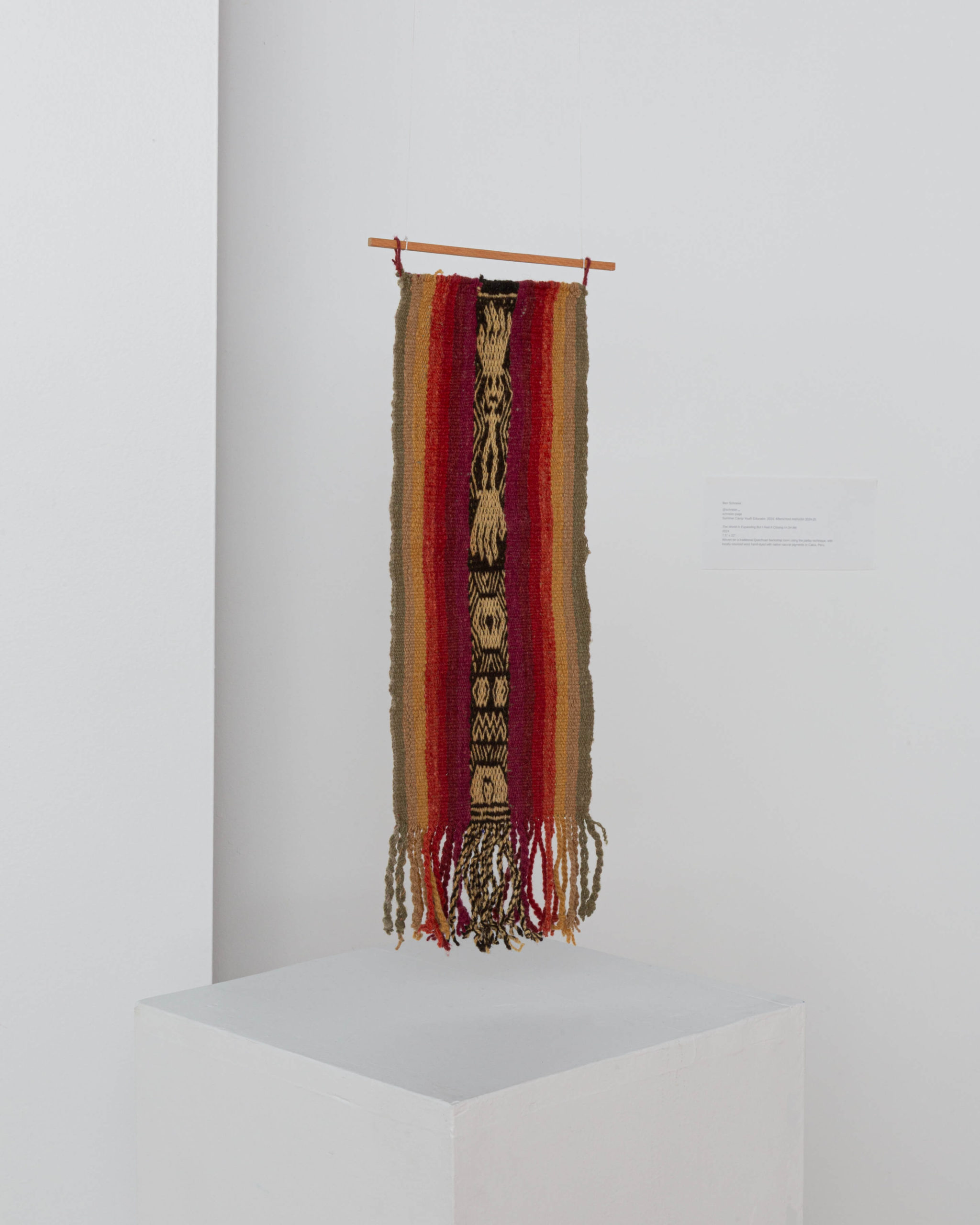
Ben Schneier
2024 Summer Camp Instructor, 2024/25 After School Instructor
The World Is Expanding But I Feel It Closing In On Me
Woven on a traditional Quechuan backstrap loom using the "pallay", with locally-sourced wool hand-dyed with native natural pigments in Calca, Peru.
Ben Schneier is an educator, textile artist, and creative technologist.
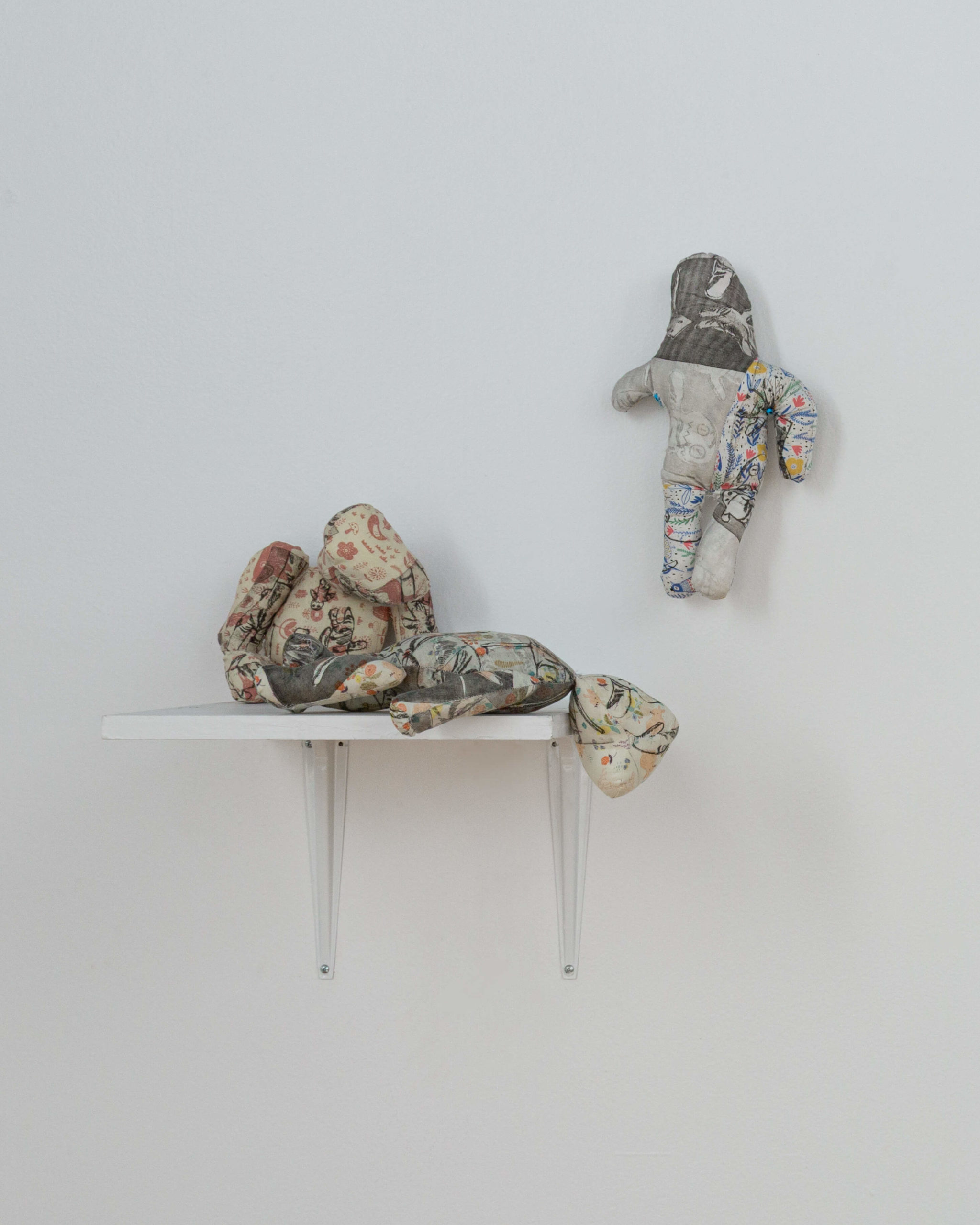
So Ye Oh
Former TAC Class Coordinator, 2024 Summer Camp Visiting Artist
Intaglio print on found fabric, polyester filling, sewing thread
12" x 9" x 5"
So Ye Oh is a New York-based artist, making paintings and soft sculptures by using fabrics based on her memories about nostalgia and attachment to her comfort object in her childhood.
So Ye received a BA from the University of Michigan in 2016 and graduated from the MFA Fine Arts program at Pratt Institute in May, 2020. Her work was selected by the Michigan Association of State Universities, being exhibited as part of the Student Art in the House exhibition program at the Michigan House of Representatives during the 2016 to 2017 academic year. She has participated in a number of group exhibitions including “Emergent Poise” at On Canal, NYC, “Platform” at Winston Wachter Fine Art, NYC, “Inheritance” at Below Grand (formerly, Super Dutchess Gallery), NYC, and “Clay and Textile” at Williamsburg Art & Historical Center, NYC.
So Ye creates stuffed animal-like soft sculptures, called the "Buddy" series, out of printed, colored, and painted fabric. The series is based on her obsession with comfort and tangibility from her childhood transitional object—a light blue blanket—and speaks to her attempts to detach from fear and loneliness in the struggles of adulthood.
The special "Haunted Buddy" series, created in 2019 with the intaglio printing method, pushes this further. As if the Buddies are possessed and cursed, these Haunted ones are engraved with the earlier Buddies. Their creepiness and crappiness intensify the psychological obsession with So Ye's childhood transitional object, while exposing the unease and dread of facing reality.
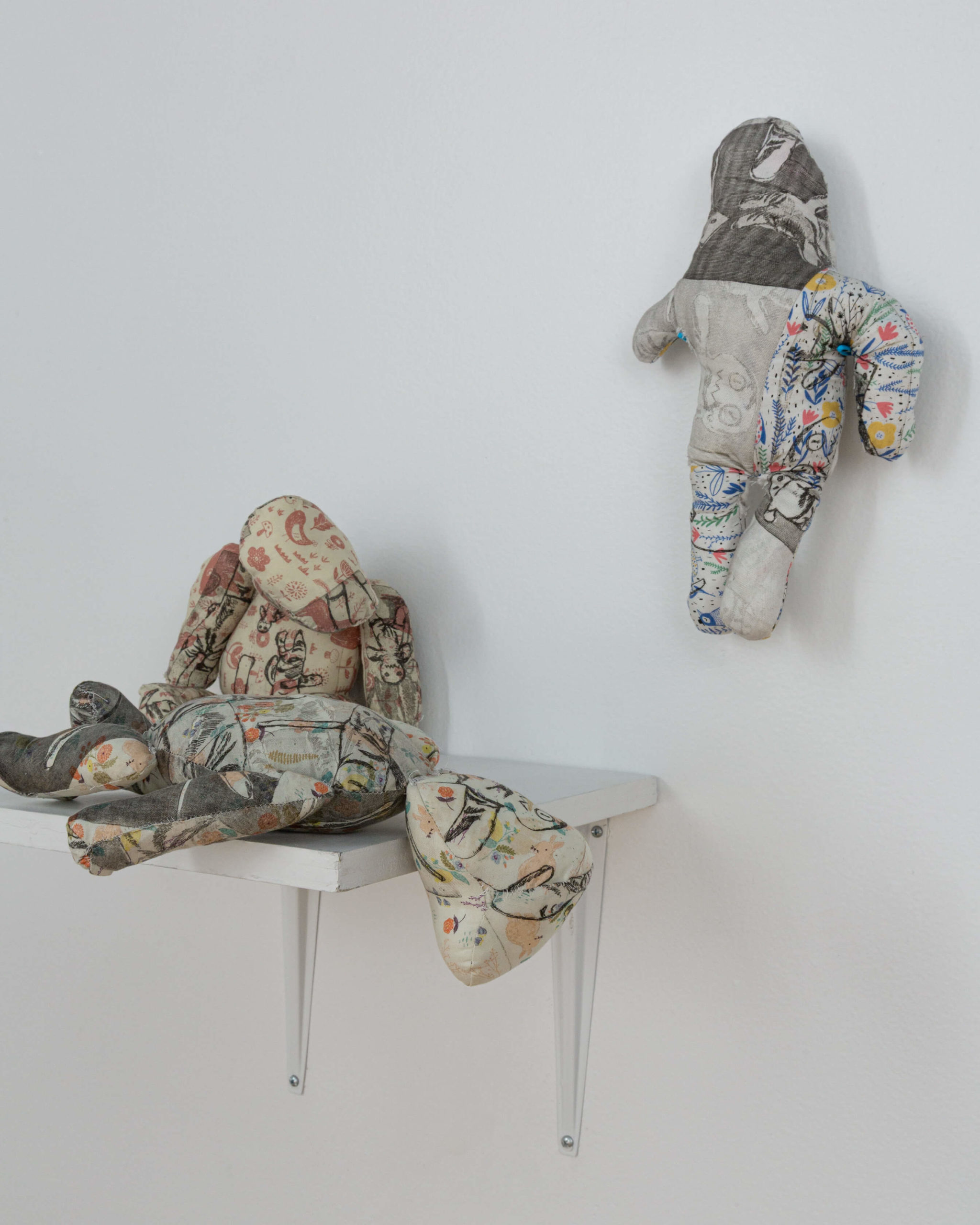
So Ye Oh
Former TAC Class Coordinator, 2024 Summer Camp Visiting Artist
Intaglio print on found fabric, polyester filling, sewing thread
12" x 9" x 5"
So Ye Oh is a New York-based artist, making paintings and soft sculptures by using fabrics based on her memories about nostalgia and attachment to her comfort object in her childhood.
So Ye received a BA from the University of Michigan in 2016 and graduated from the MFA Fine Arts program at Pratt Institute in May, 2020. Her work was selected by the Michigan Association of State Universities, being exhibited as part of the Student Art in the House exhibition program at the Michigan House of Representatives during the 2016 to 2017 academic year. She has participated in a number of group exhibitions including “Emergent Poise” at On Canal, NYC, “Platform” at Winston Wachter Fine Art, NYC, “Inheritance” at Below Grand (formerly, Super Dutchess Gallery), NYC, and “Clay and Textile” at Williamsburg Art & Historical Center, NYC.
So Ye creates stuffed animal-like soft sculptures, called the "Buddy" series, out of printed, colored, and painted fabric. The series is based on her obsession with comfort and tangibility from her childhood transitional object—a light blue blanket—and speaks to her attempts to detach from fear and loneliness in the struggles of adulthood.
The special "Haunted Buddy" series, created in 2019 with the intaglio printing method, pushes this further. As if the Buddies are possessed and cursed, these Haunted ones are engraved with the earlier Buddies. Their creepiness and crappiness intensify the psychological obsession with So Ye's childhood transitional object, while exposing the unease and dread of facing reality.
So Ye Oh
Haunted Buddies
Cedar Heffelfinger
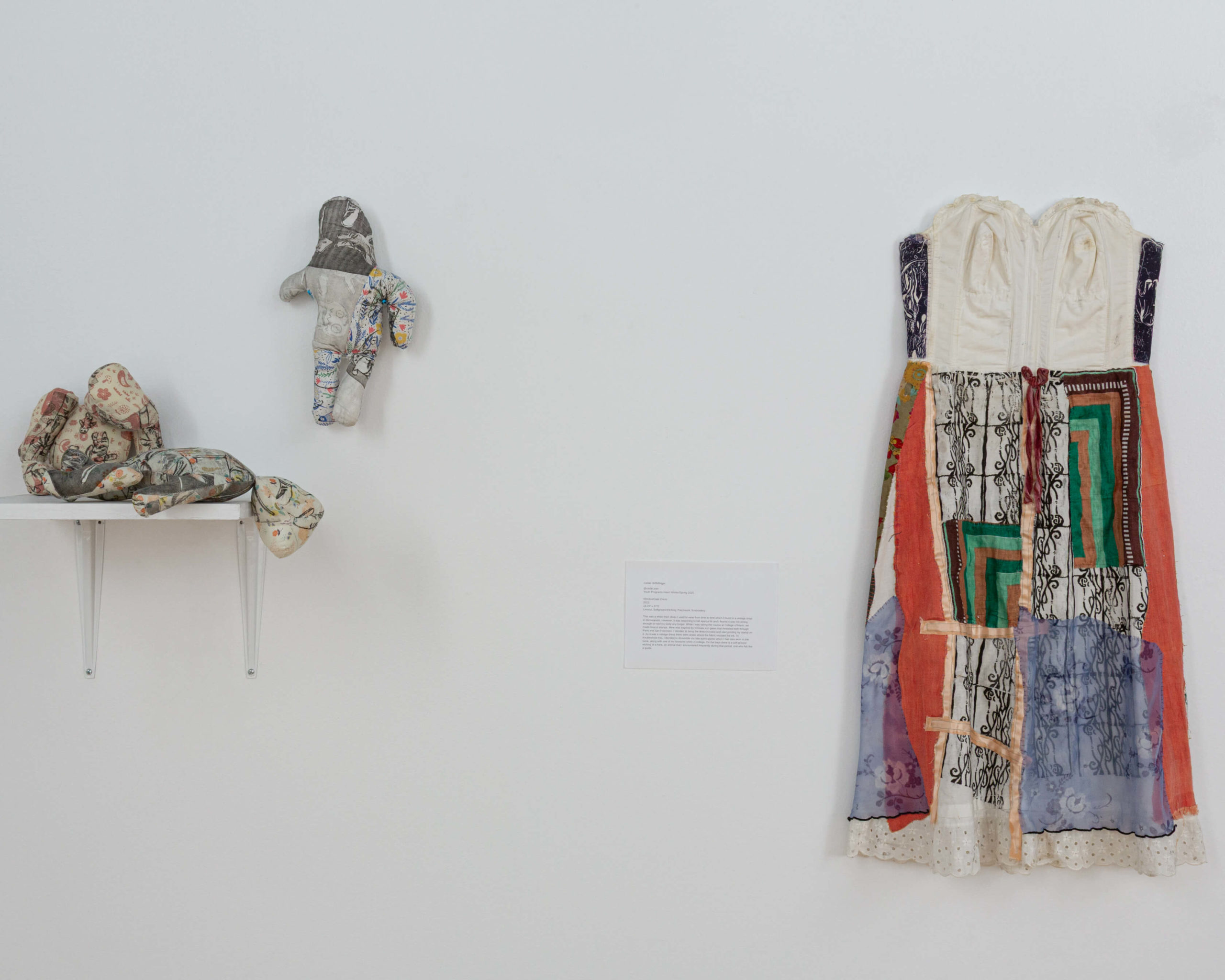
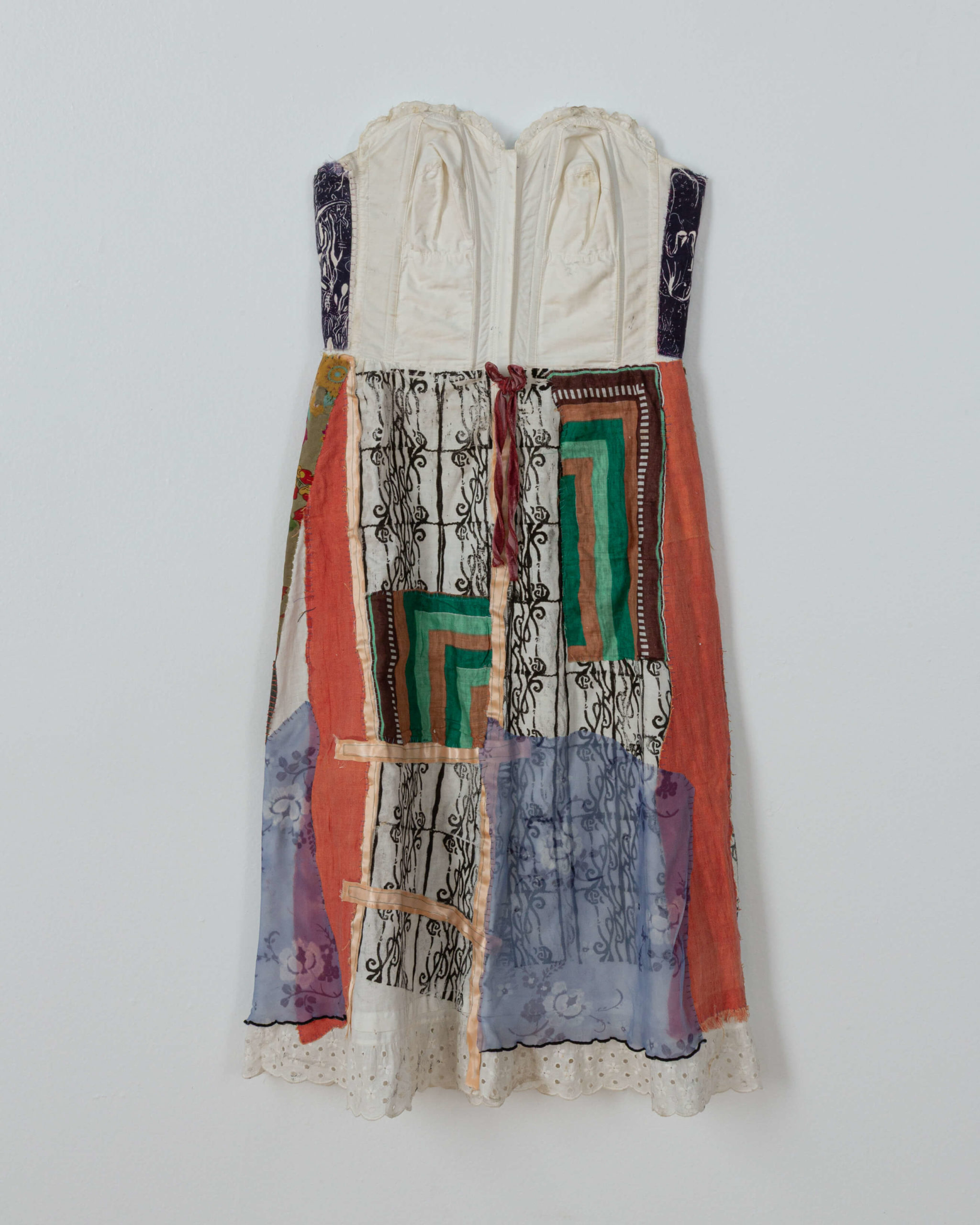
Window/Gate Dress
Cedar Heffelfinger
2025 Youth Education Intern
Window/Gate Dress
Linocut, Softground Etching, Patchwork, Embroidery
18.25 x 37.5”
This was a white linen dress I used to wear from time to time which I found in a vintage shop in Minneapolis. However, it was beginning to fall apart a bit and I feared it was not strong enough to hold my body any longer. While I was taking the course at College of Marin, we made linocut stamps. Mine was inspired by intricate iron gates that threaded both through Paris and San Francisco. I decided to bring the dress to class and start printing my stamp on it. As it was a vintage dress there were areas where the fabric resisted the ink. To troubleshoot this, I decided to dissemble my late aunt’s purse which I had also worn to the bone, along with one of my favourite shirts in college. On the back there is a soft ground etching of a hare, an animal that I encountered frequently during that period, one who felt like a guide.
Cedar's work tends to merge mediums. She received her BA in studio art at Carleton College, focusing primarily on printmaking, though her work has grown from a childhood love of drawing. Cedar has interned/taught at Highpoint Center for Printmaking in Minneapolis, the Textile Arts Center and Brooklyn, and The Putney School in Vermont. Two summers ago she has the pleasure of being an Artist in Residence at 59 Rivoli in Paris. She is currently pursuing her MFA at the School of the Art Institute of Chicago. Teaching, creating, and being in nature all bring her deep joy.
I think often of the image of a skipping stone when I think about my art making process. When a stone skips across water, there are instances of contact and transport. When the stone meets the water, it makes a connection. Then the rock is airborne again, suggesting transport from one state to another. The center of art, I believe, is this feeling of simultaneous recognition and transportation, being lifted to a place beyond. The stone contacts the water and immediately takes flight again.
My childhood was fragmented because of my father’s work. When I was 12, we left Atlanta, Georgia for Dhaka, Bangladesh. Three years later we moved to Manila, Philippines. I have had the sense of passing through others’ lives and worlds, though never quite having a place of my own. But as poet Edmond Jabés said, “You are never really anywhere, because everywhere you go you have brought all the places you have left with you.”
My artistic practice feels related to this sense of my personal past. In printmaking, which was my undergraduate focus, you have the capacity to repeat an image, and thus the capacity to bring it into various mediums, like paper or muslin. As such, the same image can move fluidly from home to home.
I feel aligned with the processes of artists like Anni Albers and Etel Adnan, creators who emphasize the voice of the material itself. Albers speaks to the importance of listening to material and how, by learning to handle material, we are given a freer entrance into our search for our soul. Adnan underlines how material facilitates thought and how material itself becomes a “co-author of one’s work.”
My artistic practice seeks a relationship between the viewer and the material. The layers and fine details in my work require viewers' close attention and their willingness to take time to see: the story that unfolds for each person is different and, in that way, the viewer's own experience weaves itself into the work, enriching the tapestry. A skipping stone, after all, mimics the movement of stitching, of moving the thread in and out of fabric. The viewer is being transported like the stone, like the thread, and the community of viewers’ experiences compose one quilted home.
Oscar A. Chavez
Youth Instructor
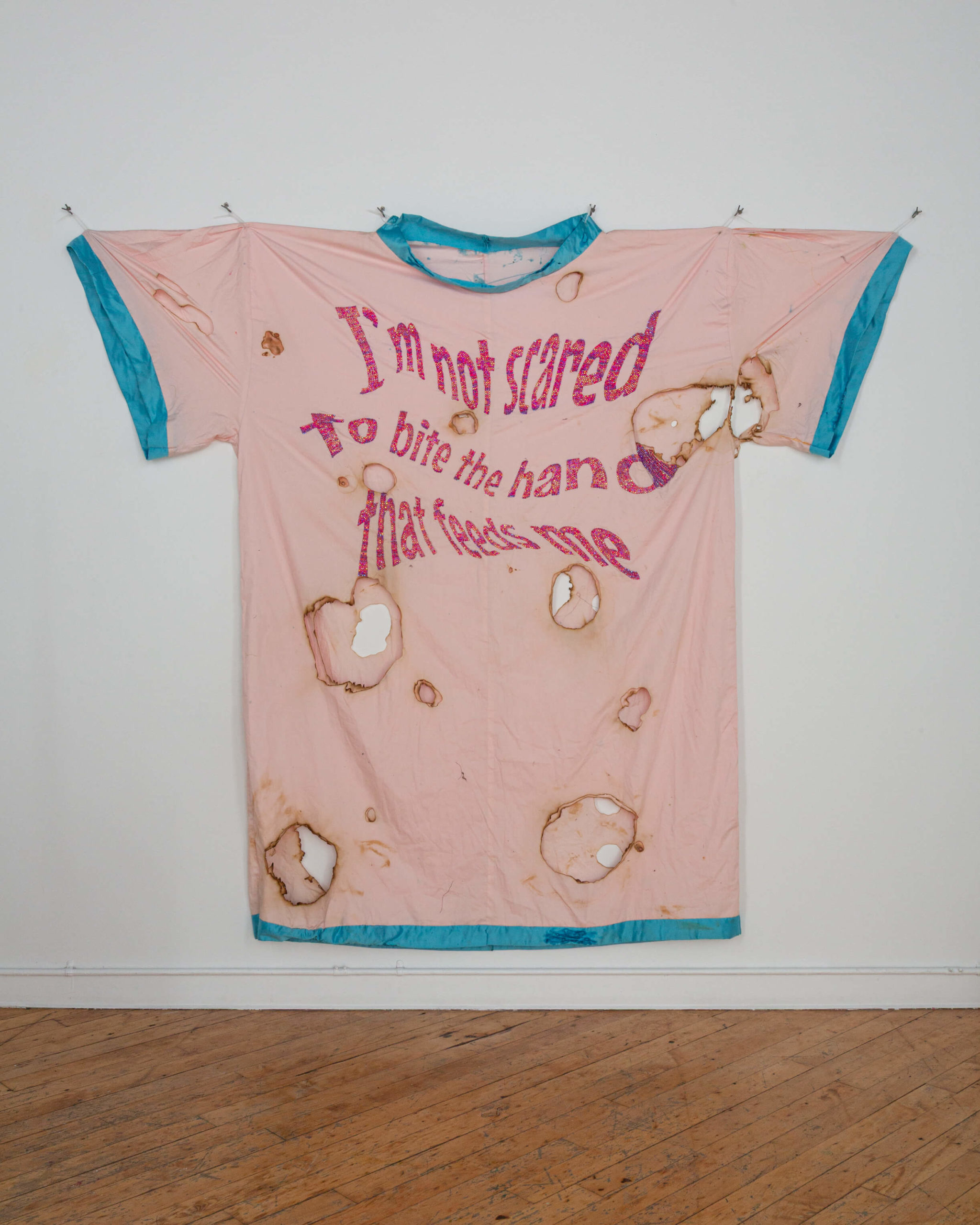
Oscar Chavez is an artist from Chicago currently working and living in Brooklyn, NY. By utilizing found objects and recycled materials he makes fashion embedded with a living history. His work has been seen in publications such as Cult Classic and Ladygunn and has exhibited work in spaces across the country.
Oscar A. Chavez
Youth Instructor
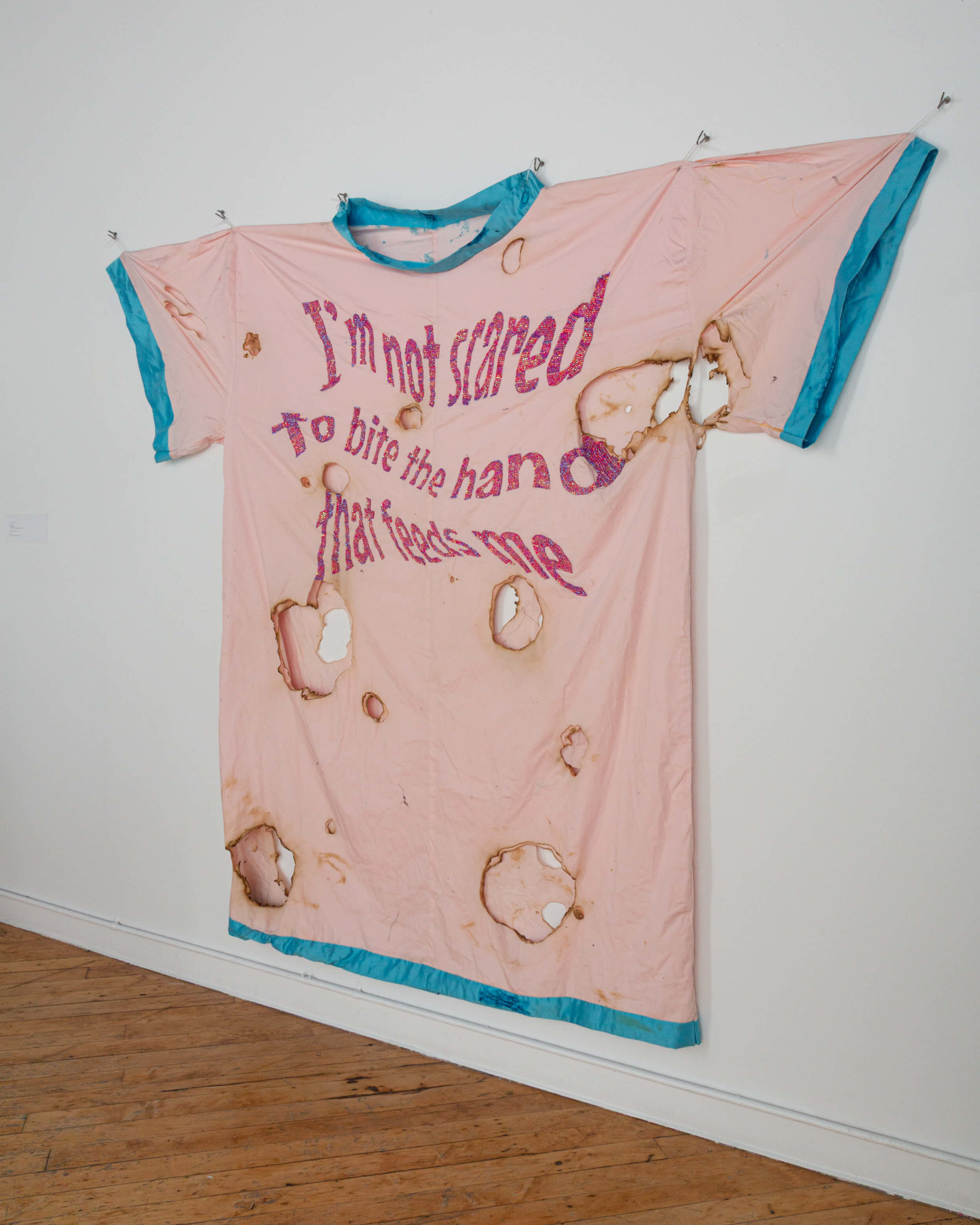
Oscar Chavez is an artist from Chicago currently working and living in Brooklyn, NY. By utilizing found objects and recycled materials he makes fashion embedded with a living history. His work has been seen in publications such as Cult Classic and Ladygunn and has exhibited work in spaces across the country.
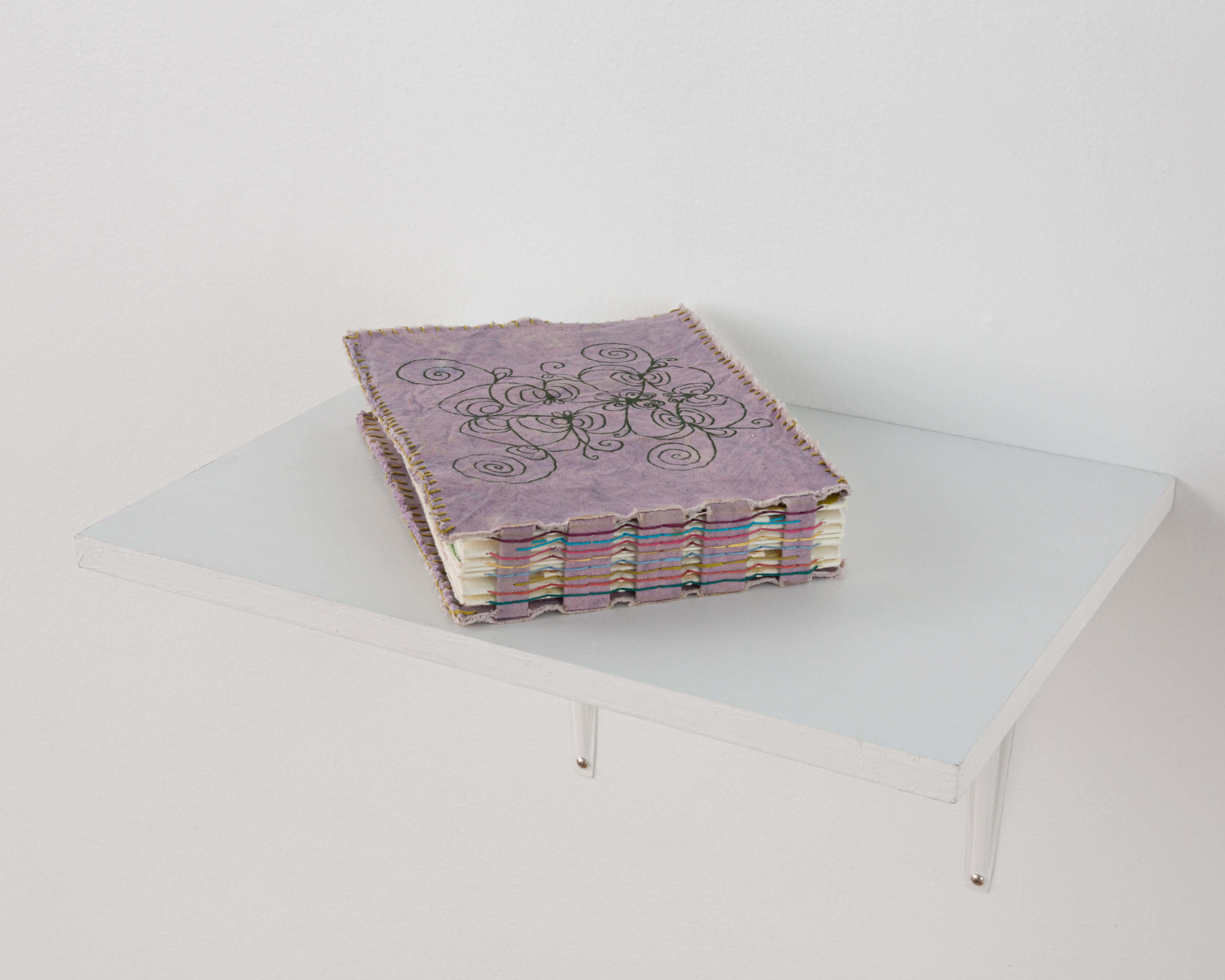
Julia Scheiber
Youth Education Intern and 2025 Summer Camp Instructor
Big Book
Handbound book full of watercolor and printed imagery, covers are screenprinted and dyed canvas
closed- 11 1/4 x 2 x 8 1/2"
open- 24 1/4 x 8 1/2"
Julia Scheiber (b. 2003, Long Island, NY) received her BFA in Fine Arts from the Fashion Institute of Technology with a focus on Craft and Textiles. Scheiber uses her practice as a means to process the day to day through working with processes that feel meditative. Currently that looks like weaving, dying, bookbinding, and ceramics. Her work has been included in group shows including FIT’s Art and Design Thesis Show, The Space in Between (2025); FIT’s Art and Design Gallery’s Pattern, the Grid, and Other Systems (2023); and Parrish Art Museum's 2021 Student Exhibition. She currently lives and works in Manhattan and Brooklyn.
My art practice functions as a means to process the day to day. Focusing on processes that feel meditative. The work that I make feels like a reflection of self. Through photo and textile I explore an ever questioning of life and the meaning of it, pondering on what it means to exist and make art. With a focus on practices that feel meditative, I find artmaking provides me a space of solace, somewhere to reflect. In my current work I use techniques of weaving, dyeing, stitching, and photography as a way to memorialize the passing of time. More than anything, I have such a love for the process, working from a small pile of materials and seeing what could come of them, how they can be arranged in a way that feels good.
Lately, I’ve been thinking a lot about how fibers and objects hold onto memory just as photos do. Through using pre-owned supplies there is an added layer of life and wear that contributes to this idea of memorializing the passing of time. Much of what I use comes from things I’ve collected over time or have found in places that I frequent. The wood was once used for easels at school, shells tell a story of a walk along the beach, yarn makes me think of where I got hold of it. Each material embodying the memory of life at the times they were found. I like to think there is a life cycle to materials, and I see my work as a part of their lives, as it is a part of mine.
I'm deeply attracted to the unpredictable nature of dyeing. Although I control the color palette and where color is placed, dyeing as a process forces you to let go of some control. The powdered dyes that I use are made of several pigments. When they touch water the dyes split into some of their component colors. This for me is therapeutic, leaving me as a kind of spectator to these elements beyond my control. It’s all about the process of stepping away and coming to see what’s been left, a kind of controlled surprise, choosing the materials I want to work with but putting them together in ways that make the outcome hard to predict. I find that there is only ever so much planning that can be done, and then I give the rest to my hands. I love to turn to intuition, working with the moment, working with the moves you made yesterday and finding ways to expand on them today.
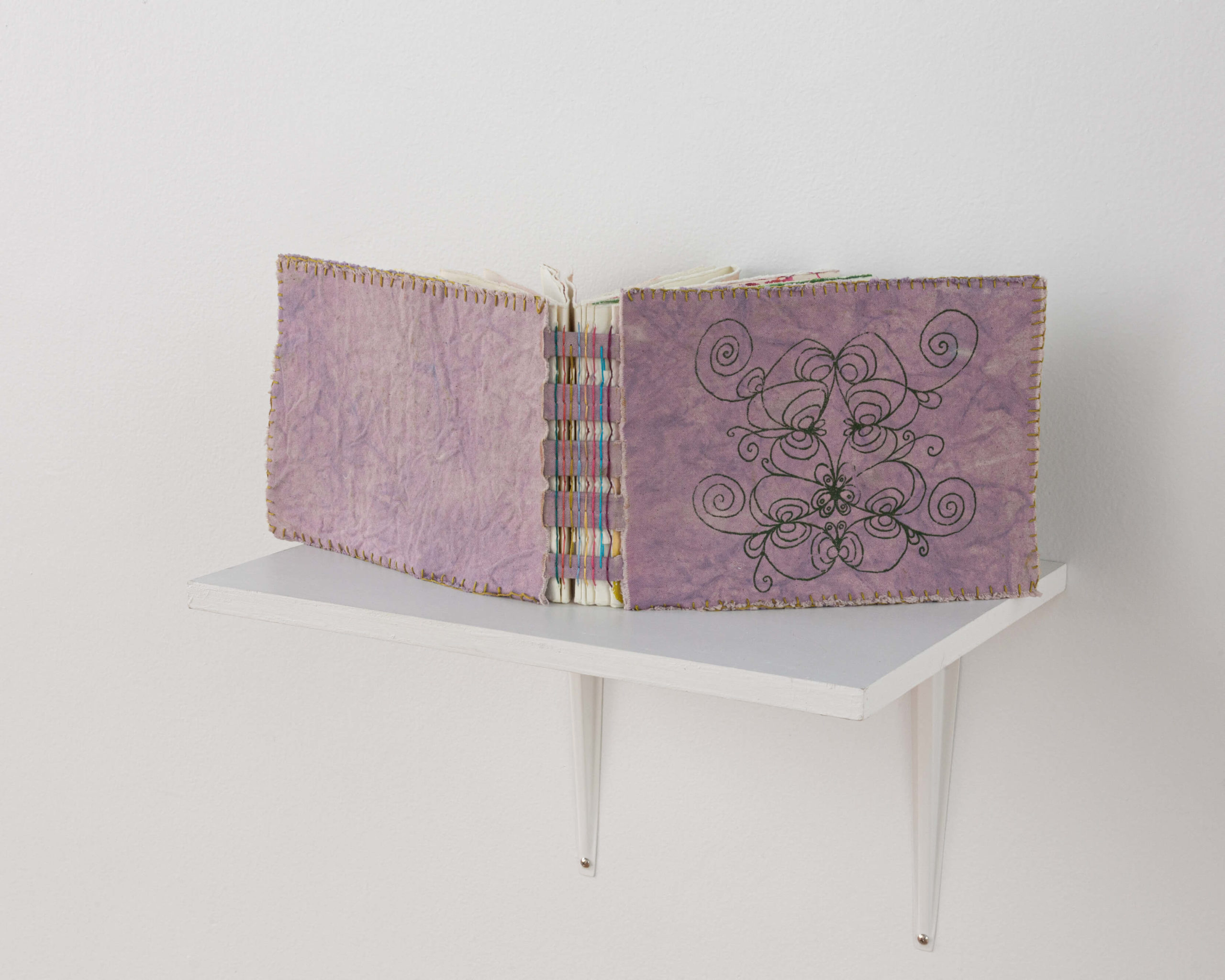
Julia Scheiber
Youth Intern and Summer Camp Instructor
Big Book
Handbound book full of watercolor and printed imagery, covers are screenprinted and dyed canvas
closed- 11 1/4 x 2 x 8 1/2" open- 24 1/4 x 8 1/2"
Julia Scheiber (b. 2003, Long Island, NY) received her BFA in Fine Arts from the Fashion Institute of Technology with a focus on Craft and Textiles. Scheiber uses her practice as a means to process the day to day through working with processes that feel meditative. Currently that looks like weaving, dying, bookbinding, and ceramics. Her work has been included in group shows including FIT’s Art and Design Thesis Show, The Space in Between (2025); FIT’s Art and Design Gallery’s Pattern, the Grid, and Other Systems (2023); and Parrish Art Museum's 2021 Student Exhibition. She currently lives and works in Manhattan and Brooklyn.
My art practice functions as a means to process the day to day. Focusing on processes that feel meditative. The work that I make feels like a reflection of self. Through photo and textile I explore an ever questioning of life and the meaning of it, pondering on what it means to exist and make art. With a focus on practices that feel meditative, I find artmaking provides me a space of solace, somewhere to reflect. In my current work I use techniques of weaving, dyeing, stitching, and photography as a way to memorialize the passing of time. More than anything, I have such a love for the process, working from a small pile of materials and seeing what could come of them, how they can be arranged in a way that feels good.
Lately, I’ve been thinking a lot about how fibers and objects hold onto memory just as photos do. Through using pre-owned supplies there is an added layer of life and wear that contributes to this idea of memorializing the passing of time. Much of what I use comes from things I’ve collected over time or have found in places that I frequent. The wood was once used for easels at school, shells tell a story of a walk along the beach, yarn makes me think of where I got hold of it. Each material embodying the memory of life at the times they were found. I like to think there is a life cycle to materials, and I see my work as a part of their lives, as it is a part of mine.
I'm deeply attracted to the unpredictable nature of dyeing. Although I control the color palette and where color is placed, dyeing as a process forces you to let go of some control. The powdered dyes that I use are made of several pigments. When they touch water the dyes split into some of their component colors. This for me is therapeutic, leaving me as a kind of spectator to these elements beyond my control. It’s all about the process of stepping away and coming to see what’s been left, a kind of controlled surprise, choosing the materials I want to work with but putting them together in ways that make the outcome hard to predict. I find that there is only ever so much planning that can be done, and then I give the rest to my hands. I love to turn to intuition, working with the moment, working with the moves you made yesterday and finding ways to expand on them today.
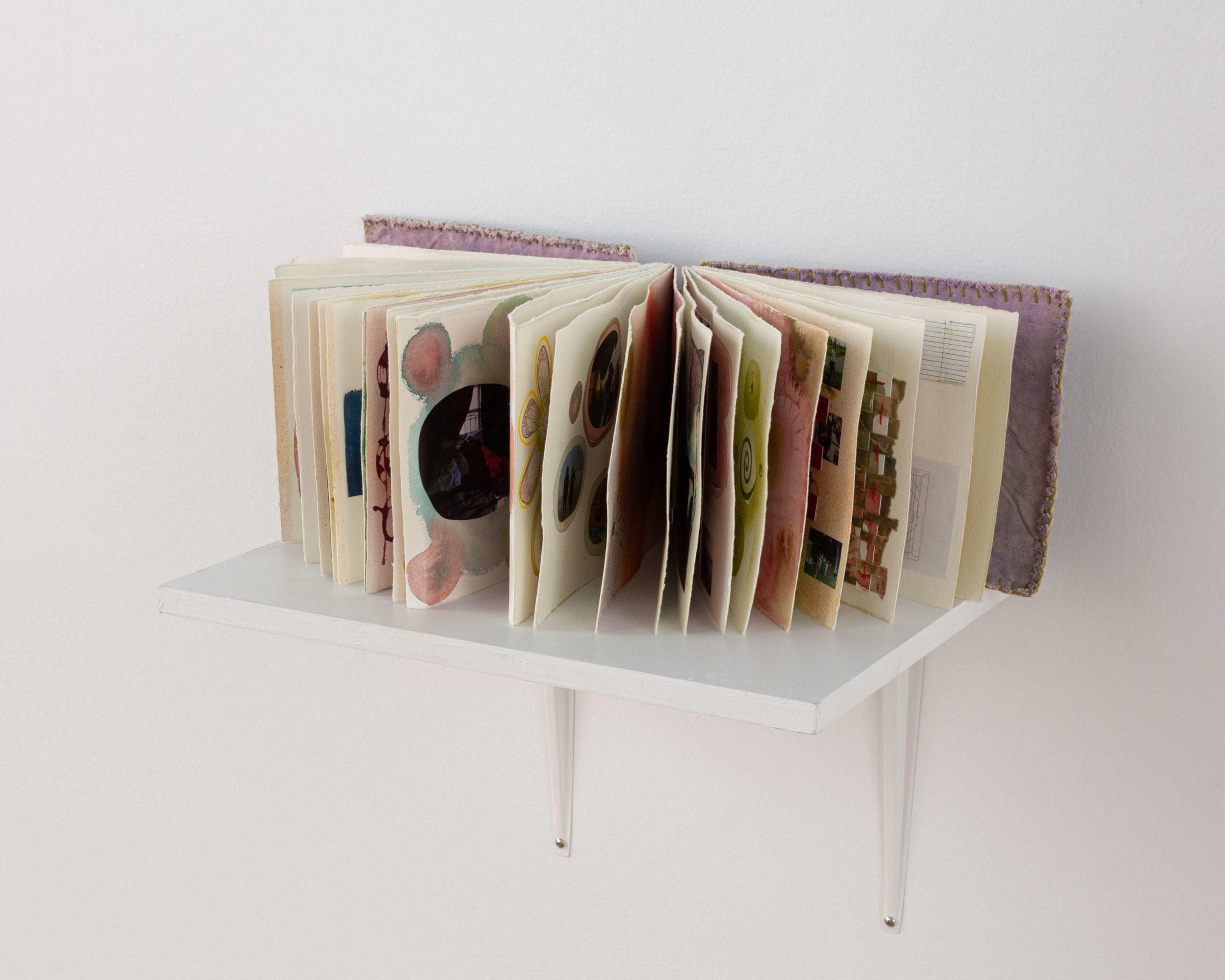
Julia Scheiber
Youth Intern and Summer Camp Instructor
Big Book
Handbound book full of watercolor and printed imagery, covers are screenprinted and dyed canvas
closed- 11 1/4 x 2 x 8 1/2" open- 24 1/4 x 8 1/2"
Julia Scheiber (b. 2003, Long Island, NY) received her BFA in Fine Arts from the Fashion Institute of Technology with a focus on Craft and Textiles. Scheiber uses her practice as a means to process the day to day through working with processes that feel meditative. Currently that looks like weaving, dying, bookbinding, and ceramics. Her work has been included in group shows including FIT’s Art and Design Thesis Show, The Space in Between (2025); FIT’s Art and Design Gallery’s Pattern, the Grid, and Other Systems (2023); and Parrish Art Museum's 2021 Student Exhibition. She currently lives and works in Manhattan and Brooklyn.
My art practice functions as a means to process the day to day. Focusing on processes that feel meditative. The work that I make feels like a reflection of self. Through photo and textile I explore an ever questioning of life and the meaning of it, pondering on what it means to exist and make art. With a focus on practices that feel meditative, I find artmaking provides me a space of solace, somewhere to reflect. In my current work I use techniques of weaving, dyeing, stitching, and photography as a way to memorialize the passing of time. More than anything, I have such a love for the process, working from a small pile of materials and seeing what could come of them, how they can be arranged in a way that feels good.
Lately, I’ve been thinking a lot about how fibers and objects hold onto memory just as photos do. Through using pre-owned supplies there is an added layer of life and wear that contributes to this idea of memorializing the passing of time. Much of what I use comes from things I’ve collected over time or have found in places that I frequent. The wood was once used for easels at school, shells tell a story of a walk along the beach, yarn makes me think of where I got hold of it. Each material embodying the memory of life at the times they were found. I like to think there is a life cycle to materials, and I see my work as a part of their lives, as it is a part of mine.
I'm deeply attracted to the unpredictable nature of dyeing. Although I control the color palette and where color is placed, dyeing as a process forces you to let go of some control. The powdered dyes that I use are made of several pigments. When they touch water the dyes split into some of their component colors. This for me is therapeutic, leaving me as a kind of spectator to these elements beyond my control. It’s all about the process of stepping away and coming to see what’s been left, a kind of controlled surprise, choosing the materials I want to work with but putting them together in ways that make the outcome hard to predict. I find that there is only ever so much planning that can be done, and then I give the rest to my hands. I love to turn to intuition, working with the moment, working with the moves you made yesterday and finding ways to expand on them today.
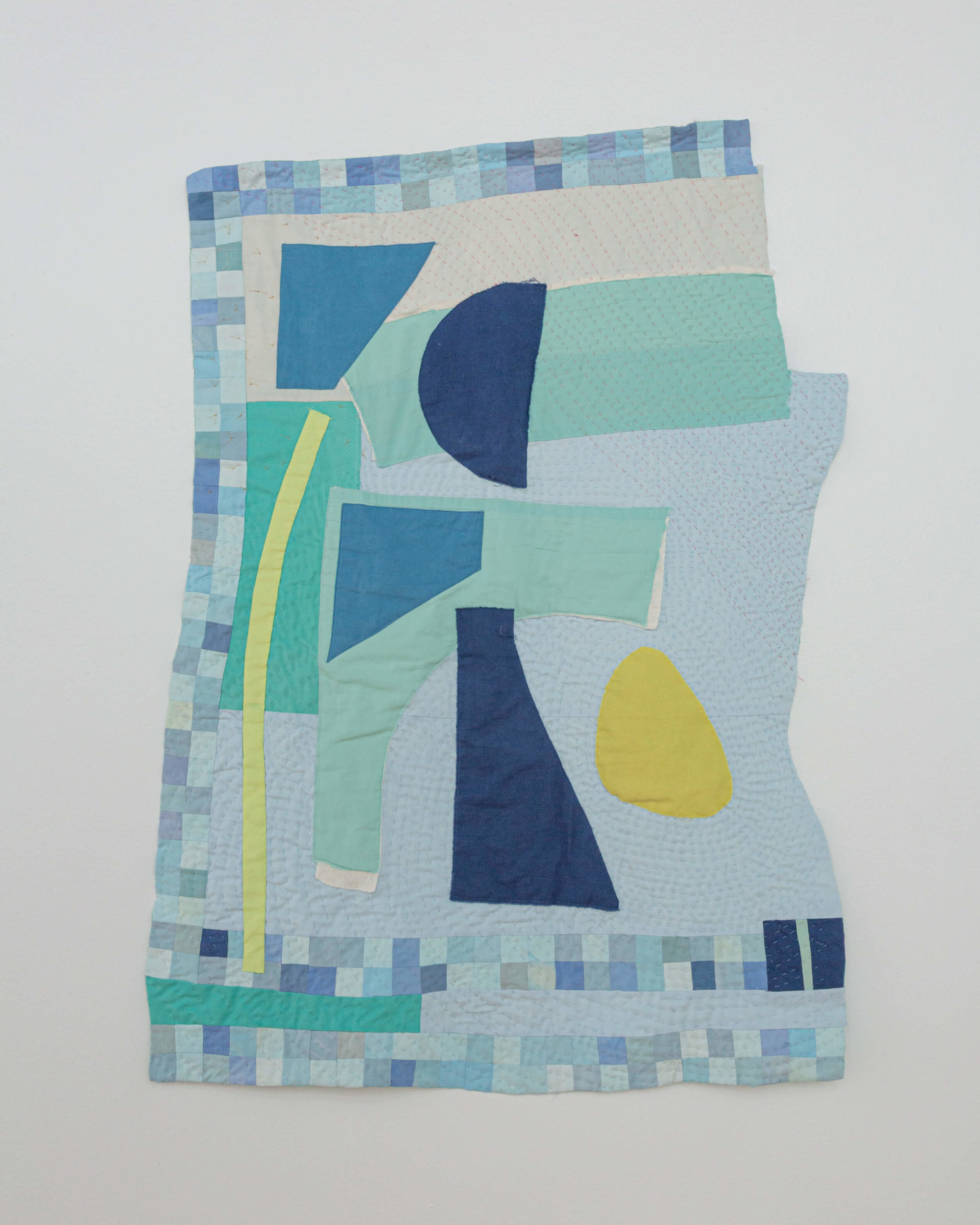
Caitlyn McLaughlin
Summer Camp, After School, Mini Camp, Birthday Party Instructor
Hike at Yoho
Hand-dyed cotton fabric, cotton and polyester thread, cotton batting
33" x 48"
2025
Caitlyn McLaughlin is a textile artist and educator living in Brooklyn, New York. She received her MFA from NYU Steinhardt and her BFA from School of Visual Arts. She currently teaches classes at Textile Arts Center, Riverbank State Park, and with Young Audiences New York. She's also taught as adjunct faculty at New York University and at Vesterheim Folk Art Museum. She's attended artist residencies "Le Festival de Bargemon" in Provence-Alpes-Côte d’Azur, Bargemon, France and "Sculpture, Installation, and New Media Art" at School of Visual Arts in New York, NY. Her work has been published in Brazenhead Review and she's participated in shows at NARS Foundation (Brooklyn, NY) , Theodore:Art (Brooklyn, NY), UpFront Exhibition Space (Port Jervis, NY), 80WSE (New York, NY), MANA Contemporary (Jersey City, NJ), among others.
My work explores the essential role textiles play in our lives and the deeply human connection we have with cloth. Fabric touches us daily—protects our bodies and comforts us—yet this immensely intimate relationship is often taken for granted. I examine the relationship between the hidden labor behind textile production and the overconsumption of fabric in modern life; these interests underpin my process of creating quilts that emphasize process, care, and the quilt’s role as a personal comfort object.
I hand-dye cotton, often using recycled or remnant materials, to craft quilts that evoke warmth, intimacy, and personal space. My practice also honors the historically collaborative and women-centered tradition of quilting. Influenced by folk art and the quiet compositions found in nature, my work features floating shapes, expressive color, and fluid stitch-work—both hand-sewn and machine-made.
Each quilt is a meditation on material, memory, and touch. I aim to create pieces that feel familiar yet liminal, inviting reflection and emotional connection. My work celebrates fiber art as a process-driven form, revealing unexpected beauty through texture and bold color.
Camila Ruiz
2022 Summer Camp Instructor
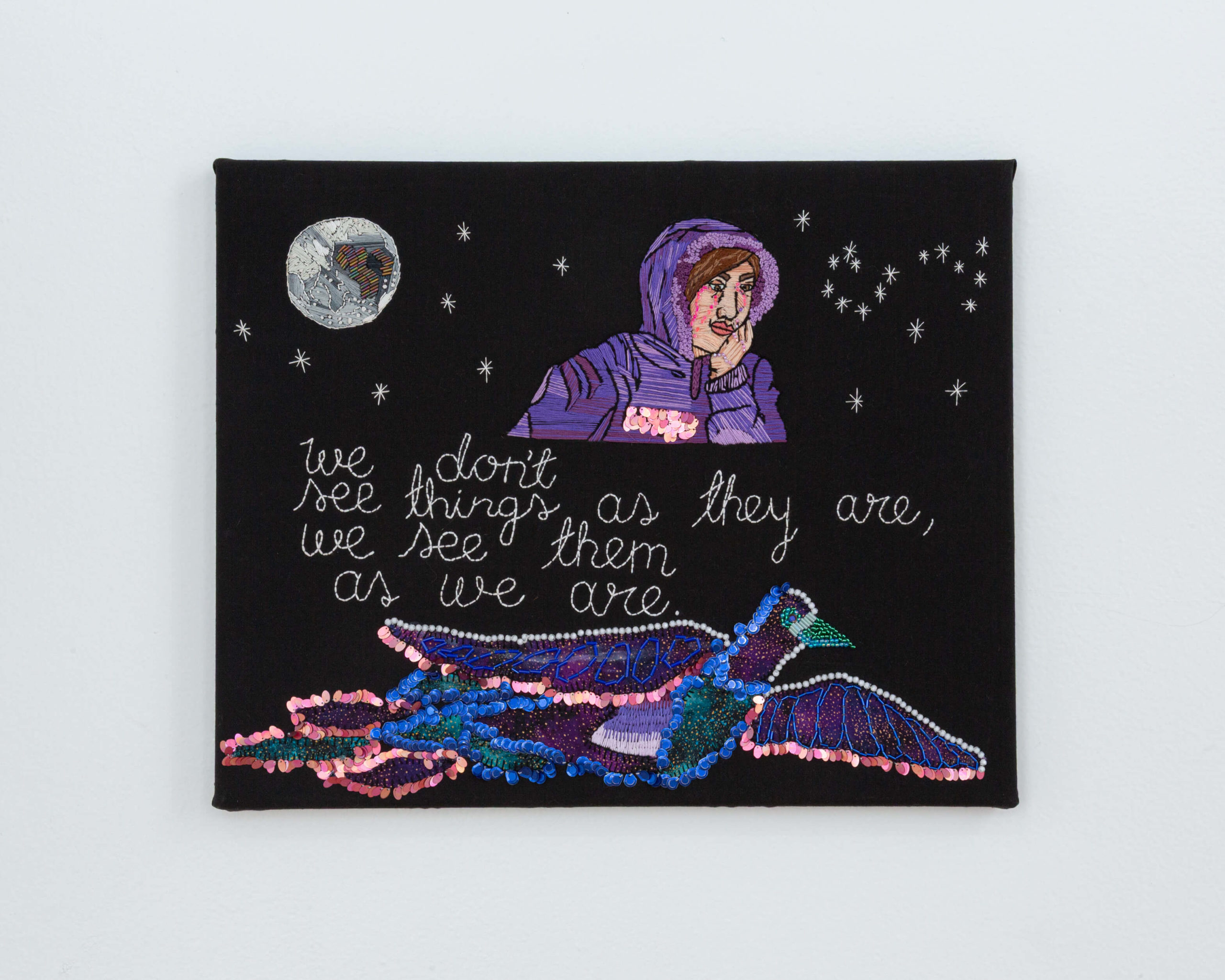
Starling
20" x 16"
"Starling" began as an embroidery self-portrait in 2020. That year, I completed the top third of the embroidery. Unsure of what to make to complete the piece, it remained untouched for four years. I felt guilty for giving up after putting so much time and effort into it. Earlier this year, I came across a quote attributed to Anais Nin: "We don't see things as they are, we see them as we are." This quote resonated with me on a deeply personal level, inspiring me to reflect on how I see myself. I see myself as a starling.
Camila Ruiz is a Colombian artist, educator, and art studio manager based in Brooklyn, NY. Camila’s art practice is focused on textile mediums such as embroidery, knitting, and dressmaking. As an educator, she develops and teaches art workshops in English and Spanish for families and children.
Camila Ruiz
2022 Summer Camp Instructor
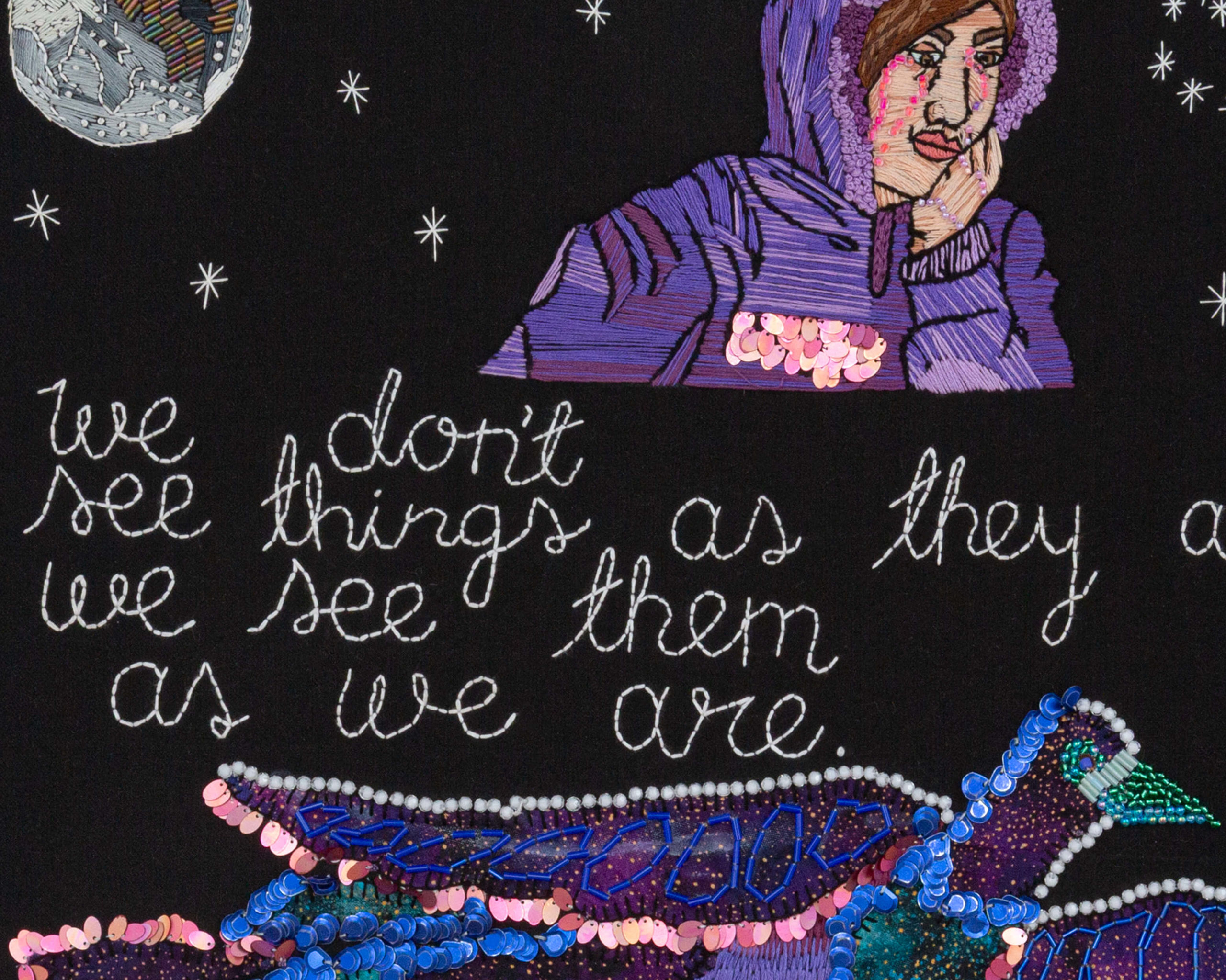
Starling
20" x 16"
"Starling" began as an embroidery self-portrait in 2020. That year, I completed the top third of the embroidery. Unsure of what to make to complete the piece, it remained untouched for four years. I felt guilty for giving up after putting so much time and effort into it. Earlier this year, I came across a quote attributed to Anais Nin: "We don't see things as they are, we see them as we are." This quote resonated with me on a deeply personal level, inspiring me to reflect on how I see myself. I see myself as a starling.
Camila Ruiz is a Colombian artist, educator, and art studio manager based in Brooklyn, NY. Camila’s art practice is focused on textile mediums such as embroidery, knitting, and dressmaking. As an educator, she develops and teaches art workshops in English and Spanish for families and children.
Flo Low
2025 Summer Camp Instructor
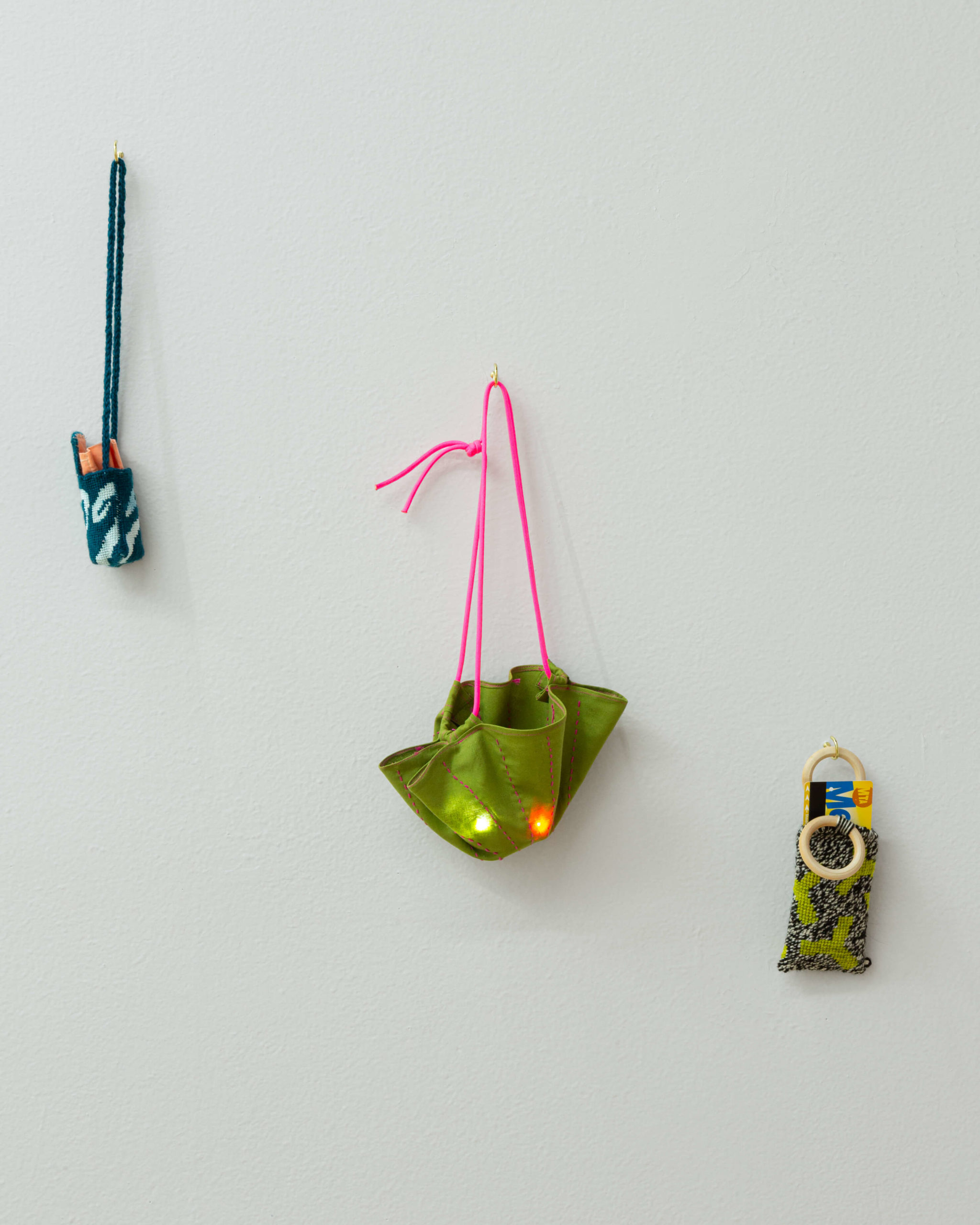
Bags for Life
Life is the occasion: three bags, one to carry quarters for the laundromat, another to hold a metrocard or OMNI card, and the third as an accessory for a night out, to hold bike lights for the ride home while you’re dancing.
Flo Low is from London, discovered themself as an artist in the post-Soviet Republic of Armenia, and now lives in New York. Chained to graphic design but liberated through art education, printmaking and textile art, they take joy in collecting typography from around the city, co-facilitating a zine club at Interference Archive, learning arcane art and design processes, and letting loose at karaoke and the gay bar. Flo approaches every day with the curiosity and awe of being in a foreign supermarket.
The bags signify a peaceful, curious, collaborative and caring approach to the world: Ursula K. Le Guin posits that the carrier bag, not the weapon, should be seen as the archetypal and original tool created by humans. Inspired by the young campers whom I taught every week and their creative instinct to make tiny bags for almost no purpose, I imagined what a single-purpose (but not single-use) bag would look like. Teaching the children about Faith Ringgold’s Tar Beach - making the ordinary extraordinary - made me wonder how to turn the most mundane of errands, like taking the subway or washing clothes, into an utterly fabulous outing.
Kelly Valletta
Executive Director
Karin Persan
2016 Summer Camp Surface Design Instructor Manhattan, Current Studio Manger
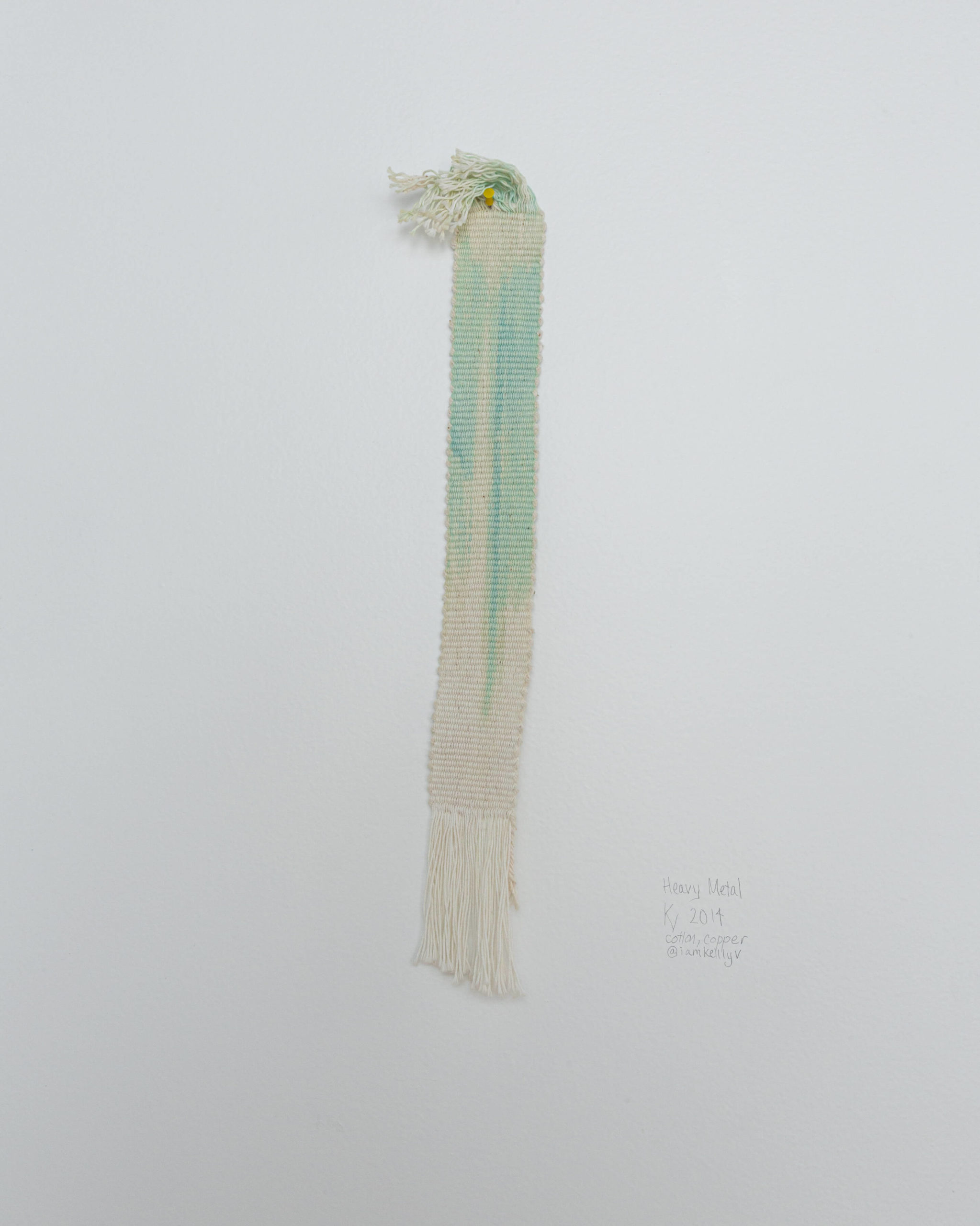
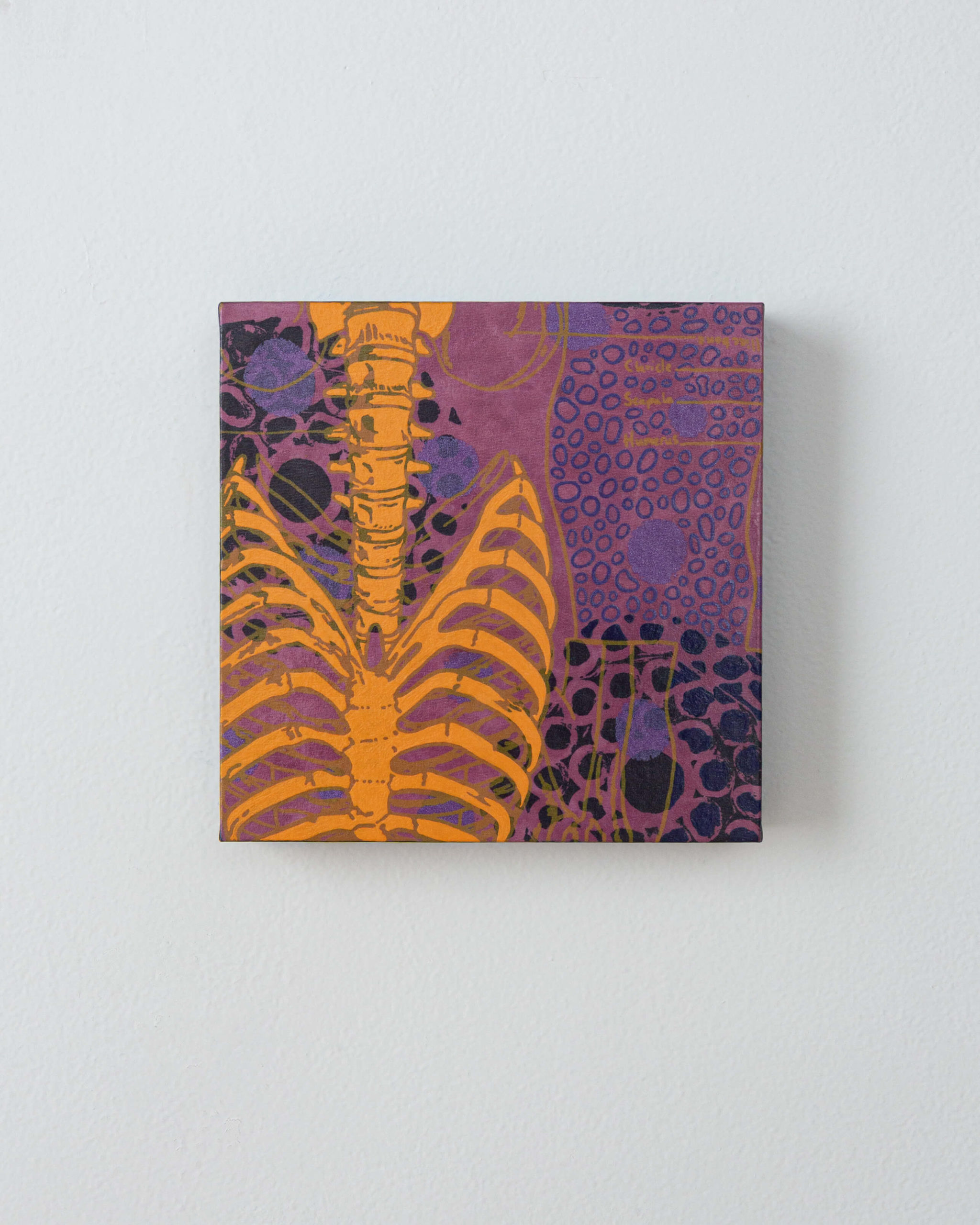
Ribs
12"x12", Dyed and Screen Printed Jersey Cotton over Wood Panel with Painted Details in Acrylic Paint
My work centers on textiles—a fusion of dyeing, painting, and printing on fabric and paper. Each piece is one-of-a-kind, whether it's a bold fashion statement, a distinctive home décor item, or a standalone work of art. I'm drawn to vibrant colors and unconventional prints that demand attention. My process is meditative, layering pattern upon pattern, even if the final result may feel visually intense to the viewer.
Karin Persan is a hands on textile designer, maker, and instructor working from her studio in Brooklyn, NYC. She received her BFA in 2001 from the School of the Art Institute of Chicago, where she focused in Fiber and Material Studies. Her now closed business "Better Than Jam" sold her work line of clothing, accessories, and home goods using her hand dyed and printed textiles, as well as the handmade works of many local artisans for 15 years. You can now find her traveling with her handmade wears and teaching at Textile Art Center, Brooklyn Brainery, Peters Valley School of Craft, Snow Farm, Museo de Textiles, and anywhere who will have her. She is passionate about hand printing and dyeing with nature.
Erina Pearl
2025 Summer Camp Visiting Artist
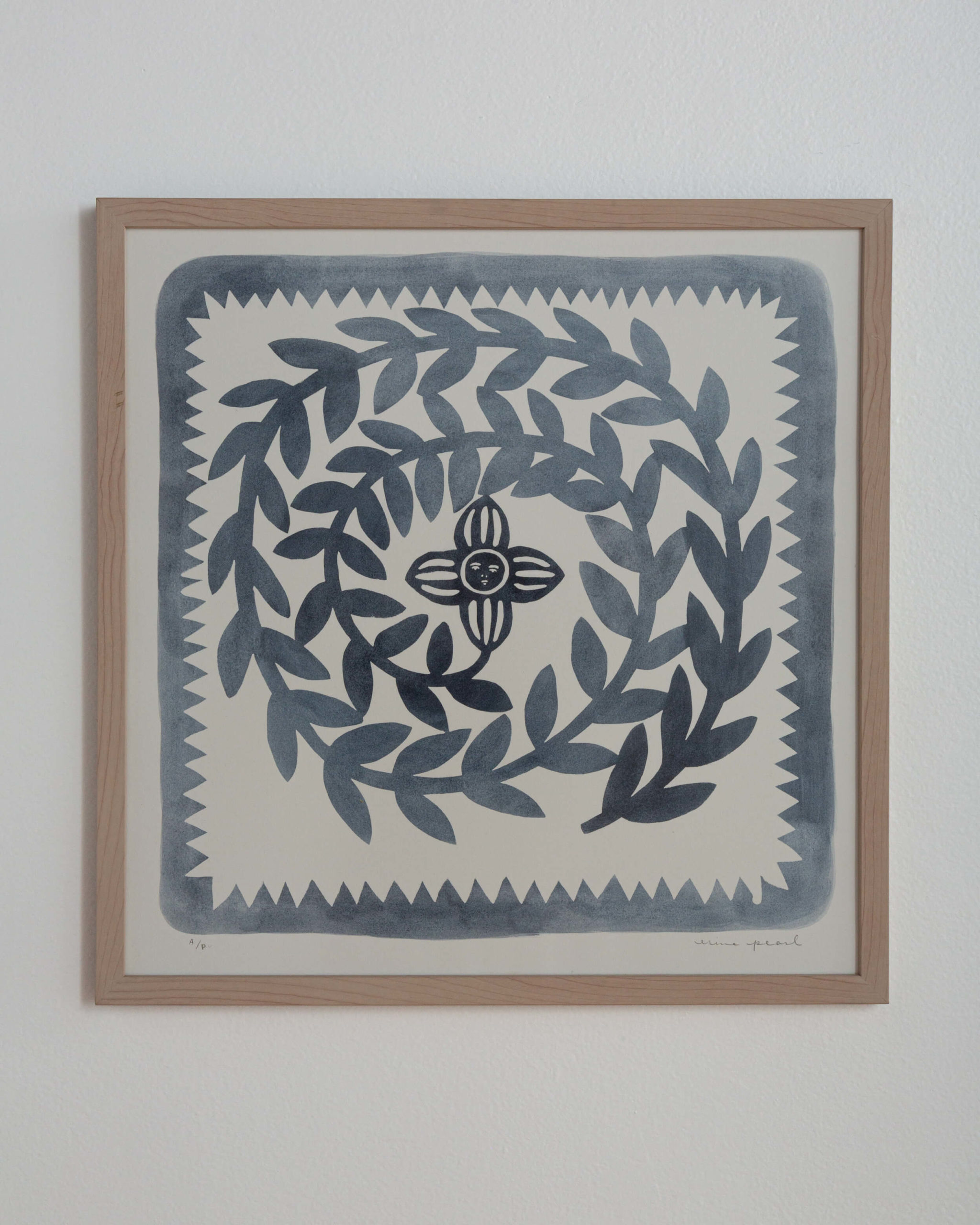
Growing Blue
Rives BFK, katazome print
20" x 20"
The garden has always been more than just a plot of soil—it is a place of memory and meaning. Growing up, I watched my grandmother tend to her garden with patience and curiosity, dedicating herself fully to its quiet rhythms. I later learned she had pursued a certification in Ikebana, the Japanese art of flower arrangement. However, she was never able to complete it; my grandfather dismissed it as frivolous, a waste of time and money.
My work honors her dedication and the quiet joy she found in working with nature. I integrate natural materials not only in the subjects I depict but in the process itself. My practice often begins in the garden, where I grow plants both as inspiration and as raw materials. Some I use directly, while others I transform into pigments, crafting my own paints—an act that, like my grandmother’s pursuit, might be seen as unnecessary.
Through this practice, I reclaim the value of time spent in connection with nature and celebrate the often-overlooked labor and creativity of women like my grandmother. My work is an act of homage, a continuation of her story, and a reminder that beauty grown slowly and intentionally is always worth the effort.
Erina Pearl’s work is deeply rooted in the natural world—both in imagery and material. Growing up along the shores of Florida, she developed an early connection to nature that continues to shape her artistic practice today in the Hudson Valley. Erina integrates earth and lake pigments into all of her work, grounding her art in the very materials that inspire it.
Her studio practice centers around cut-stencil printing and natural dyeing, drawing on traditional Japanese katazome techniques to inform her process. By incorporating natural materials directly into her work, she explores the interplay between environment and art, bringing elements of the outdoors into the studio. Erina earned her BFA with a concentration in printmaking from Appalachian State University, and continues to study art through workshops and her art community.
Annika Wahlsten
Current Afterschool Instructor, Former Afterschool attendee
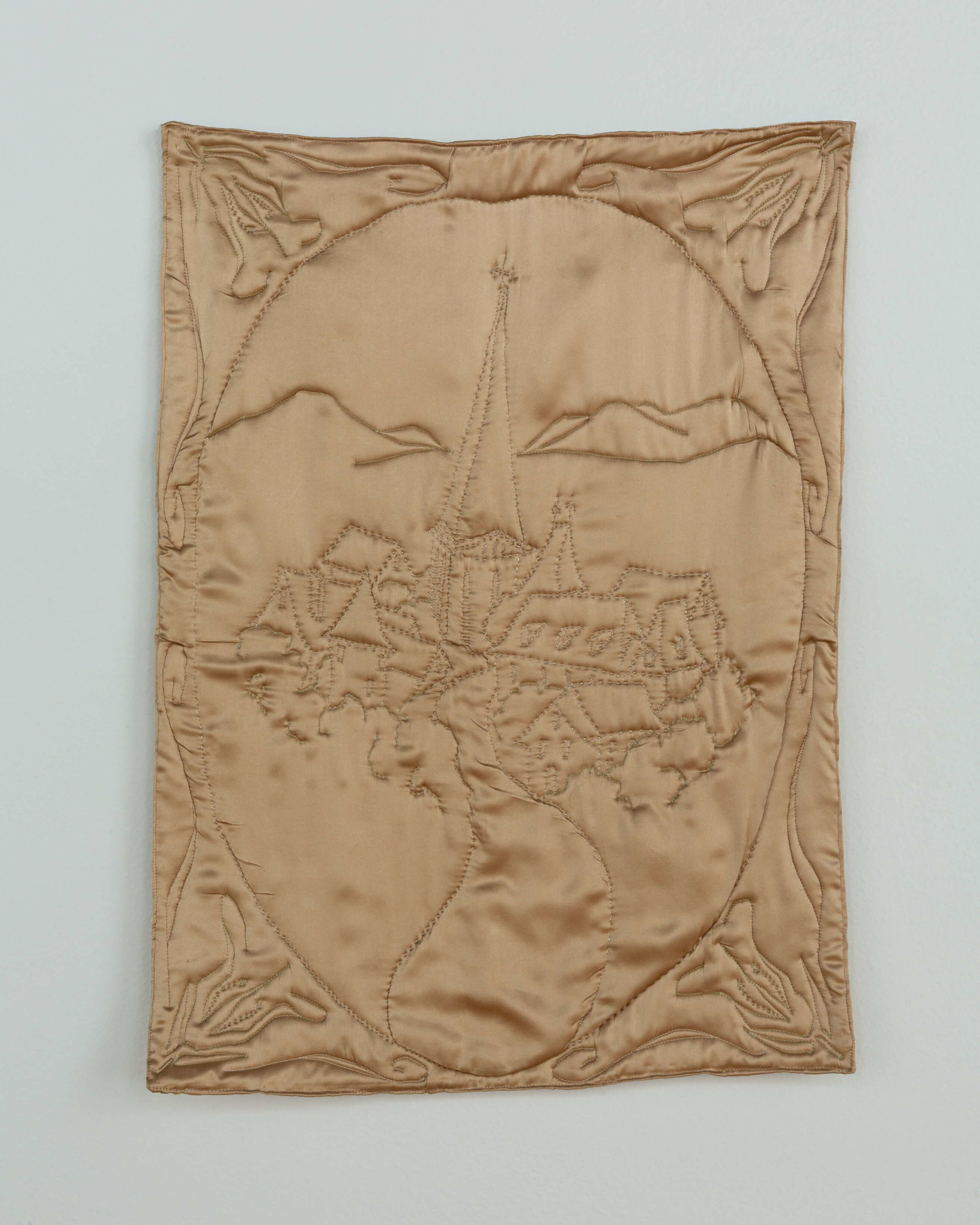
Heidi's House
Whole cloth Quilt, 16" x 20" (2025)
She lived in a crumbling, ramshackled, mosaiced house built upon a stone foundation in the ancient woods of Morvan, France.
She painted the walls with pastel blues fading into purples and pinks, layered with gauzy, sparkly fabrics, cobwebs, crust, and dust. Dried flowers were tacked up, alongside German poetry painted in script. There were collections of doll-sized clothing she made, and angel girls—angels everywhere. She made them from clay and fabric. They had big eyes and purposeful poses.
Heidi had no money and never had a job besides making her angels and puppet shows. She built her crumbling castles in the Algarve of Portugal, a cave in Tenerife, Spain, and lived there until she ran out of food. She worked tirelessly and prolifically on her yearly puppet show. None of the other artists quite understood Heidi, and it was clear her work was different from
the conceptual and the established. Her puppet shows were incredibly long and bizarre, with props falling down and moments of Heidi with her back to the audience, adjusting things. I was hypnotized and moved. They reminded me of being a teacher. She reminded me of a child. As when teaching kids, she reminded me that sometimes art is about urgently making something you find beautiful, with materials you wish to touch and play with. She made exactly what she liked.
This piece is inspired by her.
Annika Wahlsten is a multidisciplinary artist from Brooklyn, New York. She is an embroiderer for BODE and a Youth Instructor at Textile Arts Center.
Itala Aguilera
Summer Camp, After School, Mini-Camp Instructor
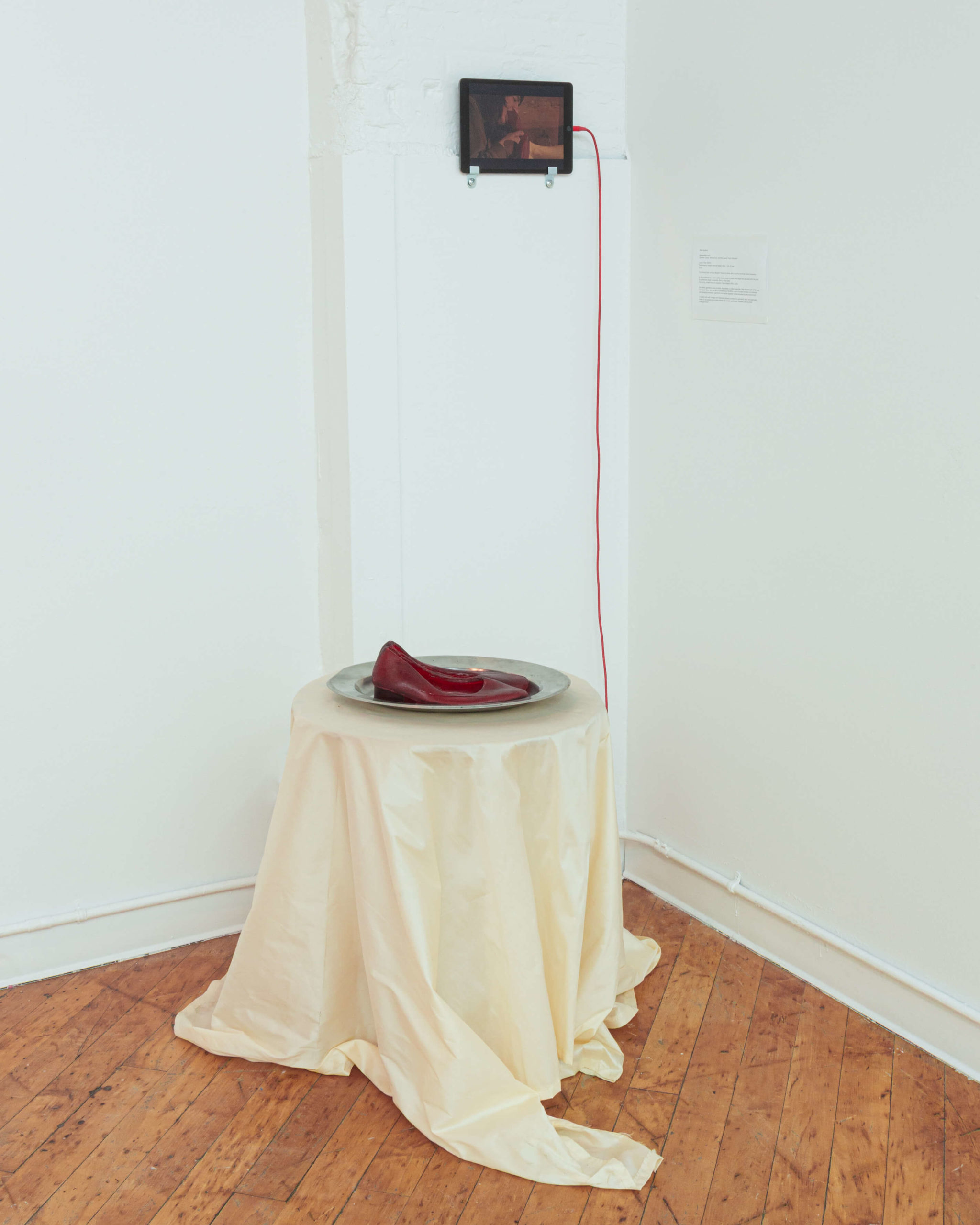
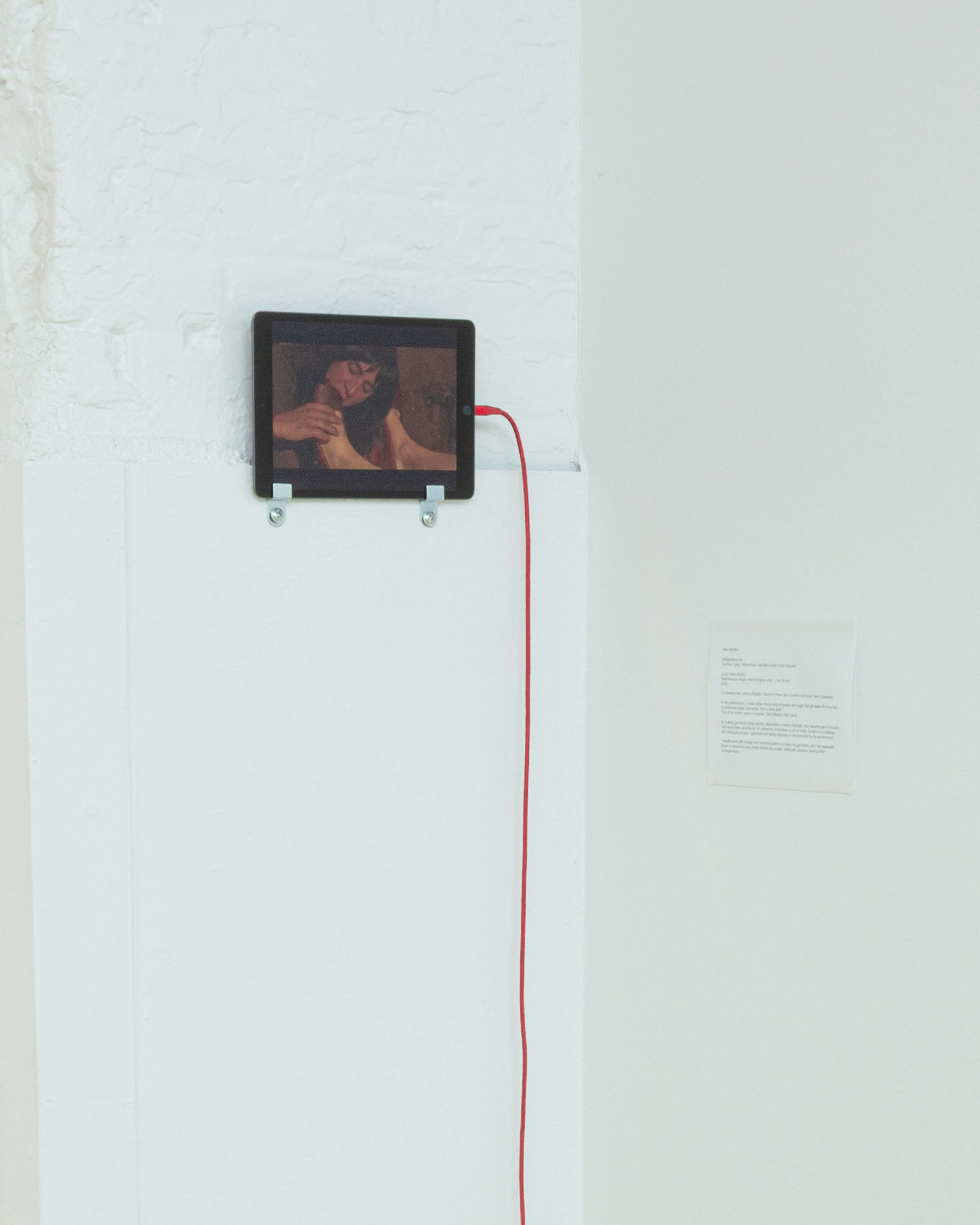
Single channel video, 1min 26 sec
2025
Lunch Time (2025), digital video, performance. Co-directed with Joshua Bogatin. Sound by Neve Jahn.Gummy technician David Gassaway
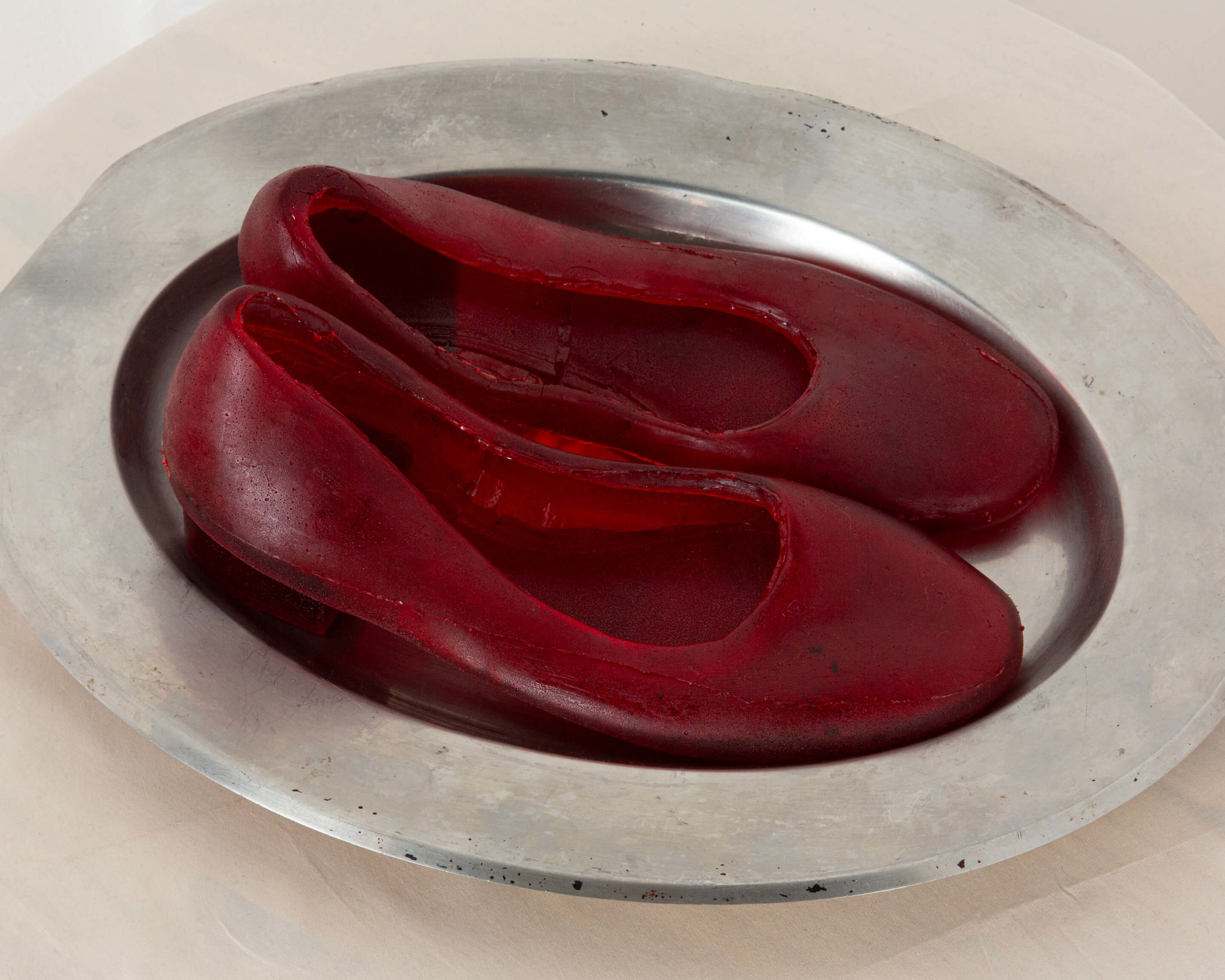
In this performance, I wear edible shoes made of gelatin and sugar that get eaten off of my feet, by performer Jorge Cervantes, from a silver plate.
Part of my current work in progress Tierra Mojada (Wet Land).
My search for new ways of relating to clothing has led me to experiment with different media: for my piece Love Bug I used electronics; in my project One Million Undresses I used water-soluble textiles, heat-reactive wire (NiTiNOL), and performed; and for my current project Tierra Mojada (Wet Land) I'm experimenting with edible and water-soluble materials, ice, silicone mold casting, performance, and video.
By making garments using soluble, degradable or edible materials, they become part of the body that wears them, and the act of undressing is therefore a sort of bodily function or a chemical and biological process—garments are literally digested or decomposed by the environment.
I usually work with vintage and historical patterns to make my garments, and I am especially drawn to structured and ornate clothes like corsets, petticoats, drawers, among other undergarments.
Itala Aguilera
Summer Camp, After School, Mini-Camp Instructor
Single channel video, 1min 26 sec
2025
Lunch Time (2025), digital video, performance. Co-directed with Joshua Bogatin. Sound by Neve Jahn.Gummy technician David Gassaway
In this performance, I wear edible shoes made of gelatin and sugar that get eaten off of my feet, by performer Jorge Cervantes, from a silver plate.
Part of my current work in progress Tierra Mojada (Wet Land).
My search for new ways of relating to clothing has led me to experiment with different media: for my piece Love Bug I used electronics; in my project One Million Undresses I used water-soluble textiles, heat-reactive wire (NiTiNOL), and performed; and for my current project Tierra Mojada (Wet Land) I'm experimenting with edible and water-soluble materials, ice, silicone mold casting, performance, and video.
By making garments using soluble, degradable or edible materials, they become part of the body that wears them, and the act of undressing is therefore a sort of bodily function or a chemical and biological process—garments are literally digested or decomposed by the environment.
I usually work with vintage and historical patterns to make my garments, and I am especially drawn to structured and ornate clothes like corsets, petticoats, drawers, among other undergarments.
Itala Aguilera
Summer Camp, After School, Mini-Camp Instructor
Single channel video, 1min 26 sec
2025
Lunch Time (2025), digital video, performance. Co-directed with Joshua Bogatin. Sound by Neve Jahn.Gummy technician David Gassaway
In this performance, I wear edible shoes made of gelatin and sugar that get eaten off of my feet, by performer Jorge Cervantes, from a silver plate.
Part of my current work in progress Tierra Mojada (Wet Land).
My search for new ways of relating to clothing has led me to experiment with different media: for my piece Love Bug I used electronics; in my project One Million Undresses I used water-soluble textiles, heat-reactive wire (NiTiNOL), and performed; and for my current project Tierra Mojada (Wet Land) I'm experimenting with edible and water-soluble materials, ice, silicone mold casting, performance, and video.
By making garments using soluble, degradable or edible materials, they become part of the body that wears them, and the act of undressing is therefore a sort of bodily function or a chemical and biological process—garments are literally digested or decomposed by the environment.
I usually work with vintage and historical patterns to make my garments, and I am especially drawn to structured and ornate clothes like corsets, petticoats, drawers, among other undergarments.