

Nadege Pierre, Artist Programs intern at TAC, spent time with December WIP resident Anna Ill.
Nadege: What are you currently working on as a resident?
Anna: I am planning to pursue my practice, gathering a few objects found in the streets of New York. Allowing my subconscious to play an important role, where I choose objects that remind me of particular body parts or organic shapes. I gather the materials in the studio space until I start playing with them by adding some lace, welding them together or doing some assemblage.
Nadege: What’s unique about sculpting with abandoned objects? How do you connect them to your artistry?
Anna: Primarily, I collect and work with metals, wood, and textiles. I am fascinated by the hidden histories they carry. I explore ways to recontextualize abandoned objects or remnants, offering them a new possibility of existence and a renewed purpose.
I work with objects that are aggressive, rusted, rigid, and quite impossible to destroy, and I combine them with fragile loose textiles and thin cotton laces. I repurpose materials to assemble parts of the human body, allowing discarded metals, wood, and textiles to take on corporeal presence and embody new meanings.
Recently I have been focused on the area of South Bermondsey (London) as it's going through a massive gentrification process. Every street corner is under construction. The speed of change around me is crazy, super fast; the environment is quite violent. These external elements have an impact on me, so I question the environment’s impact on the body. I naturally create to combine contrasting themes of intimacy and the human body’s fragility. I create fragile textiles as if they were about to break to respond to these external elements. I incorporate themes related to the body, connecting them to my personal experiences as well as those of others. Drawing from past experiences, my work collectively expresses pain, love, the absence of love, grief, and fear. I share my emotional experiences and anxieties by giving them physical form through sculpture.
I started exploring abandoned objects 10 years ago. I recalled memories with my family, where we collected items, like furniture from the street, so there is a body-action memory of my art process. Instinctively, I am attentive to finding objects that allow my inner desires to speak through them. Unconsciously, as I observe object shapes I think through them. As a visual artist, I might not find the words to express my thoughts, so my sculptures are trying to communicate that to the audience.
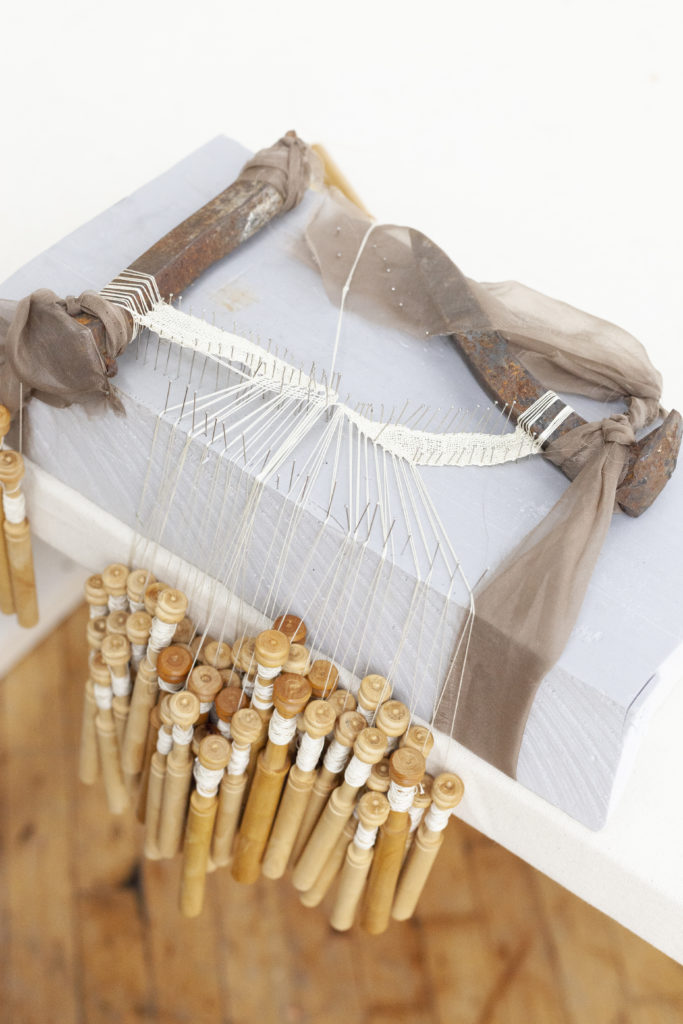
Nadege: Speaking of fragility, you create textiles to escape physical boundaries, allowing space for a new imaginary strategy. The cotton lace around the sculpture reflects that, what's unique about threading with bobbin lace?
Anna: Inadvertently, one summer, my 85 year old Auntie taught me how to thread. I have memorable memories of observing her threading in action. It's a female tradition in my family that's been there for quite some time. I was eager to learn and observe the process of this technique. This technique allowed me to work with found materials that have many gaps and mistakes. I modified the sculpture in an organic way for bobbin laces to enter small holes, fill in the gaps, and add missing parts.
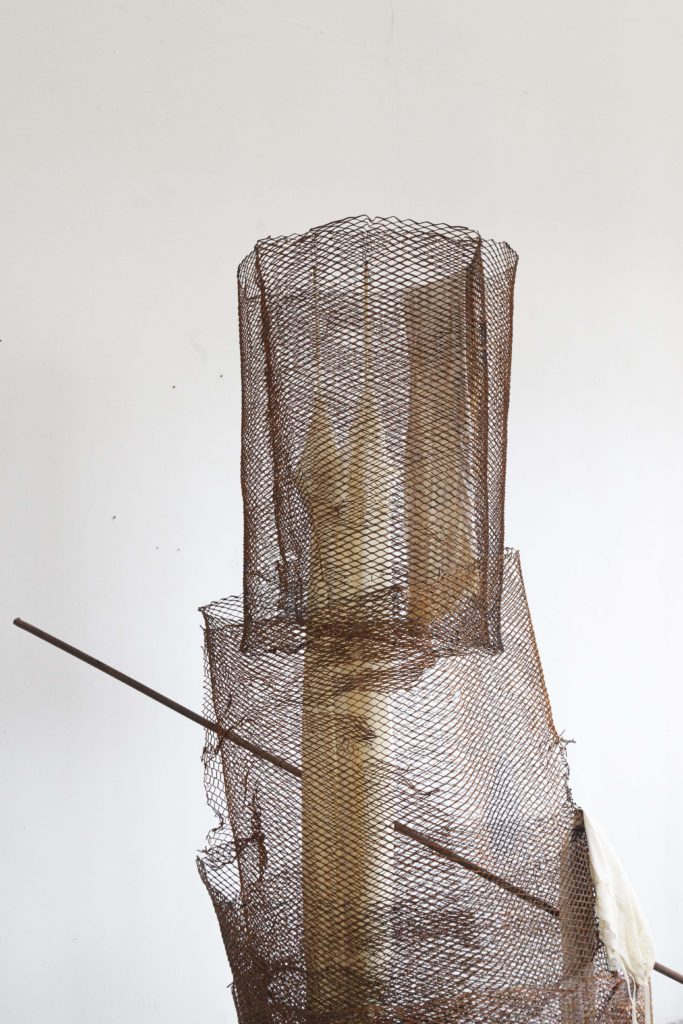
Nadege: I was intrigued by your sculpture, Oneself. What's unique about this piece? What techniques did you explore to sculpt?
Anna: It’s a rusted mesh metal with some cement that was used in construction. As you could see, there were three dresses placed and trapped inside the sculpture. These dresses were in my collection for 10 years. They were drenched and soaked in boiled linseed oil to appear wet, sticky, dirty, and worn. They hung inside the mesh with an arrow pole that goes through it. The whole concept reflected different phases of yourself. A reflection of different phases of fears we encounter. Emotionally, when one cycle ends, another one begins. As you still exist as yourself, a new version of yourself evolves. As if there’s a reproduction of yourself; an evolution through fear.
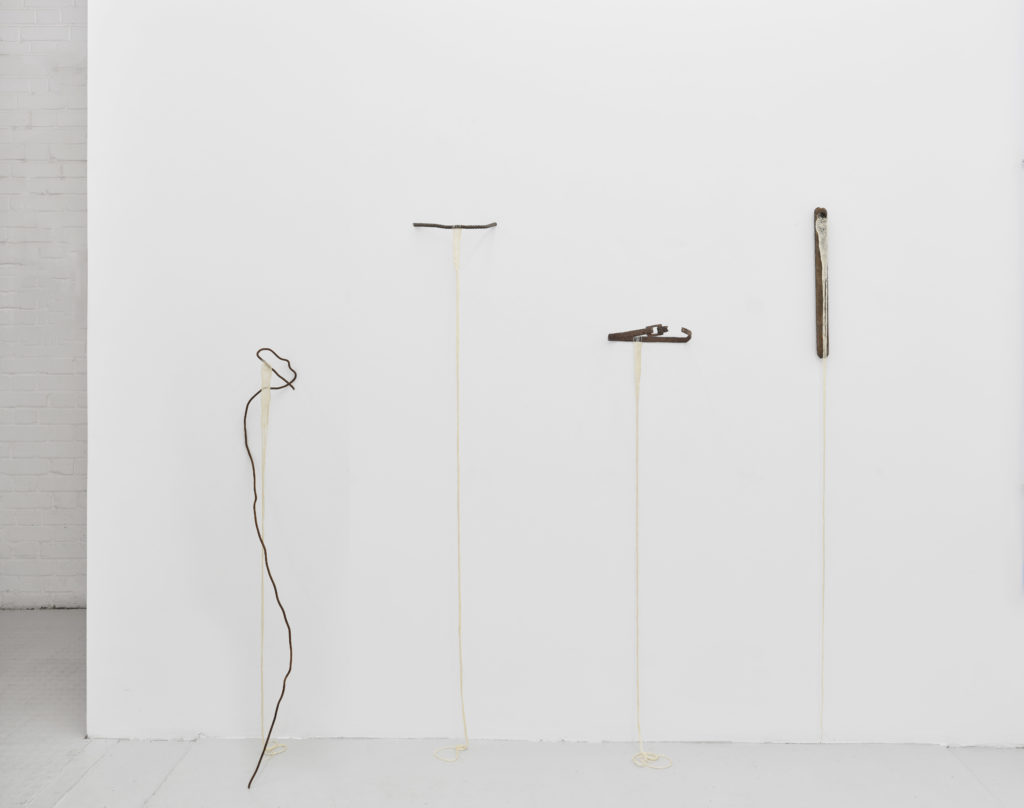
Nadege: The Liminal Bodies series resembled the female reproductive system. Why the female body as a source of inspiration?
Anna: Liminal Bodies reflected primal and foundational bonds. The initial development of mother and child. There was an idea of the legal in the political cord. They resembled the presence of the body through its absence. Sculpting with these objects insinuated that there was a body, remnants of a womb in relation to the waist of a woman. Adding the cotton laces reflected how the woman's body could be fragile, yet simultaneously strong. Dipping the laces in seed oil revived that concept, as something that is humid and still alive. The metal belts, weights, and strings reflected their strengths. The sculptures questioned the deep, but not permanent, connections of protection and vulnerability between a mother and the child.

Another example of the insinuated body is Hanche, a sculpture made with textiles and cement. Hanche sculpture is a block of cement that resembles the waist of a female body. The leather fabric was covered around it in the form of a plaster. My whole idea was to sculpt a damaged body by using textile as a form of resilience and care.
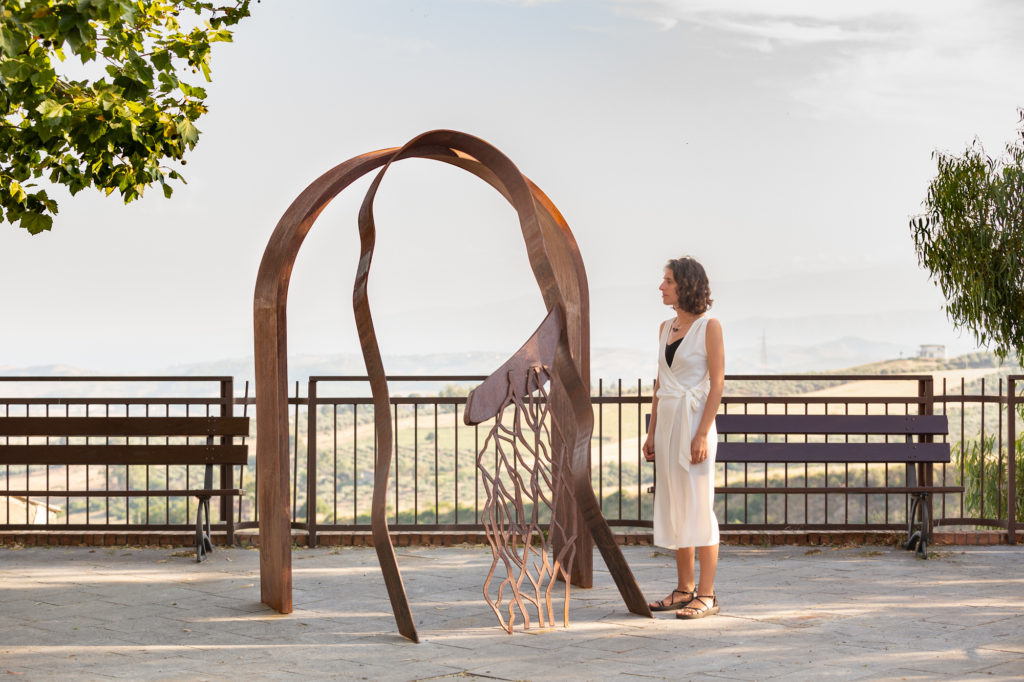
Nadege: Was your new project, Ceaseless Care, a continuation of the Liminal Bodies series?
Anna: This sculpture was quite different, commissioned in Italy by Fondazione Elpis and Una Boccata d’Arte, 20 artists were invited to create public sculpture in some remote areas in Italy. My project was inspired through found objects and then composed of three elements: the reproduction of an arch that was part of a wall from the 1960s that sustained a village, a figure of Kourotrophos with the idea of genderless figure of care and protection. The third element was an Indian Fig Opuntia, a cactus originally from Mexico. This plant regenerated on its own and is located in abrupt climates around the mediterranean landscape. With the idea of an autogenerative nature, I created this idea of a parent, a family member, or a friend protecting a child. Also, there’s a moment of independence to auto-generate yourself.
Without any textiles, the sculpture was designed for the outdoors. Adding textiles was quite impossible, considering the environment, and of course safety. Metaphorically, the skeleton of the cactus substituted the textile for endurance.
My piece is permanently on display in the public piazza Matteotti in Simeri (Calabria, Italy).
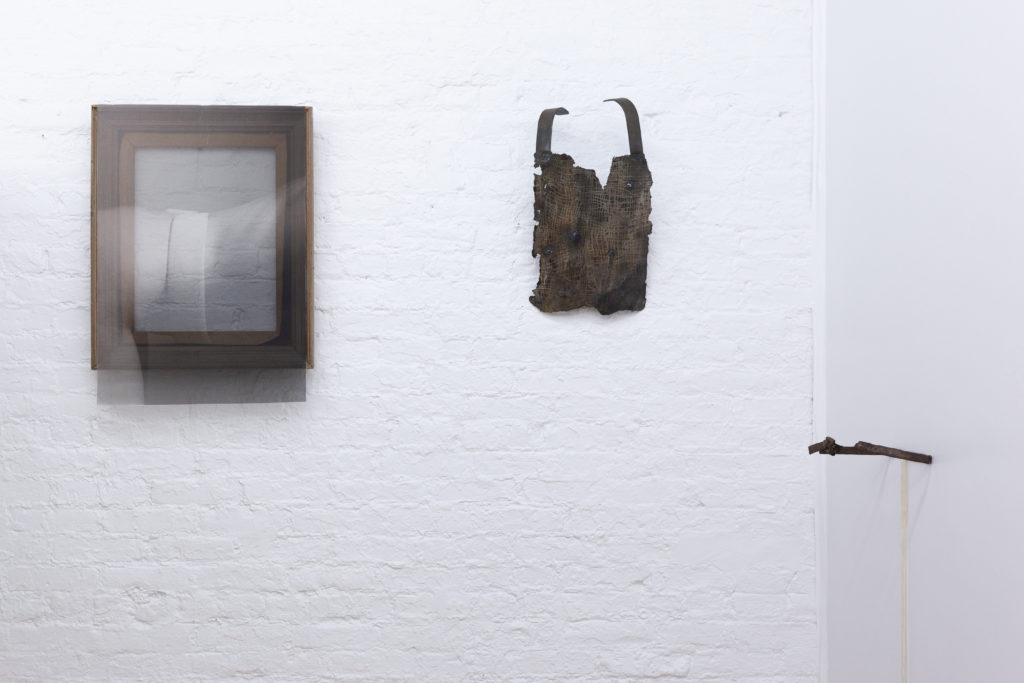
Nadege: With the idea of protection and vulnerability, what was unique about the project A(r)mour ?
Anna: I found this rusted piece of metal in the street of London and associated it with an armor. I envisioned a connection of vulnerability and protection. I figured out a balance between these two concepts of protecting yourself and allowing others to be present.
In the piece called Transit, I found pieces of a palm tree in Spain that also reflected an armor. As the seasons change into Fall, so many palm trees drop on the ground. I was intrigued by the natural shapes and envisioned new shapes. Similar to ephemera, the palm trees organically decompose on their own. The sculptures ended up becoming a series of photographs, where the palm trees were positioned as symbols of wearable protections. One of the photos captured two palm trees with the idea of wearing one like an armor, the other unworn and left behind suggesting the possibility of the individual to choose when to wear those layers of protection.
Recently, I have reworked on the found piece of the armor, by creating a new metal piece that is wearable. I have been developing this idea of including the body in the actual sculpture during my residency in New York, and I plan to keep working on it in London.
Nadege: I'm intrigued by the Heart Back Together video performance. What materials did you use to re-enact emotional healing?
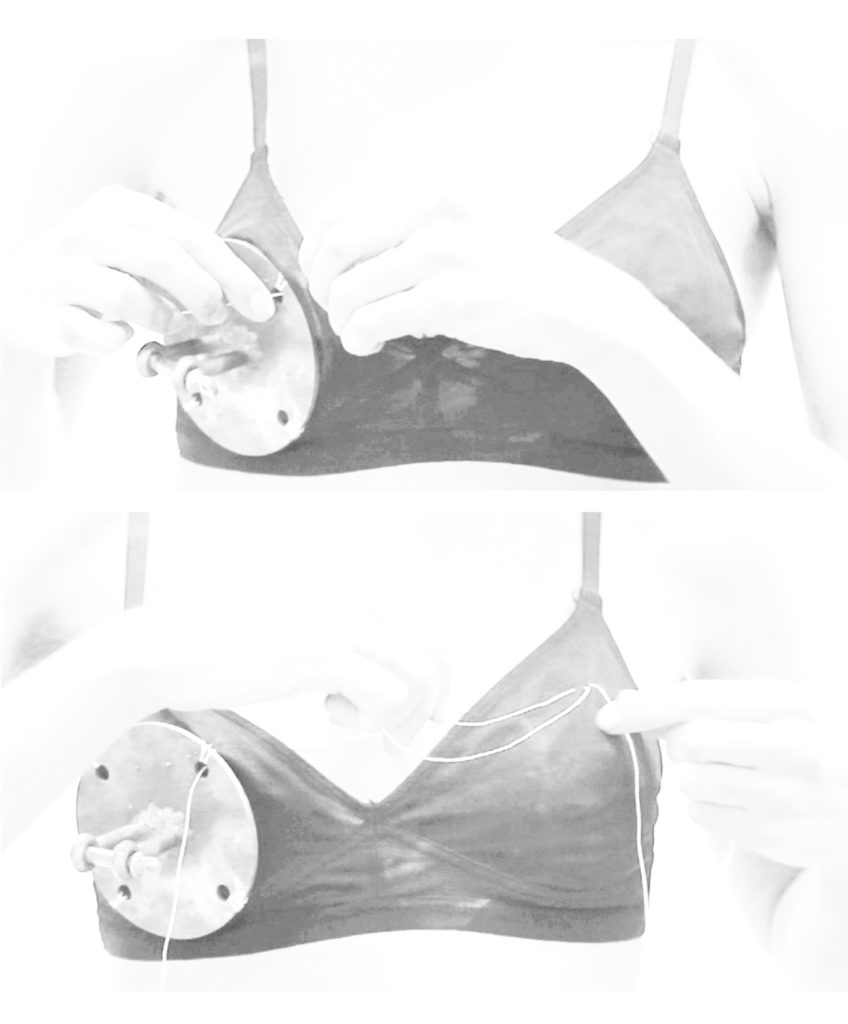
Anna: At the start of my artistic career, actual performance was incorporated into my work. However, it was quite difficult to transcribe my concepts. Performance was not totally my realm to explore. With sculpture, I work on the limitations of space and time in relation to my body. It’s an intimate, yet solitary world that I enjoy exploring in my studio, as I am constantly intrigued by new shapes and concepts. Exploring with objects, translating my thoughts through the materiality and the process, then executing them in exhibitions is my playground. In Heart Back Together, the sculpture was activated through the video recording of a repeated action. The video filmed me sewing a round hook on the right breast. The entire performance re-enacted an emotional process of self-healing, mending a broken, fragile heart back together. The element of the hook is a metaphor of love as an attachment.
Anna Ill (Vilanova i la Geltrú, Barcelona, 1990) is a London-based visual artist. She holds an MA in Art and Space from Kingston University, London (2017), a BA in Textile Art from Escola Massana, Barcelona (2014), and a year course in Decoration from École Boulle, Paris (2015).
In 2025, she was commissioned to create a permanent public sculpture for Una Boccata d’Arte in Simeri, Italy. Her work received the Acquisition Prize at Contextile 2024 (Portugal) and wasselected for the Antoni Vila Casas Sculpture Prize (Spain).
Anna Ill has held solo exhibitions at L&B Gallery, Barcelona (2023); Centre Cultural La Mercè, Girona (2022); Filet Space, London (2020); and Sensei Gallery, London (2016).
She has participated in numerous international group exhibitions including Sid Motion Gallery (London, 2025), Fundació Úniques (Barcelona, 2025), Textile Arts Center (NY, 2024), Wonzimer (LA, 2023); Fundació Vila Casas (Barcelona, 2021-24); Laterna Magica Museum (Copenhagen, 2022); Sala Parés (Barcelona, 2018); Incheon Art Platform (Seoul, 2018); Le Beffroi of Montrouge (Paris ,2017), Spazio Culturale Antonio Ratti (Como, 2018).
Her residencies include All Art Now (Online, 2021), In-Ruins (Italy, 2021), Jiser (Tunisia, 2019), and the JCE Biennale (Paris, 2017).