

Geo Barrios, Artist Programs Intern at TAC, spent time with April WIP resident Elise Marks Vazelakis:
E: This piece reminds me of the Anthropocene, the geologic age we’re currently in, which will ultimately reflect man-made materials in the sediment. The structure I’m working on looks very organic, almost like a landscape. I envision the paper cord and the plastic acting as layers of sediment.
G: This suggests to me that you have a viewer in mind. You may not necessarily know who the audience is, but you know what you want them to find. You want them to see layers of history. Where did that thought originate?
E: I started doing a lot of research and came across plastiglomerates, a type of rock that has been washing up on shorelines in Hawaii. It’s essentially plastic that has melted and fused with molten volcanic flows, then cooled in the water. When I was doing my MFA, my advisor also talked about the Anthropocene and how humanity is leaving its mark on the natural world in a geological way. In a thousand years, we’ll be able to see consumption patterns.
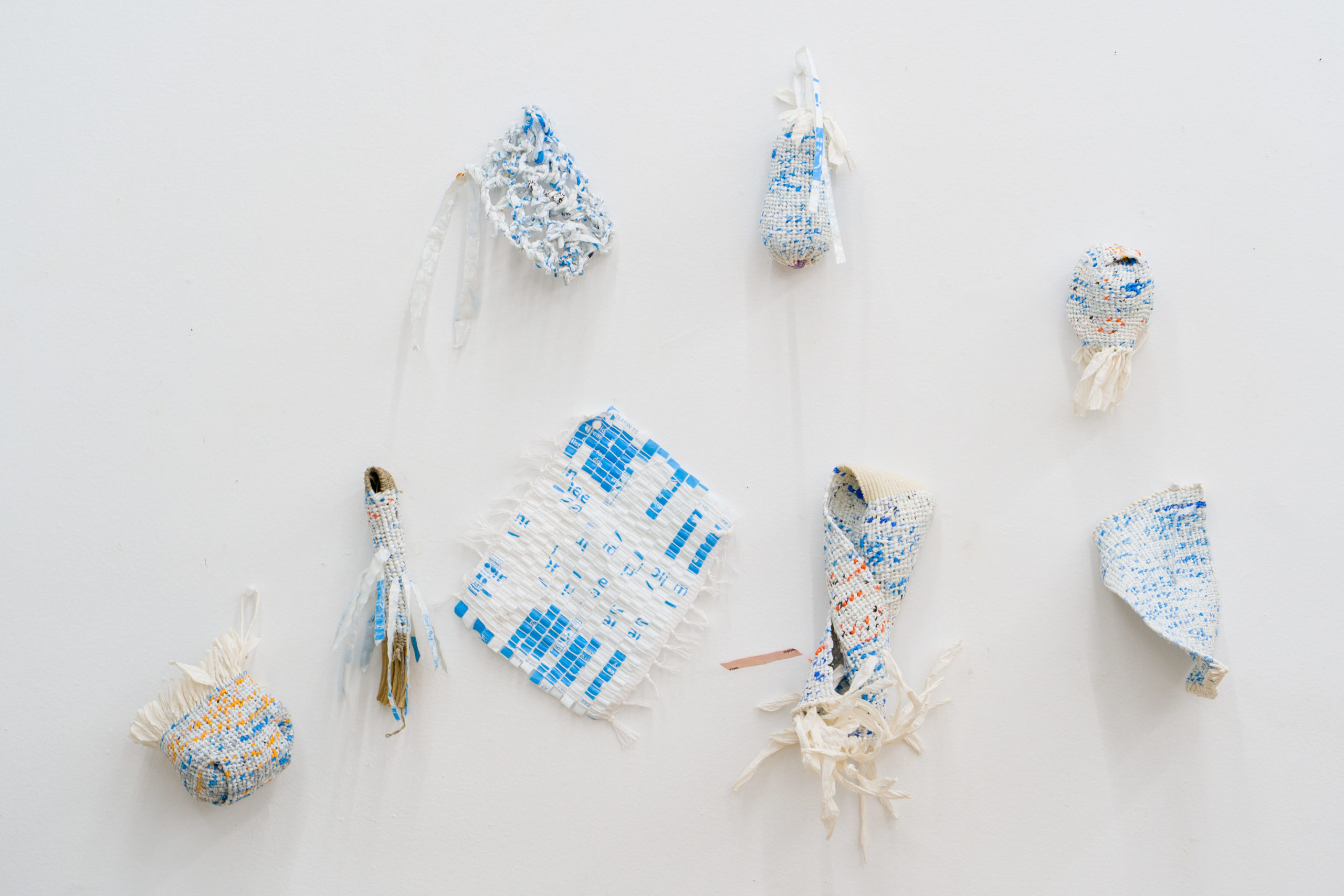
My last few series started with mapping my own consumption by saving every single-use plastic item I used. During that process, I amassed a stack of Amazon packaging and thought, what am I going to do with all of this? I began experimenting to see if I could fabricate yarn from it to weave, crochet, or twine. As I worked with the packaging, I started to understand the material in a very intimate way.
On the back of Amazon bubble envelopes, there is a chasing arrow symbol that makes it appear they can be curbside recycled, but they can’t. It’s deceptive. I see them all over New York in recycling bags on the street, and they’re ultimately going to end up in a landfill. While the packaging can be taken to a store for recycling, as indicated by a website next to the symbol, most people are not going to take the time to research drop-off locations or make the effort to bring them to a store.
G: While you’re observing the world and how people engage with materials, do you ever think of yourself as an anthropologist? Especially when you talk about collecting materials from others. In a way, these forms become your studies.
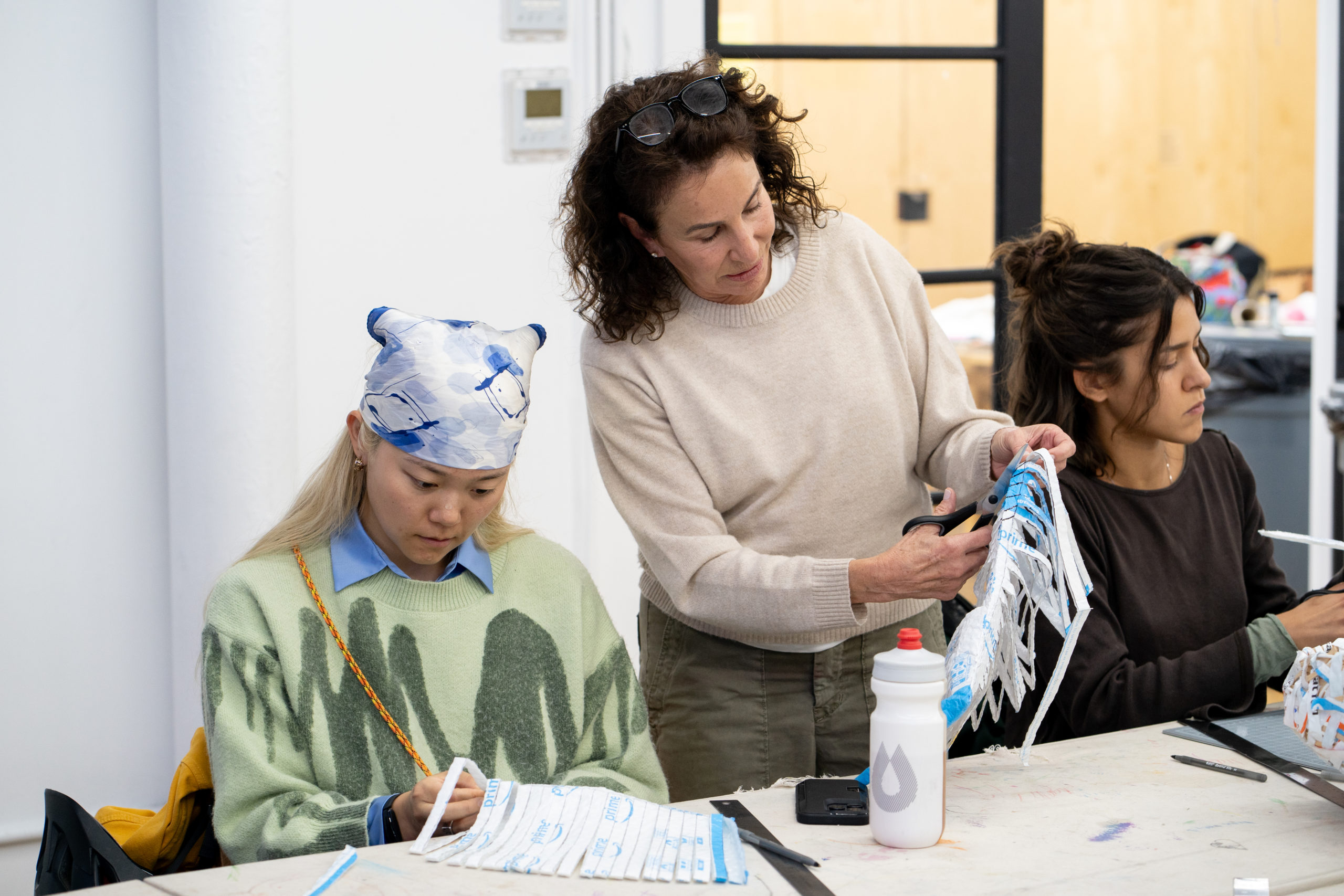
E: I’ve never thought of myself as an anthropologist, but I guess I am. The series exists because of community involvement. When I ran short on materials, I asked friends, family, and Instagram followers to save packaging for me. They became part of the work and became more aware of their own single-use plastic consumption. It wasn’t something I formally organized. It happened through conversations and relationships.
As I worked with the collected envelopes, I started noticing small details. Some people scratch their names out with a marker or completely remove the label. Everyone has a different way of ripping or cutting the packaging open. Each envelope is marked by its original user.
G: What does that say to you about privacy and consumption? It feels different from your approach, since your work openly acknowledges and shares your waste.
E: I think people are really concerned about their identity being taken, which reflects the world we’re living in. At the same time, participants became more conscious of their waste patterns. When they began collecting their own single-use plastic, I believe it started to shift their buying behavior.
G: Even now, the way you gather materials feels very distinct. It requires other people to participate in your work.
E: I love that aspect of it. I love bringing my community into the process. At the same time, people can feel a little uncomfortable. Some feel embarrassed handing over a pile of Amazon packaging. But it’s part of how we live now. Recently, I called a local store looking for a product, and they told me it would be best to just order it on Amazon.
It’s also important for me to spread awareness about plastic and recycling. I’d like to think I’m helping people understand the limits of curbside recycling. These materials are either going to a landfill, to a store drop-off, or to me.
G: How do you feel about being the point where people confront their waste?
E: I try not to make people feel guilty. We’re all consumers, and this system is deeply embedded in our lives. Our choices are limited. Unfortunately, with rising rents, brick-and-mortar stores are decreasing.
In my earlier series, Driving With My Eyes Closed and Thirst, the materials carry traces of many people and moments. Thirst came out of collecting water bottles during the rebuild of my home after the Woolsey Fire, making visible a shared pattern of use and disposal. With Driving With My Eyes Closed, the Amazon packaging reflects a much larger system of convenience that we’re all part of.
I do think we can all make small changes and be more mindful about how much plastic we use. Every time we reduce our plastic use, even a little, we are making a difference.
G: How do you reconcile working with such an ancient practice like basketry and the lifespan of your materials?
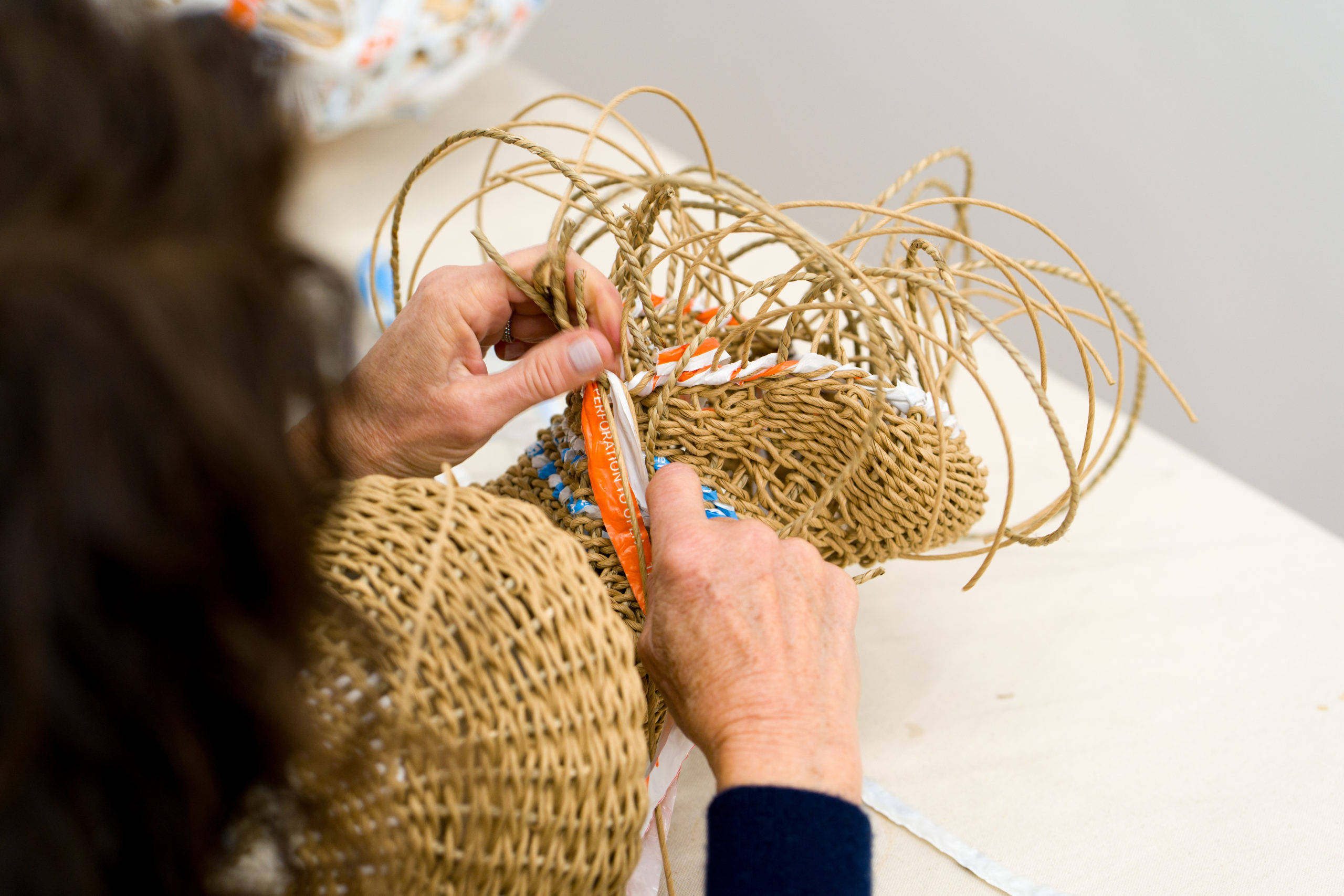
E: I’m drawn to that tension. Twining and basketry are slow, labor-intensive processes with deep histories, while the plastic Amazon packaging represents speed and convenience. Historically, people used plant materials from their environment. I’m doing something similar, but my environment is saturated with plastic. In an urban setting, it’s often more present than natural fibers.
Who knows what materials will look like in 150 years? Technology is changing so quickly. Hopefully, plastics won’t be as prevalent. My work could become a record of this specific moment in time. Even in my own life, I’ve seen major shifts in how products are made and distributed.
I hope future viewers will see my work alongside historical baskets and understand it in relation to their own time.
In terms of disintegration, plastic doesn’t break down the way natural fibers do. I’ve placed some pieces in my garden, and the natural materials I use as the core of the baskets are already degrading, while the plastics are not.
G: What are you working on at TAC, and how do you see your practice evolving after this residency?
E: Being here has been a time of research and reflection. I’ve been experimenting with bioplastic yarn made from algae. Working with these materials has begun to shift my practice and the materials I want to use moving forward. While I’ve primarily been sourcing post-consumer materials, I’m now interested in engaging materials that can be returned to the environment.
It’s also been really meaningful during my residency to be in conversation with other textile artists. As with most artists, my practice is solitary, so it’s been refreshing to share ideas and energy in a communal space.
This is my first residency, and I’ve really valued the experience. Having access to a wide range of materials has opened up new directions, especially working with textile remnants. Textile waste is a major contributor to pollution, so incorporating it into my work feels like a natural extension of my focus on consumption and excess.
Ultimately, I want people to see the beauty in the world, even in what we discard. I also think it’s important to stay open to change. Reinvention is part of the process at any stage of life, and I’m still excited by that.
Elise Marks Vazelakis is a Los Angeles-based artist whose practice transforms repurposed and unconventional materials into textile forms. By integrating discarded plastics, found objects, and metal wire into fiber processes, she blurs the boundary between textile and sculpture.
Her current series, Driving With My Eyes Closed, investigates the intersection of traditional textile practices and contemporary consumer culture. Using the ancient technique of twining, Marks Vazelakis works with plastic yarn made from discarded Amazon packaging, materials that reflect a collective dependence on convenience and its environmental consequences.
The work examines patterns of consumption, questioning what is preserved and what is discarded. By weaving synthetic waste through time-honored processes, she emphasizes the contrast between slow, deliberate making and the accelerated pace of modern life. In this context, single-use plastics are reimagined, challenging conventional ideas of value, sustainability, and permanence.
Elise Marks Vazelakis earned a BS from San Diego State University and an MFA in Fiber from California State University, Long Beach. She has had solo exhibitions in Dubai, San Francisco, and Los Angeles, and has participated in group exhibitions in New York, Los Angeles, Austin, Chicago, Toronto, Santa Fe, and Phoenix, among other cities. Her work is held in both private and public collections internationally.
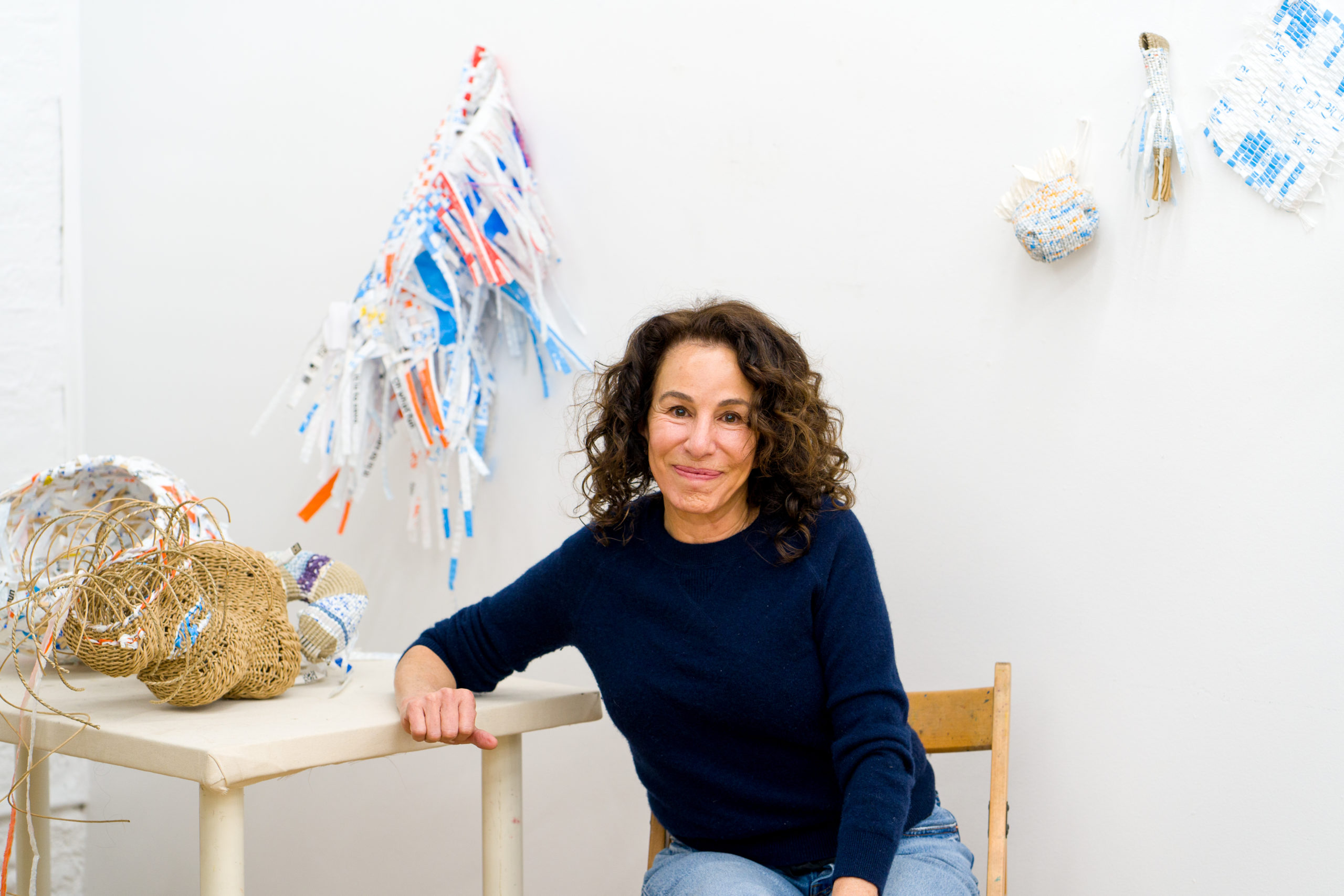
Cover image credit: Elise in her studio at the Textile Arts Center, Brooklyn, NY. Photo by Geovanni Barrios.