

Certain Restrictions Do Apply: Carolyn Mazloomi and Sharon Kerry-Harlan
Claire Oliver Gallery: 2288 Adam Clayton Powell Jr. Blvd.
New York, NY 10030
https://www.claireoliver.com/exhibitions/71-certain-restrictions-do-apply-carolyn-mazloomi-and-sharon/overview
January 9 - March 7, 2026
Claire Oliver Gallery celebrated the enduring friendships of two remarkable artists: Carolyn Mazloomi and Sharon Kerry-Harlan. Collaboratively, their inaugural exhibition presented Black American experiences and historical trailblazers with quiltmaking and textile arts. Mazloomi and Kerry-Harlan narrated culture, acceptance, and memory. The quilts and textile arts were configured in an intimate space, reflecting their creative journeys, shared conversations, critiques, and support for one another.
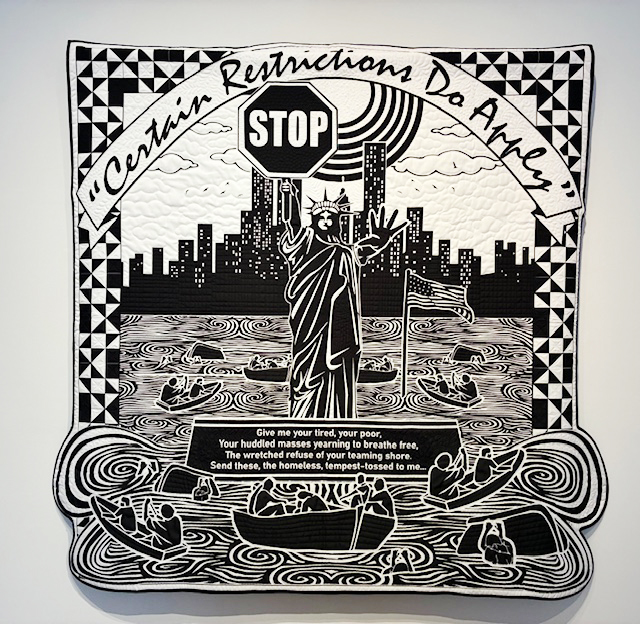
Entering the gallery, I was enthralled by a large black and white geometric bordered quilt boldly titled Certain Restrictions Do Apply. Stitched on cotton fabric, the quilt resembled a front page story right from a newspaper. Mazloomi commercially printed the historical figure of the Statue of Liberty, holding up a “Stop” sign with one hand, raising up the other hand with a flat and open palm. The iconic 1883 sonnet, “The New Colossus", printed at the base of the statue was a symbol of hope for immigrants. Mazloomi hand stenciled and painted them in boats seeking refuge. Some were capsized by the rip currents, and some rowing around “Lady Liberty” for a promised freedom. The American flag waving on the New York Harbor was a sign of a new beginning, but immigrants were tossed with frustrations and uncertainty. I was reminded of Mazloomi’s resonating words:
“A quilt holds touch, time, labor, and story — it holds lives. The histories of the people I depict are sewn into the fabric itself. Quilts speak on behalf of those whose voices might otherwise go unheard.” —Carolyn Mazloomi.
The quilt visualized the voices of immigrants and their turbulent journey for hope, freedom, and an opportunity.
Sauntering around, I could not help but notice a wide quilt, covering an entire wall called The Empire Builder. Kerry-Harlan stitched and dyed discharge curated fabrics to form a geometric, beautiful young face. I was enamored by each framed cowrie shells and patriotic ball barrettes fastening the hair. Embellished with jewelry, patched with patterned fabrics, Kerry-Harlan words reverberated throughout the entire quilt:
“Memory is layered. In fabric, I find the ability to embed echoes — of family, of the past, of cultural inheritance. My work is about carrying forward what must not be forgotten, but also making space for reinterpretation.” —Sharon Kerry-Harlan.
Joyous memories that were layered re-surfaced while viewing this quilt. The long pigtails transported me back to a time in my adolescence, playfully styling my hair for a celebratory time at Caribbean carnivals and family gatherings.
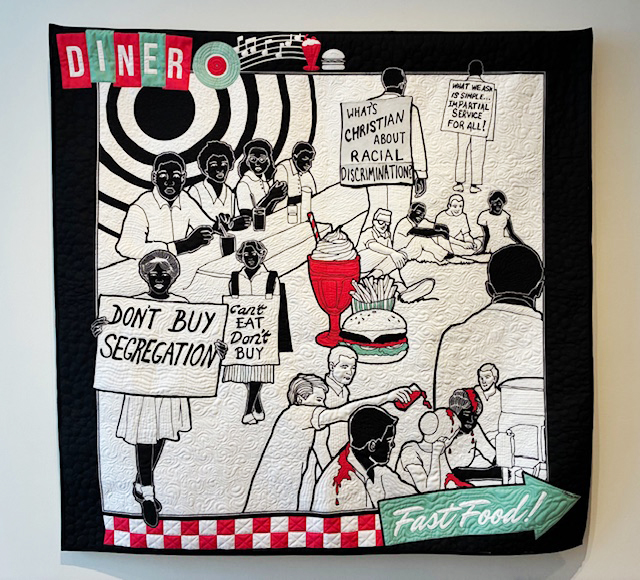
Another quilt that piqued my interest was Sit-Ins. The large black and white, bold-colored quilt from afar seemed appetizing; I assumed it was an advertisement for good Southern food and dining. As I approached closely, it was quite the contrary. Mazloomi invited me to sit down at a segregated diner and experience the harsh realities of eating at Woolworth’s lunch counter in North Carolina. The quilt was in contrast to a typical whimsical food advertisement you would see on flyers, newspapers, or magazines during the 1960s. Mazloomi intricately stitched the jarring treatments of students protesting, challenging inequality throughout the South. The hand-painted, stenciled event called to mind my visit at Smithsonian National Museum of African American History and Culture in Washington, DC. The installation of the actual Greensboro Lunch Counter transported me back to the youth-led movement. As I looked at the cotton fabric, textile ink, and commercial printing, Mazloomi visualized the voices of those students and revived their activist spirits.
So many questions came to mind while walking towards, I Am Invisible. The large black geometric female figure with short length spiked pigtails was quite interesting to view. She was entirely bare, with one hand covering her eyes. The dyed discharge cotton fabric expressed somewhat isolation, where she appeared overlooked or undervalued by others. Was she hiding from someone or somewhere, embarrassed? Was the body a primary focus? Only Kerry-Harlan could answer those questions and reveal the true meaning of this phenomenal piece.
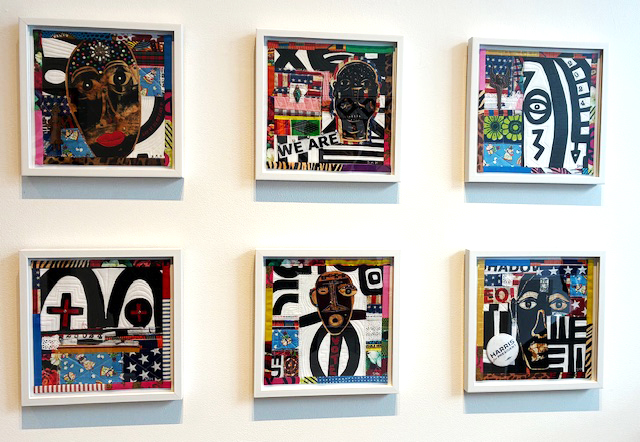
As I continued to walk around, there were white framed textile collages that expressed the current times we were living in. I Voted Early and Go Vote transported me to Kamala Harris presidential campaign in 2024. African, rusted fabrics stitched together to form seams of a memorable moment in Black History. Another striking collage, Say It To My Face, demanded a direct, in-person conversation. The large embellished face with sequins, glass beads, and metal studs refused nonverbal assertions. Kerry-Harlan celebrated beauty and identity in We Are and reminded the world to Stay Alert in these present times
Before exiting the gallery, I journeyed to freedom with Harriet Tubman, stenciled, stitched in a victorious red headwrap and dress with an oil lamp leading the way. Impressively, Mazloomi and Kerry-Harlan narrated the voices of the past and current time. Both configured their artistic expressions in a celebratory spirit, reminding the world of Black heritage.